IN-DEPTH / IN-DEPTH
China’s latest AI scientific model highlights unique open-source ecosystem built on tech sharing to tackle global challenges
Open Science Path
Editor's Note:
As global challenges grow increasingly interconnected, technological solutions are rarely confined to a single country. Through research collaboration, open sharing of expertise and partnerships with international institutions, Chinese scientists, engineers and enterprises are engaging more deeply with the world, contributing tools and experience to problems that demand collective answers.
The Global Times launches a series of "Tech Seeds, Global Bloom," spotlighting China's achievements in advancing technology for good both domestically and internationally. By following these trajectories, the series invites readers to consider a different measure of progress: Not how advanced technology becomes, but whom it ultimately serves, and how widely its benefits can spread.
This article is the third installment. It examines how China's open-source AI ecosystem, exemplified by ScienceOne 100, combines technological openness, scientific collaboration, and governance ambitions to reshape global innovation and AI for Science.

In Beijing, an AI scientific agent has already identified more than 11 previously unknown particle decay modes - discoveries that would traditionally require research teams to spend years filtering through enormous volumes of high-background noise data. In the field of space science, another AI scientific agent in the same system has achieved highly accurate solar flare prediction, capturing 100 percent of X-class flares while enabling an autonomous intelligent telescope observation system.
These breakthroughs stem from the ScienceOne 100 model system released in late April by the Chinese Academy of Sciences (CAS). The Global Times learned from the academy that ScienceOne 100 is neither a chatbot nor a text-to-image generator. Rather, it is a comprehensive "AI scientist" system purpose-built for scientific research, designed to empower disciplines ranging from mathematics and physics to biology, representing China's globally leading position in AI for Science.
More importantly, this advanced system has not been kept technologically exclusive. Instead, it has been opened and shared with researchers globally.
Tech sovereignty is not about isolation. High-standard opening up to the outside world has earned its own chapter in China's five-year blueprint, according to the Xinhua News Agency on March 10, 2026.
Not long ago, DeepSeek released a preview version of its next-generation V4 model, which is also planned to be fully open-sourced. At the same time, multiple Chinese technology companies have rapidly upgraded their open-source large-model ecosystems in recent months.
While many Western companies guard their most valuable models, China has embraced open source, and almost all of its top-performing systems are widely available, The New York Times reported on April 24, 2026.
A distinct "Chinese-style open source" ecosystem is now emerging - one that goes beyond simple code sharing to combine the collectivist belief that "shared prosperity is true prosperity" with China's strategy of achieving technological self-reliance and strength through cooperation rather than exclusion, Zhu Yue, an expert from the Tongji University Law School, told the Global Times.
Open model tackling shared challenges
"China's open-source large models not only help global users tackle daily life challenges and provide technical references for global large model development, but also deliver tangible benefits to more people in various professional fields, such as scientific research," Zeng Dajun, deputy director of the Institute of Automation, CAS, told the Global Times.
According to Zeng, the ScienceOne 100 system is an achievement of joint research coordinated by dozens of CAS-affiliated institutes. It advances AI for Science from fragmented, closed operations to collaborative and open platform-based development, fundamentally reshaping the organizational patterns and workflows of traditional scientific research.
The launch of ScienceOne 100 is no coincidence, but a response to the global trend of AI for Science.
Amid the accelerated evolution of a new round of technological revolution, AI is evolving from an auxiliary tool into a core driving force for scientific research. Unlike standalone research-oriented AI models, ScienceOne 100 forms a full industrial chain covering foundational models, discipline-specific models and scenario-based applications. As one of the world's first systematic and full-stack AI for Science model systems, it is truly capable of understanding scientific theories, conducting research and enabling practical implementation, according to Zeng.
"Popular general-purpose large models work well for daily chatting, copywriting and image generation, yet they fall short in scientific research. They are prone to factual errors and reasoning hallucinations, and fail to interpret scientific data such as particle signals, astronomical spectra and cellular information, making them unfit for rigorous scientific studies," Zhang Jiajun, researcher at the Institute of Automation, CAS, told the Global Times.
Zhang explained in simple terms the core differences between professional research AI and general large models. According to him, ScienceOne 100 model is positioned to achieve three progressive transformations: from a research auxiliary tool to a research collaborator, and ultimately to a virtual AI scientist, capable of independently completing the full research cycle including data collection, analysis, hypothesis formulation, verification and iteration.
"In the past, AI was merely a tool for scientists to process data; now it has become a research partner that can hold discussions and put forward hypotheses. Systems like ScienceOne 100 have laid the groundwork for genuine AI scientists," Zhang said.
In the future, one scientist equipped with the ScienceOne 100 system will be able to accomplish research work that currently requires dozens or even hundreds of researchers, according to Zhang.
Zhang disclosed that CAS is among the first institutions worldwide to release such a comprehensive system. At present, CAS has established in-depth cooperation with Belt and Road partner countries, empowering their scientific research with the ScienceOne 100 and participating in shaping new norms and ecosystems for global scientific research in the future.
Building collaborative technology ecosystem
To date, China has inked 120 government-to-government sci-tech cooperation agreements, a significant portion of which are with developing countries, according to a Xinhua report on March 10, 2026.
In the corporate sphere, Chinese companies have also become major drivers of global open-source momentum. As The New York Times observed, "Chinese companies have embraced making their most advanced artificial intelligence models available to all."
When the Chinese start-up DeepSeek published details about one of its AI models last year, it sent shock waves through the tech industry, The New York Times reported.
The DeepSeek moment reflected a shift in the global AI landscape. The change was about not only lower costs but also openness in how the technology is shared, said the report.
According to a March 17 report released by Hugging Face, a huge open-source community, the geographic composition of the open-source ecosystem has fundamentally changed. Hugging Face data shows China surpassing the US in monthly downloads and overall downloads. In the past year, Chinese models quickly accounted for the plurality or 41 percent of downloads.
The rise and persistence of "Chinese-style open source" are not accidental. Behind it lies both the urgency of responding to external technological restrictions and a strategic determination to build an open collaborative ecosystem, according to Chinese experts.
Lacking independent core systems leaves countries vulnerable to technological "strangleholds," reported CCTV News in August 2025. The report quoted Xia Yubin, a professor at Shanghai Jiao Tong University, as saying that growing international pressures have strengthened the determination of Chinese researchers to build indigenous operating systems.
The 15th Five-Year Plan has elevated tech self-reliance and the mastery of homegrown, risk-controllable core technologies to unprecedented strategic prominence, reported Xinhua.
The rise of OpenHarmony offers a vivid example. In September 2020, Huawei contributed the foundational capabilities of its Harmony operating system to the OpenAtom Foundation, which incubated and operates the OpenHarmony project. Fully open and accessible, the platform allows any company to develop its own intelligent terminal operating system in compliance with licensing agreements, reported the Economic Observer.
The results are increasingly visible. According to a May 11 report by Xinhua-affiliated Economic Information Daily, the OpenHarmony community's codebase has grown from 7 million lines to 130 million lines, with more than 13,000 contributors, over 550 ecosystem partners and more than 1,700 products passing compatibility certification. Devices powered by the OpenHarmony ecosystem have now exceeded 1.3 billion units.
Open-source AI models from Chinese firms have topped global usage charts, and their rapidly expanding global adoption underscores the fact that China's tech rise is expanding the pie rather than taking slices from others, Xinhua reported.
The old Chinese saying that "shared prosperity is true prosperity" has found renewed meaning in the digital age, Zhu said.
Openness, capability and responsibility
Why does China have the capacity to pursue this approach? Zhu said that China's open-source large models boast five prominent strengths.
First, they deliver cutting-edge performance. Open-source models such as DeepSeek-r2 rank among the world's top-tier models in performance, while most advanced American models remain closed-source by contrast. Second, they feature a high degree of openness. Apart from releasing model weights, core technical ideas and practical methodologies are widely shared via peer-reviewed papers, technical reports, social media and other platforms, Zhu said.
Third, they boast a sound open ecosystem. Beyond foundational base models, supporting frameworks, massive datasets, skill modules and other auxiliary components are also made accessible to the public. Fourth, they are subject to minimal usage restrictions. Most adopt highly open and standardized open-source licenses like the MIT License, with few additional constraints and loose application limits, according to Zhu.
Fifth, they enjoy extensive downstream applications. China's open-source large models and their supporting ecosystems empower numerous AI applications worldwide, forming a distinctive competitive edge globally, Zhu added.
At the same time, openness does not mean the absence of regulation. Security and copyright issues concerning open-source large models are currently prevalent and intractable challenges.
In parallel to technical advances in open-source AI systems, China's AI regulation is also taking shape. Although no official draft of such a law has been released in China yet, law experts in China have drafted two influential proposals on AI, Model AI Law and AI Law, that have become important references for understanding and researching China's AI regulation, according to Zhu.
Despite some challenges, Zhu and his Chinese colleagues still agree that the future of AI lies in openness.
We advocate for an open future of AI not only because of its considerable local and global economic value, but also because in-depth global cooperation, for which openness has always been, and will always be, necessary. Furthermore, it is a prerequisite for the urgently needed "national institutions and international governance to enforce standards preventing recklessness and misuse" by rapidly progressing frontier AI, read an article co-authored by Zhu and other Chinese experts published in Science in October 2025.
A solution that simultaneously promotes openness and innovation for AI can act as the most workable lowest common denominator for the global AI governance dialogue. In the meantime, China's AI regulation system, especially legislation on the healthy development of AI, will become better balanced, globally inclusive and future proof by incorporating more ideas from international stakeholders in China and international dialogue involving China, Chinese experts said in the article.
Today, leveraging the systematic capabilities of ScienceOne 100, large models across eight major scientific disciplines have already been deployed on the front lines of research, with more than 100 scenarios achieving large-scale application across fundamental research, engineering, public welfare and national strategic priorities. In the foreseeable future, through open-sharing mechanisms, these achievements are increasingly becoming resources that benefit more countries around the world.
As global challenges grow increasingly interconnected, technological solutions are rarely confined to a single country. Through research collaboration, open sharing of expertise and partnerships with international institutions, Chinese scientists, engineers and enterprises are engaging more deeply with the world, contributing tools and experience to problems that demand collective answers.
The Global Times launches a series of "Tech Seeds, Global Bloom," spotlighting China's achievements in advancing technology for good both domestically and internationally. By following these trajectories, the series invites readers to consider a different measure of progress: Not how advanced technology becomes, but whom it ultimately serves, and how widely its benefits can spread.
This article is the third installment. It examines how China's open-source AI ecosystem, exemplified by ScienceOne 100, combines technological openness, scientific collaboration, and governance ambitions to reshape global innovation and AI for Science.
Conceptual image of data center server room Photo: VCG
In Beijing, an AI scientific agent has already identified more than 11 previously unknown particle decay modes - discoveries that would traditionally require research teams to spend years filtering through enormous volumes of high-background noise data. In the field of space science, another AI scientific agent in the same system has achieved highly accurate solar flare prediction, capturing 100 percent of X-class flares while enabling an autonomous intelligent telescope observation system.
These breakthroughs stem from the ScienceOne 100 model system released in late April by the Chinese Academy of Sciences (CAS). The Global Times learned from the academy that ScienceOne 100 is neither a chatbot nor a text-to-image generator. Rather, it is a comprehensive "AI scientist" system purpose-built for scientific research, designed to empower disciplines ranging from mathematics and physics to biology, representing China's globally leading position in AI for Science.
More importantly, this advanced system has not been kept technologically exclusive. Instead, it has been opened and shared with researchers globally.
Tech sovereignty is not about isolation. High-standard opening up to the outside world has earned its own chapter in China's five-year blueprint, according to the Xinhua News Agency on March 10, 2026.
Not long ago, DeepSeek released a preview version of its next-generation V4 model, which is also planned to be fully open-sourced. At the same time, multiple Chinese technology companies have rapidly upgraded their open-source large-model ecosystems in recent months.
While many Western companies guard their most valuable models, China has embraced open source, and almost all of its top-performing systems are widely available, The New York Times reported on April 24, 2026.
A distinct "Chinese-style open source" ecosystem is now emerging - one that goes beyond simple code sharing to combine the collectivist belief that "shared prosperity is true prosperity" with China's strategy of achieving technological self-reliance and strength through cooperation rather than exclusion, Zhu Yue, an expert from the Tongji University Law School, told the Global Times.
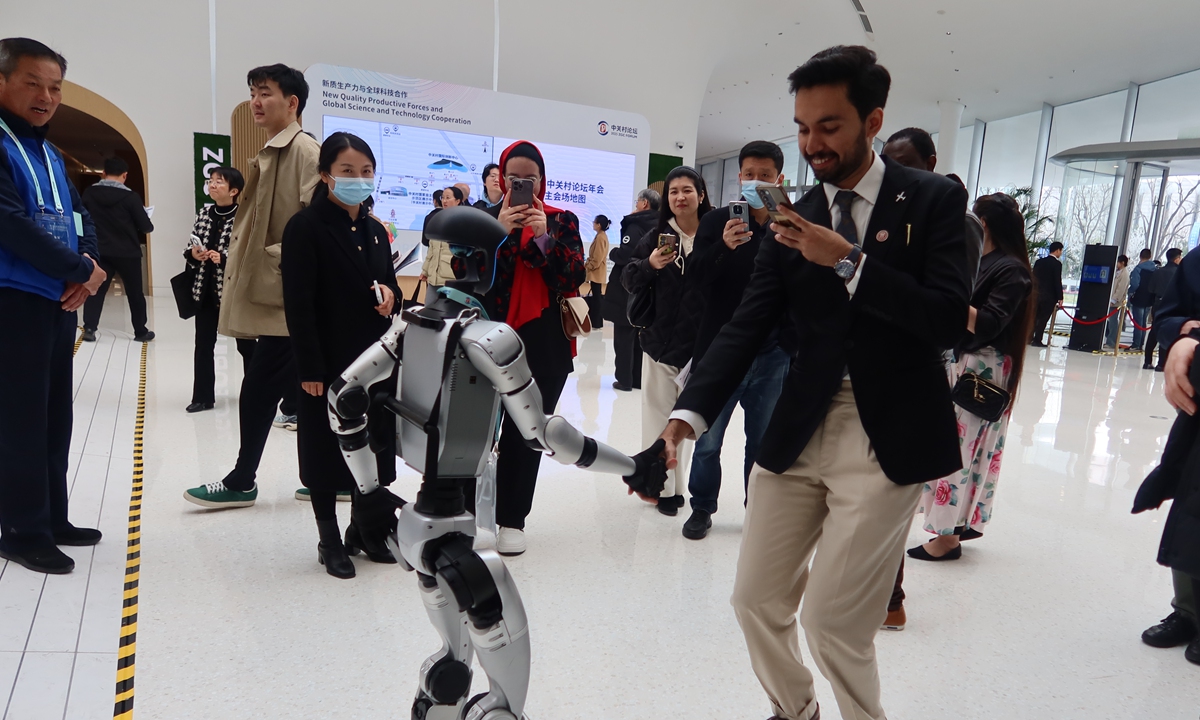
An intelligent robot attracts Chinese and foreign audiences at the 2025 Zhongguancun Forum Annual Conference on March 28, 2025. Photo: VCG
Open model tackling shared challenges
"China's open-source large models not only help global users tackle daily life challenges and provide technical references for global large model development, but also deliver tangible benefits to more people in various professional fields, such as scientific research," Zeng Dajun, deputy director of the Institute of Automation, CAS, told the Global Times.
According to Zeng, the ScienceOne 100 system is an achievement of joint research coordinated by dozens of CAS-affiliated institutes. It advances AI for Science from fragmented, closed operations to collaborative and open platform-based development, fundamentally reshaping the organizational patterns and workflows of traditional scientific research.
The launch of ScienceOne 100 is no coincidence, but a response to the global trend of AI for Science.
Amid the accelerated evolution of a new round of technological revolution, AI is evolving from an auxiliary tool into a core driving force for scientific research. Unlike standalone research-oriented AI models, ScienceOne 100 forms a full industrial chain covering foundational models, discipline-specific models and scenario-based applications. As one of the world's first systematic and full-stack AI for Science model systems, it is truly capable of understanding scientific theories, conducting research and enabling practical implementation, according to Zeng.
"Popular general-purpose large models work well for daily chatting, copywriting and image generation, yet they fall short in scientific research. They are prone to factual errors and reasoning hallucinations, and fail to interpret scientific data such as particle signals, astronomical spectra and cellular information, making them unfit for rigorous scientific studies," Zhang Jiajun, researcher at the Institute of Automation, CAS, told the Global Times.
Zhang explained in simple terms the core differences between professional research AI and general large models. According to him, ScienceOne 100 model is positioned to achieve three progressive transformations: from a research auxiliary tool to a research collaborator, and ultimately to a virtual AI scientist, capable of independently completing the full research cycle including data collection, analysis, hypothesis formulation, verification and iteration.
"In the past, AI was merely a tool for scientists to process data; now it has become a research partner that can hold discussions and put forward hypotheses. Systems like ScienceOne 100 have laid the groundwork for genuine AI scientists," Zhang said.
In the future, one scientist equipped with the ScienceOne 100 system will be able to accomplish research work that currently requires dozens or even hundreds of researchers, according to Zhang.
Zhang disclosed that CAS is among the first institutions worldwide to release such a comprehensive system. At present, CAS has established in-depth cooperation with Belt and Road partner countries, empowering their scientific research with the ScienceOne 100 and participating in shaping new norms and ecosystems for global scientific research in the future.
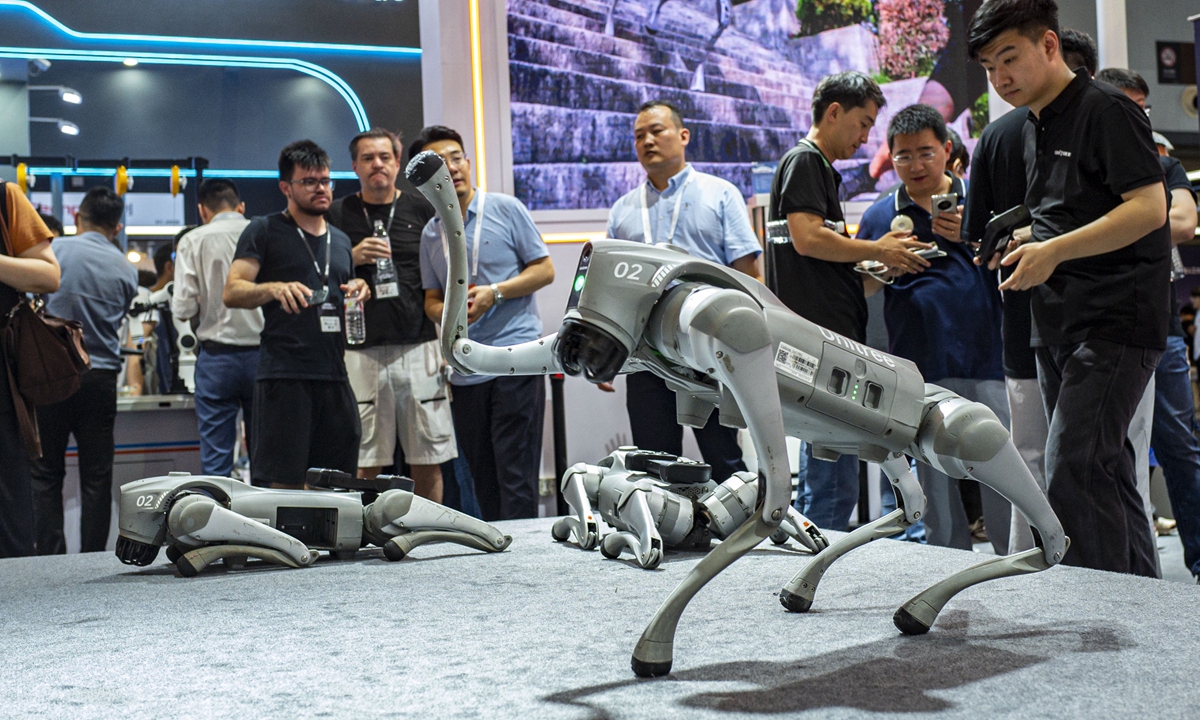
Quadruped robots developed by Unitree Technology draw crowds at the World Artificial Intelligence Conference in Shanghai. Photo: VCG
Building collaborative technology ecosystem
To date, China has inked 120 government-to-government sci-tech cooperation agreements, a significant portion of which are with developing countries, according to a Xinhua report on March 10, 2026.
In the corporate sphere, Chinese companies have also become major drivers of global open-source momentum. As The New York Times observed, "Chinese companies have embraced making their most advanced artificial intelligence models available to all."
When the Chinese start-up DeepSeek published details about one of its AI models last year, it sent shock waves through the tech industry, The New York Times reported.
The DeepSeek moment reflected a shift in the global AI landscape. The change was about not only lower costs but also openness in how the technology is shared, said the report.
According to a March 17 report released by Hugging Face, a huge open-source community, the geographic composition of the open-source ecosystem has fundamentally changed. Hugging Face data shows China surpassing the US in monthly downloads and overall downloads. In the past year, Chinese models quickly accounted for the plurality or 41 percent of downloads.
The rise and persistence of "Chinese-style open source" are not accidental. Behind it lies both the urgency of responding to external technological restrictions and a strategic determination to build an open collaborative ecosystem, according to Chinese experts.
Lacking independent core systems leaves countries vulnerable to technological "strangleholds," reported CCTV News in August 2025. The report quoted Xia Yubin, a professor at Shanghai Jiao Tong University, as saying that growing international pressures have strengthened the determination of Chinese researchers to build indigenous operating systems.
The 15th Five-Year Plan has elevated tech self-reliance and the mastery of homegrown, risk-controllable core technologies to unprecedented strategic prominence, reported Xinhua.
The rise of OpenHarmony offers a vivid example. In September 2020, Huawei contributed the foundational capabilities of its Harmony operating system to the OpenAtom Foundation, which incubated and operates the OpenHarmony project. Fully open and accessible, the platform allows any company to develop its own intelligent terminal operating system in compliance with licensing agreements, reported the Economic Observer.
The results are increasingly visible. According to a May 11 report by Xinhua-affiliated Economic Information Daily, the OpenHarmony community's codebase has grown from 7 million lines to 130 million lines, with more than 13,000 contributors, over 550 ecosystem partners and more than 1,700 products passing compatibility certification. Devices powered by the OpenHarmony ecosystem have now exceeded 1.3 billion units.
Open-source AI models from Chinese firms have topped global usage charts, and their rapidly expanding global adoption underscores the fact that China's tech rise is expanding the pie rather than taking slices from others, Xinhua reported.
The old Chinese saying that "shared prosperity is true prosperity" has found renewed meaning in the digital age, Zhu said.
Openness, capability and responsibility
Why does China have the capacity to pursue this approach? Zhu said that China's open-source large models boast five prominent strengths.
First, they deliver cutting-edge performance. Open-source models such as DeepSeek-r2 rank among the world's top-tier models in performance, while most advanced American models remain closed-source by contrast. Second, they feature a high degree of openness. Apart from releasing model weights, core technical ideas and practical methodologies are widely shared via peer-reviewed papers, technical reports, social media and other platforms, Zhu said.
Third, they boast a sound open ecosystem. Beyond foundational base models, supporting frameworks, massive datasets, skill modules and other auxiliary components are also made accessible to the public. Fourth, they are subject to minimal usage restrictions. Most adopt highly open and standardized open-source licenses like the MIT License, with few additional constraints and loose application limits, according to Zhu.
Fifth, they enjoy extensive downstream applications. China's open-source large models and their supporting ecosystems empower numerous AI applications worldwide, forming a distinctive competitive edge globally, Zhu added.
At the same time, openness does not mean the absence of regulation. Security and copyright issues concerning open-source large models are currently prevalent and intractable challenges.
In parallel to technical advances in open-source AI systems, China's AI regulation is also taking shape. Although no official draft of such a law has been released in China yet, law experts in China have drafted two influential proposals on AI, Model AI Law and AI Law, that have become important references for understanding and researching China's AI regulation, according to Zhu.
Despite some challenges, Zhu and his Chinese colleagues still agree that the future of AI lies in openness.
We advocate for an open future of AI not only because of its considerable local and global economic value, but also because in-depth global cooperation, for which openness has always been, and will always be, necessary. Furthermore, it is a prerequisite for the urgently needed "national institutions and international governance to enforce standards preventing recklessness and misuse" by rapidly progressing frontier AI, read an article co-authored by Zhu and other Chinese experts published in Science in October 2025.
A solution that simultaneously promotes openness and innovation for AI can act as the most workable lowest common denominator for the global AI governance dialogue. In the meantime, China's AI regulation system, especially legislation on the healthy development of AI, will become better balanced, globally inclusive and future proof by incorporating more ideas from international stakeholders in China and international dialogue involving China, Chinese experts said in the article.
Today, leveraging the systematic capabilities of ScienceOne 100, large models across eight major scientific disciplines have already been deployed on the front lines of research, with more than 100 scenarios achieving large-scale application across fundamental research, engineering, public welfare and national strategic priorities. In the foreseeable future, through open-sharing mechanisms, these achievements are increasingly becoming resources that benefit more countries around the world.
RELATED ARTICLES