EU’s ‘diversified procurement’ push discriminatory, unfair to firms on both sides: experts
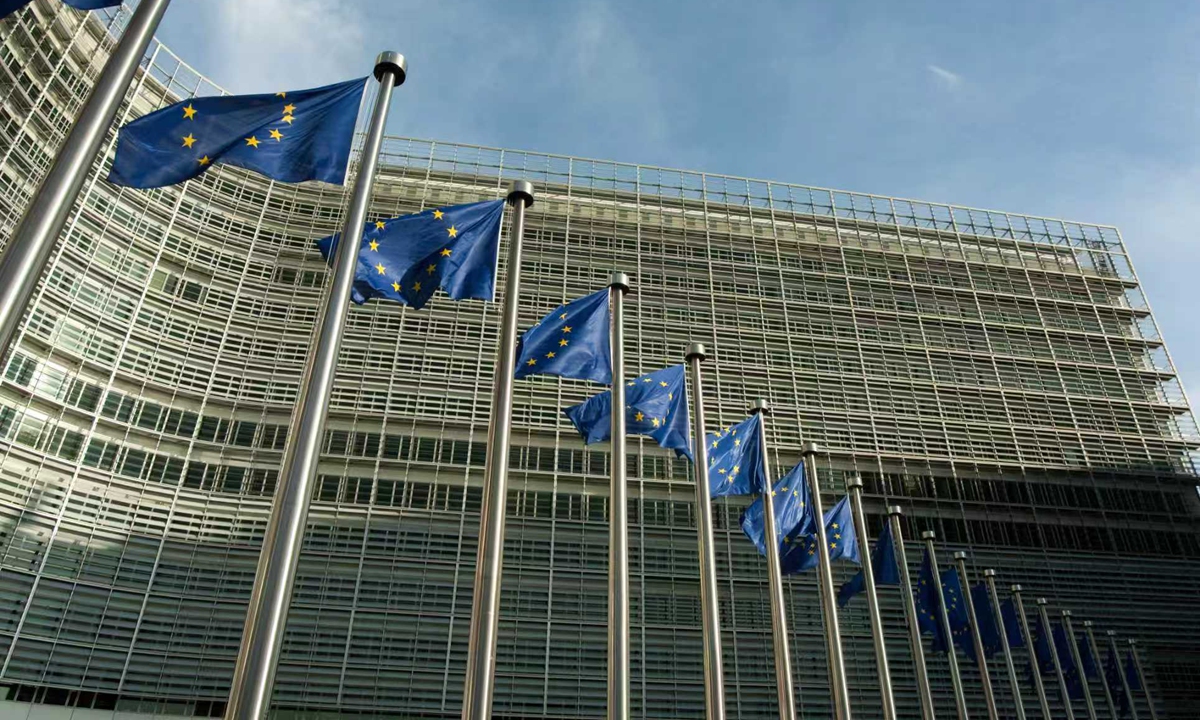
The European Union flags in front of EU headquarters in Brussels, Belgium. Photo: VCG
The EU is drawing up plans to force European companies to buy critical components from at least three different suppliers, in a bid to reduce the bloc's reliance on China, the Financial Times (FT) reported on Monday. Chinese experts slammed the EU's "diversified procurement" push as a discriminatory policy disguised under the banner of supply-chain diversification, warning that the bloc's repeated politicization of trade and economic ties would ultimately undermine Europe's long-term economic development and global competitiveness.
According to the FT, the new rules would affect businesses in a handful of key sectors such as chemicals and industrial machinery, which have complained about a surge in cheap Chinese imports, according to two EU officials familiar with the matter.
Meanwhile, the new law would set ceilings, expected to be about 30 to 40 percent, for what can be bought from a single supplier. The rest of the components would need to be sourced from at least three different suppliers, not all from the same country, read the report.
EU Trade Commissioner Maroš Šefčovič is even reportedly seeking to launch a blitz of punitive tariffs on Chinese chemicals and machinery to curb a sharp surge in imports that officials said has left European manufacturers reeling, according to FT. Šefčovič has also sought to address the bloc's massive trade deficit with China, while describing China's actions as the "weaponization of trade."
In response, Chinese experts stressed that China's trade achievements are largely the result of the global division of labor and China's own industrial and comparative advantages, rather than any China policy toward Europe or a deliberate pursuit of trade surpluses. From the perspective of international law, China has not violated any rules.
By contrast, the EU's approach could itself run counter to the free trade principles championed by the World Trade Organization, said Jian Junbo, director of the Center for China-Europe Relations at Fudan University's Institute of International Studies. "The so-called 'diversified procurement' policy is essentially another form of the bloc's 'de-risking' and dependency-reduction agenda, carrying clear discriminatory implications for Chinese companies while also unfairly increasing costs and burdens for European firms heavily reliant on such materials."
Jian noted that many European companies have traditionally favored Chinese suppliers due to China's clear advantages in cost, scale, and industrial support networks. However, under the EU's "diversified procurement" push, companies could be forced to source from additional suppliers at higher costs, ultimately raising overall manufacturing expenses in Europe and weakening the global competitiveness of European products.
Despite seeing little tangible benefit, the EU has continued to overstretch the concept of "security" to curb the development of Chinese products and technologies within the bloc.
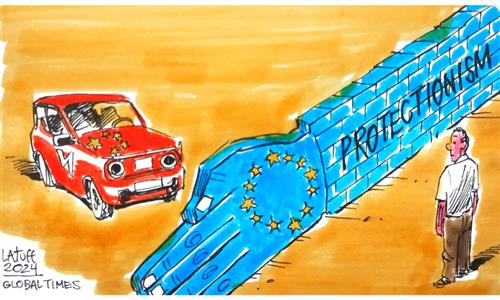
Recently, the EU has rolled out a series of measures widely viewed as targeting Chinese companies, including the Industrial Acceleration Act, which imposes restrictive requirements on foreign investment in sectors such as batteries, electric vehicles, photovoltaics and critical raw materials, as well as a proposed cybersecurity package which is widely seen as targeting Chinese companies and forms part of a broader set of EU protectionist tools targeting China. Critics say the moves reflect a broader protectionist trend under the bloc's "de-risking" agenda.
In another move that overstretches the concept of security, the European Commission (EC) recommended that EU member states exclude Huawei and ZTE gears from their local telecom operators' connectivity infrastructure, an EC spokesperson claimed, according to Reuters' another report on May 4.
China has repeatedly voiced firm opposition and serious concerns over the EU's series of measures, while vowing to safeguard the legitimate rights and interests of Chinese companies.
Stepping up its criticism over the EU's alleged abuse of the Foreign Subsidies Regulation (FSR) against Chinese companies, China said on Saturday that it has consistently opposed the bloc's use of unilateral tools such as the FSR to suppress Chinese firms, while vowing to closely monitor relevant developments and take necessary measures to firmly safeguard national security and the legitimate rights and interests of Chinese companies.
"The EU is trying to curb China's competitiveness through politicized and security-driven measures, but true industrial strength comes from market competitiveness rather than administrative protection. Such intervention in normal China-Europe business ties could ultimately undermine Europe's own long-term economic development and global competitiveness," according to Jian.
RELATED ARTICLES