IN-DEPTH / IN-DEPTH
From a dilapidated temple 70 years ago to today's 'smart campus': A visit to first modern school in Xizang region
By and Yang Ruijia in Qamdo Published: May 18, 2026 11:05 PM
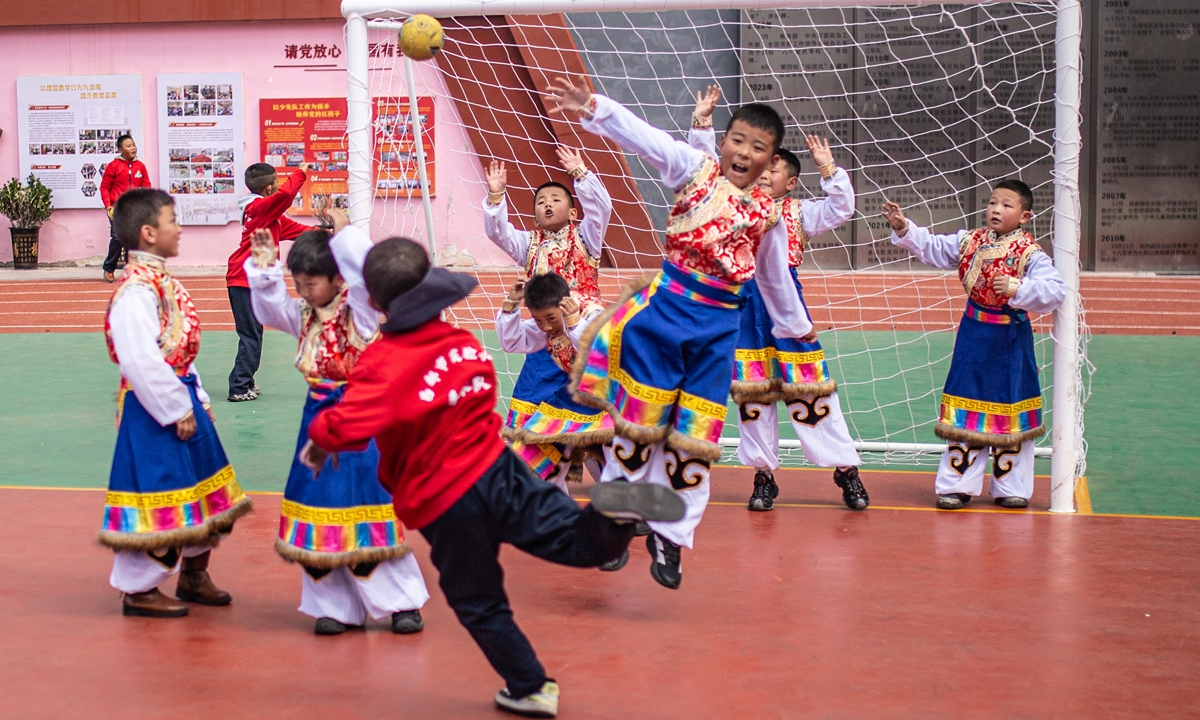
Students from Qamdo Experimental Primary School take part in various activities on campus in Qamdo, Southwest China's Xizang Autonomous Region, on May 13, 2026. Photo: Shan Jie/GT
From the urban area of Qamdo in Southwest China's Xizang Autonomous Region, the Lancang-Mekong River can be seen winding through the mountains. Not far from the river, stands Qamdo Experimental Primary School, where the sound of children reading aloud, the rhythm of Tibetan traditional dance and the buzz of drones in flight meet on the same campus.Li Yutao, a third-grade student, stands in a corner of the playground, skillfully manipulating a remote control as a drone steadily takes off under his guidance.
Li told visiting Global Times reporters that he finds drones "new and exciting." He said flying a drone allows him to see the outside world without leaving the campus. Asked where he would like to go in the future, he said he wanted to visit other parts of the country and see its "thousands of mountains and rivers."
However, the school's beginnings were far removed from modern technology. In 1951, Qamdo Primary School (the predecessor of Qamdo Experimental Primary School) was established in a local Chenghuang Temple, marking the first modern school founded by the Communist Party of China in Xizang, according to the publicity department of Qamdo.
From the classes in two shabby rooms over 70 years ago to today's "smart campus" with artificial intelligence and robotics courses, this school has chronicled the full evolution of modern education in Xizang.
The first talent cradle on the snow plateau
Qamdo, the eastern gateway of Xizang, was the first place in the region to welcome the People's Liberation Army. On October 19, 1950, Qamdo was liberated.
Before the peaceful liberation of Xizang, education was monopolized by monasteries and the nobility, and the vast majority of people had no access to schooling, with illiteracy rates as high as 95 percent, according to news outlet Tibet.cn.
To change this situation and encourage farmers and herders to send their children to school, professors Li Anzhai and Yu Shiyu went door to door, holding community meetings to ease concerns and secure student enrollment.
The school was officially established on May 1 of the same year.
Enrollment was open to all, regardless of ethnicity, age, gender or social status, and teachers were mainly officers from the PLA's mission to Xizang.
With no textbooks, the professors created their own teaching materials; with no classroom aids, they made their own.
Li and Yu not only taught students personally but also guided their daily lives, treating each child as if they were their own. Yu lent her clothes to female teachers, helped girls braid their hair and told them stories, quickly winning the trust and affection of the students, according to the news outlet China Ethnic News.
To this day, the spirit of selfless dedication demonstrated by Li Anzhai and Yu Shiyu continues to inspire generations of educators in Xizang.
Integrating traditional culture with modern education
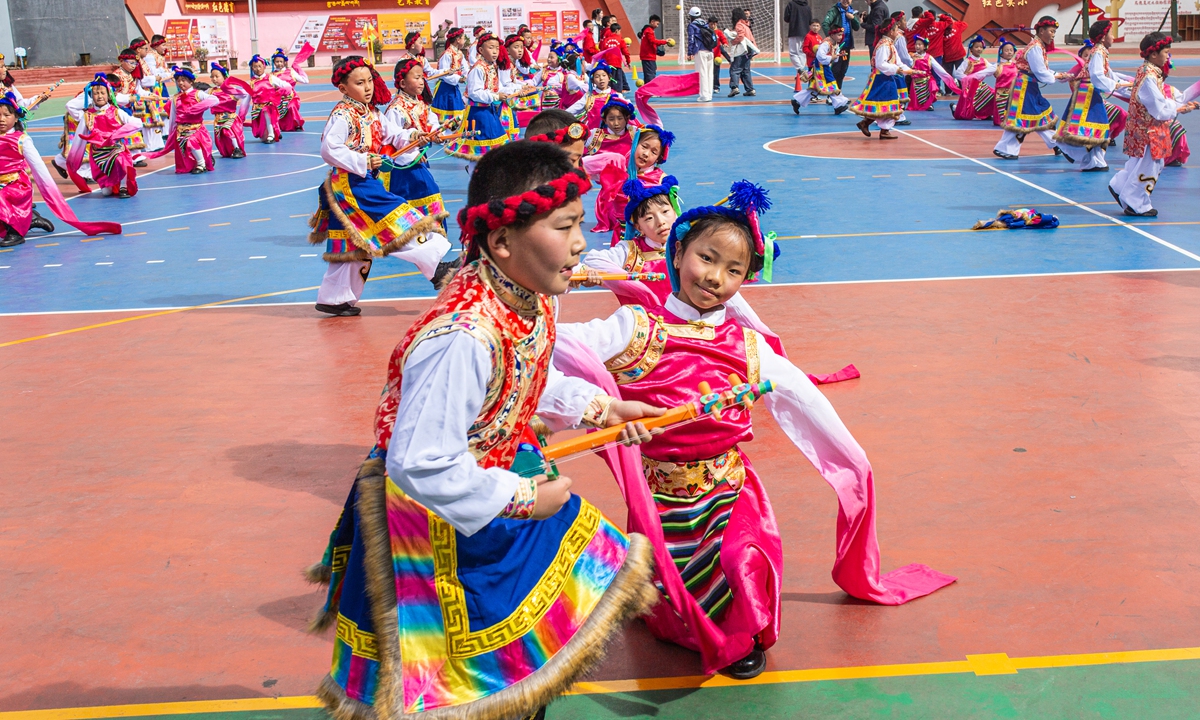
Students from Qamdo Experimental Primary School take part in various activities on campus in Qamdo, Southwest China's Xizang Autonomous Region, on May 13, 2026. Photo: Shan Jie/GT
In Qamdo Experimental Primary School's curriculum, millennia-old intangible cultural heritage resonates alongside cutting-edge technology.The school deeply integrates traditional culture into daily teaching. It offers rich aesthetic courses such as Tibetan Xianzi dance, Tibetan calligraphy, Tibetan musical instruments and paper-cutting.
Fourth-grade student Tenzin Yangzom said she prefers Xianzi dance to Tibetan-language class because, unlike reading aloud in class, Xianzi allows her to dance with her friends.
Counterbalancing traditional dance, modern technology is ubiquitous in classrooms. The school has achieved full coverage with electronic whiteboards and built future classrooms and recording classrooms.
In the drone club, many young enthusiasts like Li Yutao participate. Fifth-grade student Drolma Yingtso, elected by classmates to the drone team, said she wants to become a scientist and make drone obstacle-avoidance functions more sensitive. In addition, fifth-grade student Langga Pumo likened a drone's speed to a horse in Tibetan, saying it flies as fast as a galloping horse.
The school not only emphasizes high-end technology but also uses AI-assisted teaching to optimize lessons.
Fourth-grade student Wu Yue mentioned that subjects include Chinese, mathematics, English, music, moral education, science and information technology. This multidimensional curriculum aims to stimulate students' curiosity and hands-on abilities, nurturing them to be "avid readers, critical thinkers and daring explorers" of the new era.
Witnessing years of aid to Xizang
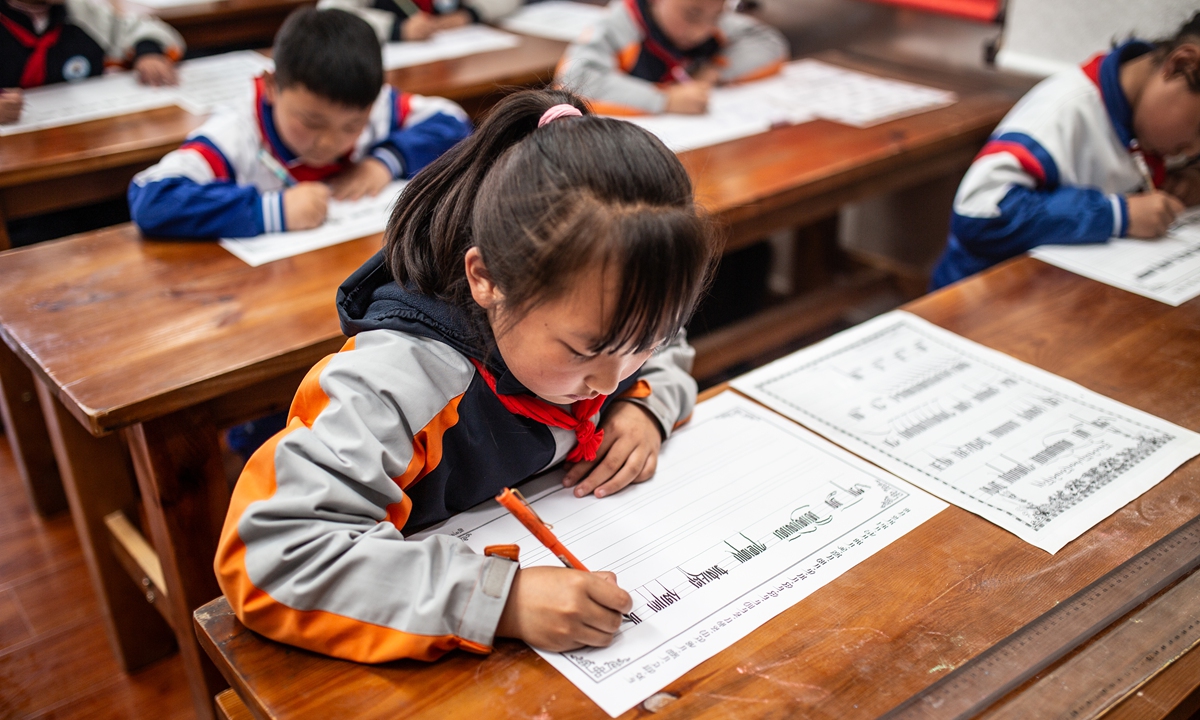
Students from Qamdo Experimental Primary School take part in various activities on campus in Qamdo, Southwest China's Xizang Autonomous Region, on May 13, 2026. Photo: Shan Jie/GT
The modernization of Qamdo Experimental Primary School owes much to sustained "team-based" educational aid to Xizang. School history archives record that from 2019, a comprehensive team-based educational aid program began, with teachers from North China's Tianjin Municipality and other regions gradually joining the campus.Current Tianjin team principal Zhou Rong explained that the aid team consists of 15 members, covering principal, vice principal and teachers across subjects. In their first semester, all teachers taught on the front line and led local teaching research.
To upgrade hardware, the Tianjin aid team invested 5 million yuan ($700,000) in enhancing the campus's gigabit fiber network and established a collaborative teaching experimental base with Tianjin Normal University.
Among the aid initiatives, the establishment of a handball team is particularly notable. In 2021, with support from aid teachers, Qamdo Experimental Primary School formed the first primary school handball team in Xizang.
Zhao Jiabin, a PE teacher from Tianjin who came to support education in Xizang and a former national-level handball player, said that children in Xizang generally have stronger physical fitness and lung capacity than their peers in other parts of China, making them well-suited for handball and soccer.
Additionally, the aid team organizes summer camps and other "exchange, interaction and integration" activities, bringing children from the border regions to see the country.
Today, Qamdo Experimental Primary School has grown from two old rooms in a Chenghuang Temple into a modern model school integrating multiple ethnicities.
As Wu Yue explained, students learn not only from textbooks, but also from red-themed storytelling and mental health activities, which help them build character, better understand history.
RELATED ARTICLES