ARTS / CULTURE & LEISURE
Visually impaired empowered to run half-marathons
Chasing the light
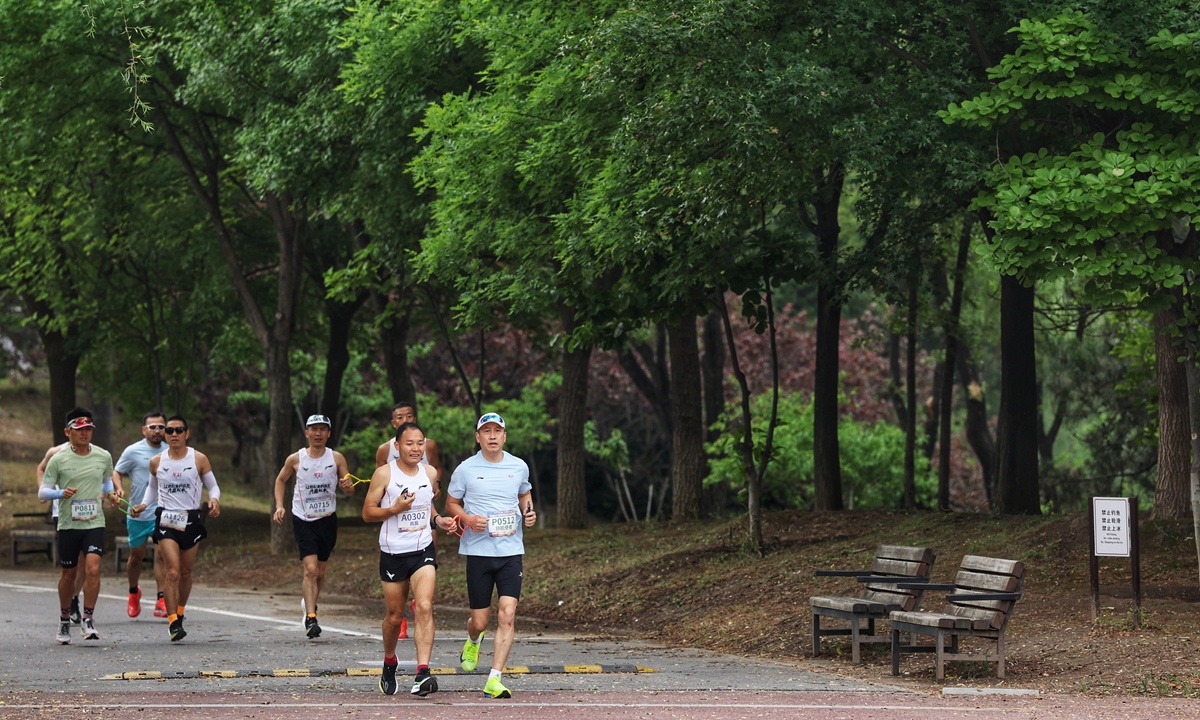
Visually impaired runners and their guide runners take part in a run at Olympic Forest Park in Beijing on May 19, 2026. Photo: Cui Meng/GT
Moving steadily along the tree-lined paths of Beijing's Olympic Forest Park on Tuesday morning, 16 pairs of runners, linked by a short guide rope and synchronized footsteps, set out on a half-marathon.For many recreational runners, covering 21.1 kilometers is a demanding physical challenge. What made the scene remarkable, however, were the 16 visually impaired runners at center stage.
The charity initiative "Chasing the Light 666," designed to inspire more visually impaired population to embrace sports, will see the participants complete a half-marathon every day for six consecutive days.
For event organizer Tang Min, the purpose extends far beyond endurance. "They cannot see the world, but we want the world to see them," Tang told the Global Times.
For years, visually impaired runners have taken part in mainstream marathons across China with the help of guide runners, but Tang felt they were often overlooked amid fields of tens of thousands of participants.
"They are usually submerged in a crowd of runners," he said. "This time, we non-disabled people are the supporting cast. They are the protagonists."
That vision gave rise to the charity challenge. Tang decided to initiate such an event for visually impaired runners only in 2025.
Interest in the event was overwhelming. Nearly 50 runners applied online, but only 16 were selected, after meeting strict standards: completing at least three full marathons in the past two years and achieving an annual running distance of over 1,000 kilometers.
Running changes lives
For visually impaired runners, every race is built on partnership.
Guide runners do far more than keep pace. They provide real-time directions, warn of obstacles, assist with hydration and respond to unexpected situations on the course.
Among the guides participating in the challenge is Wang Liping, who won the gold medal in the women's 20-kilometer walk at the 2000 Sydney Olympics.
"Running together is not only about chasing a personal best," Wang said. "It is about trust, responsibility and passing on love."
Tang and his volunteer team have spent years training visually impaired runners, beginning with 3-kilometer runs and gradually progressing to 10 kilometers and eventually full marathons.
For participant Shang Lei from Central China's Hunan Province, running has transformed his life in ways that extend far beyond physical fitness.
"The biggest change running brought me was that it helped me step out of the relatively closed circle of visually impaired people," Shang said.
One of his greatest sources of inspiration has been his younger sister Shang Chunsong, who won an Olympic bronze medal in gymnastics at the 2016 Summer Olympics before reinventing herself as a world champion in parkour.
Before he began running, most of Shang's friends were also visually impaired. Marathon events introduced him to people from all walks of life, he said.
"Now most of my friends are sighted people," he said. "That has given me access to experiences I never had before." He encouraged more visually impaired people to participate.
What he values most is the sense of equality he experiences on the course. "In a marathon, whether you are an elite athlete or an ordinary runner, everyone is on the same course doing the same thing," Shang said. "The racecourse gives me not only the joy of sports, but also the experience of being treated equally."
For He Yajun, a visually impaired runner and founder of a guide-running team for blind runners, helping others run helped him rediscover his place in society.
"There was a time when I felt like I was an unnecessary person in the world," He said.
But spending more than a decade helping visually impaired people embrace running gradually changed that perception.
"I do not see myself simply as a blind person," he said. "I see myself as someone walking through the dark in a different way, while still understanding and connecting with society."
More than a race
Tang first began running with visually impaired people in 2017, but it was not until 2024 that he started organizing regular training sessions.
Once he spent more time with them, he realized that exercise could have an even greater impact on their lives than it does on the general population. According to Tang, the greatest barrier is not physical ability, but the lack of opportunities and support.
"If nobody helps them, they may walk only 200 or 300 steps a day in their room. Their physical condition can deteriorate quickly, and they can easily become psychologically isolated."
According to the China Disabled Persons' Federation in 2025, China has around 17.31 million visually impaired people. Yet fewer than 5,000 participate in running regularly, Tang estimated.
"That is less than one-thousandth," he said. "The overwhelming majority have never experienced the benefits that sports exercise can bring."
Tang said stories about visually impaired people taking up running are often simply seen as "inspirational." "For them, running is not simply inspirational," he said. "It is a normal way of life, just like it is for us."
He hopes more people will understand that visually impaired individuals are not distant symbols of courage, but ordinary people who need exercise, health, friendship and happiness. "Every visually impaired person can run," Tang said. "And every visually impaired person should run."
Runner Shang hopes his own journey will encourage more people with disabilities to step beyond the confines of home.
"Don't limit yourself just because you cannot see," he said.
He said he thinks once people take the first step, they may discover that society is far more welcoming than they imagined.
"I hope to tell more visually impaired friends that we can absolutely walk out of our homes, participate in sports and integrate into society," Shang said. "As long as there is light in your heart, there will always be a road beneath your feet."
RELATED ARTICLES