SPORT / MISCELLANY
16 visually impaired runners to take on 6 half marathons in 6 days in Beijing
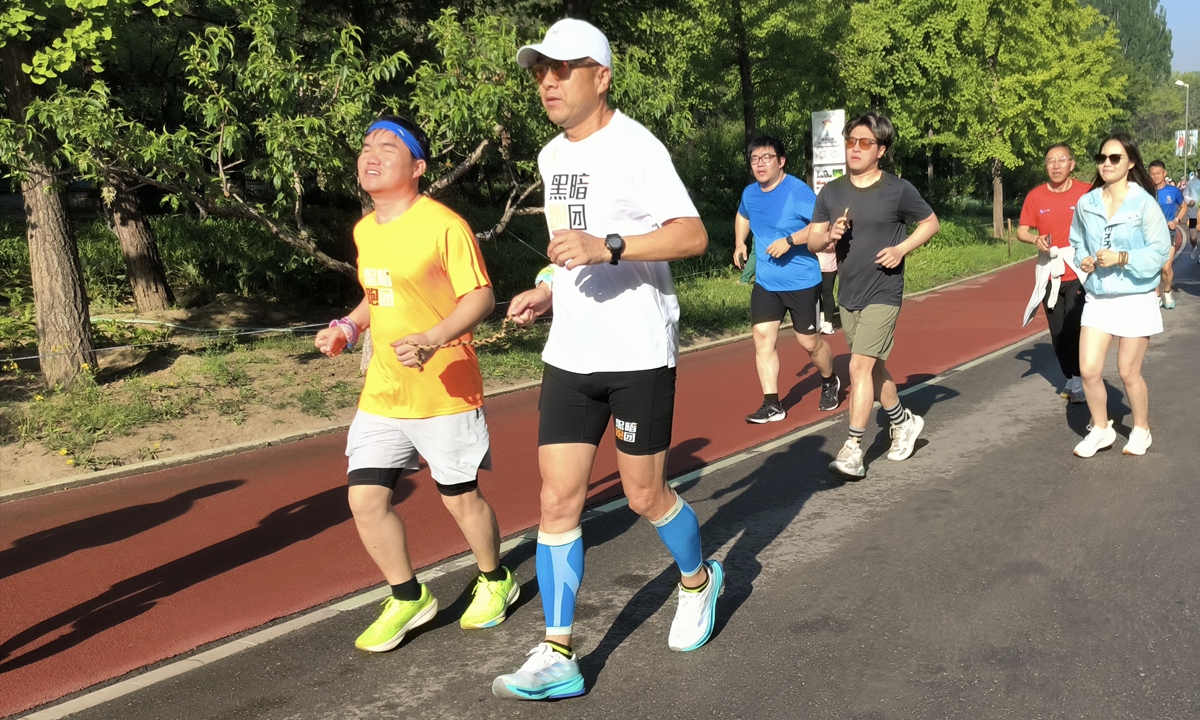
A visually impaired runner (left) trains at the Olympic Forest Park in Beijing with the assistance of a guide runner in May 2026. Photo: Courtesy of organizers
Sixteen visually impaired runners will attempt to complete six half marathons in six consecutive days in Beijing starting May 19, in an initiative aimed at encouraging more blind and visually impaired people to take up sports.The event, to be held at the Olympic Forest Park, will see participants cover 21.0975 kilometers each day, totaling more than 126 kilometers over the six-day challenge.
The organizers hope the event could go beyond athletic achievement.
"We hope to send a message to more visually impaired people that they can join running and use exercise to improve their quality of life," Tang Min, the chief organizer of the event, told the Global Times on Sunday, which coincides with China's National Day of Helping the Disabled.
In recent days, several participants have been training in Beijing in preparation for the challenge.
For visually impaired runners, taking part in road races usually requires the support of guide runners, who run alongside them and help ensure their safety through verbal communication and tethering techniques.
The participants needed to provide track record of finishing marathon races, Tang said.
Guide running has become an increasingly important way for visually impaired athletes to participate in endurance sports, combining physical activity with close cooperation between runners and volunteers.
Tang noted that the demands on guide runners are particularly high, requiring not only running ability but also patience, coordination and a strong sense of responsibility.
However, Tang believes the biggest obstacle facing visually impaired people is not a reluctance to go outdoors.
"The real challenge is the lack of social support," he said.
Tang also pushed back against the tendency to portray blind runners primarily as inspirational figures.
"That is more the perspective of able-bodied people," he said, emphasizing that running should be seen as a normal part of life rather than an extraordinary accomplishment for those with visual impairments.
According to Tang, many visually impaired people are eager to exercise but lack someone to accompany and support them.
"They cannot see the world, but we want the world to see them," he said.
The Beijing event is only the starting point for the initiative, according to Tang.
He said he hopes to bring similar events to other cities across China, although each race is likely to remain relatively modest in scale due to the high cost of safety measures and the large number of volunteers required.
By linking events in multiple cities, Tang hopes to create more opportunities for visually impaired people to participate in sports and connect with supportive communities.
His long-term objective is ambitious but straightforward.
"We hope more blind people will truly step out of their homes and begin exercising," he said.
RELATED ARTICLES