From durian imports to lychee exports: how China’s summer table is changing
Better hard and soft connectivity fuels fruit trade, delivering mutual benefits


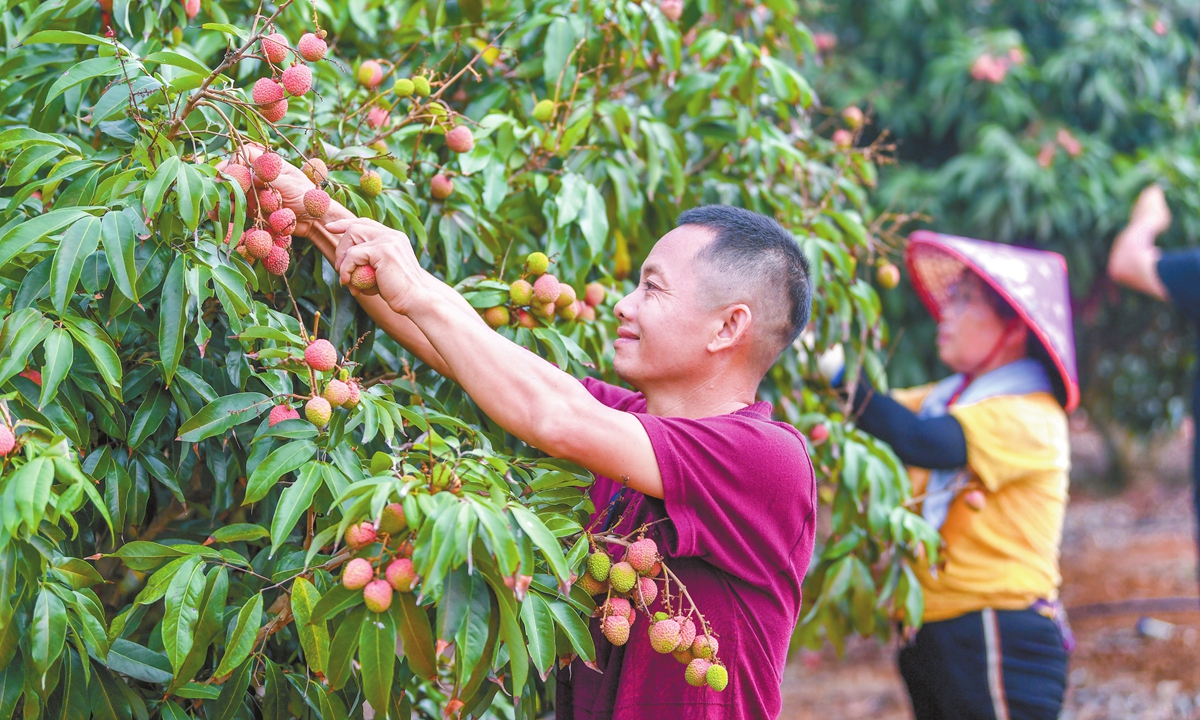
Farmers harvest lychees at a plantation in Sanmenpo town, Haikou, South China's Hainan Province, on April 28, 2026. Photo: VCG
"Lychee harvesting at our farm began before May 1. And by last week, all the crops had been shipped out," Xing Yuanyuan, a representative of Hainan State Farms Hongming Farm Co, said.
South China's Hainan Province is one of the nation's major lychee growing regions. In Sanmenpo township, where Xing's farm is located, the planting area of the tropical fruits reached 4,533 hectares, with an annual output value exceeding 500 million yuan ($75.33 million) in recent years.
Lychees are harvested once a year, and the concentrated harvest period lasts only about half a month.
"It is quite a lot of work this year, too." Xing told the Global Times on Tuesday. At the Lihai Lychee Farm, under the company, farmers have planted 23 hectares of lychees. This year, the estimated output is 275 tons. Among this, 138 tons were exported to Malaysia, while the rest will be sold domestically.
During the past two weeks, we had around 100 workers picking lychees in the fields, with an additional 14 assisting with transportation and 25 in charge of packaging of the fruits, Xing said. "Altogether, the shipments filled 20 refrigerated trucks."
As summer approaches, the fruit basket on Chinese dining tables is undergoing a remarkable transformation. On one hand, imported fruits such as durians from Southeast Asian countries are pouring into Chinese ports in record volumes, offering consumers more affordable access to the "king of fruits." On the other hand, China's homegrown lychees are racing to overseas markets at unprecedented speed.
The two-way fruit flow is reshaping what Chinese families eat and how the country participates in global agricultural trade, analysts noted.
Lychee export sprint
According to statistics from Haikou Customs, from the start of lychee harvesting to May 6, Hainan exported a total of 110 batches of lychees, an increase of nearly 40 percent year-on-year.
How did Hainan achieve such "acceleration" despite recent high temperatures and drought? The answer lies in a logistics relay race where "time is life," according to industry insiders.
According to Xing, the lychees are immediately cooled in ice water after picking, packed with ice blocks, and then transported in cold-chain trucks. This year, the process has been further refined with a high-tech fresh-keeping box that lets the fruit breathe during transit, extending its shelf life. "But speed remains the decisive factor," he added.
Fresh lychees from various farms gather at key transport hubs around Guangzhou, South China's Guangdong Province.
In recent years, China Southern Airlines has built a mature cold chain logistics system that links up orchards, airports and overseas supermarket shelves.
Since March, the airline's Guangzhou hub has handled approximately 13,000 kilograms of specialty agricultural products - including lychees from Hainan, cherries from Dalian, Northeast China's Liaoning Province, and bayberries from Southwest China's Yunnan Province - for air transport, continuously expanding international fresh-produce corridors, according to a press release the company sent to the Global Times on Tuesday.
On April 15, a 600-kilogram batch of "Guihuaxiang" lychees, having cleared final inspections at the company's international cargo terminal in Guangzhou, was loaded onto a flight bound for London, destined to arrive on British supermarket shelves within 48 hours, the company said.
Even in sea freight, the efficiency gains for China's fruit trade are remarkable.
According to a CCTV News, some Hainan lychees are first trucked to Guangdong for packaging, then shipped overseas by cargo vessel. Through pre-sorting points, rapid inspection, and data integration, the entire process - from lychee trees to ship departure in Shenzhen - now averages less than 24 hours.
The durian inflow
While Hainan's lychees head abroad, Southeast Asian durians are arriving in China in massive quantities. This year's abundant harvest, combined with expanded transport capacity, is giving Chinese consumers a new wave of "fruit freedom" - an internet buzzword suggesting consumers will be less hesitant to purchase the once-expensive fruit.
The peak durian season runs from April to June each year. At Nansha Port near Guangzhou, one of China's largest durian-importing seaports, inbound volumes are surging as Southeast Asian growing regions enter full production. Between April 15 and early May, Nansha customs authorities have processed over 30,000 tons of durians, a sevenfold increase over the same period last year, local media outlets nfnews.com reported on Tuesday.
According to the Xinhua News Agency on Sunday, Thai durians this season can now reach Kunming, Southwest China's Yunnan Province from Thai orchards in about 20 hours via designated trains along the China-Laos Railway. Meanwhile, the wholesale prices of durians in Beijing have already dropped by 35-45 percent compared with a year ago.
Gonzalo Matamala, a fruit trader with Giddings Fruit and who is based in Guangzhou, told the Global Times on Tuesday that logistics and border clearance into China have become faster, facilitating the arrival of the fruits in larger volumes and in a shorter period. "When big arrivals concentrate, prices adjust very quickly," Matamala said.
Despite the fall in prices, the Chinese market still has strong potential due to the large demand from Chinese consumers, Matamala said. "I expect strong volume and consumption, but with more pressure on average prices and a bigger gap between premium fruit and ordinary fruit."
Lei Xiaohua, an ASEAN expert from the Guangxi Academy of Social Sciences in South China's Guangxi Zhuang Autonomous Region, told the Global Times on Tuesday that the durian trade exemplifies how China-Thailand practical cooperation benefits ordinary people.
Thailand's durians are reaching Chinese consumers through multiple channels: the China-Laos railway, sea routes, and road transport. This diversity has made durian's prices more affordable, Lei said. "Chinese consumers get better prices, while Thai fruit farmers and businesses share in China's development opportunities. It's a tangible manifestation of mutually beneficial ties," Lei said.
From durian imports to lychee exports, China's fruit trade is accelerating in both directions. Improved hard and soft connectivity, including advanced cold chains, multimodal transport, and streamlined customs procedures, are enabling this transformation. According to a Chinese expert, this means more diverse, affordable tropical fruits for Chinese consumers, while opening global markets for Chinese fruit growers.
Bian Yongzu, executive deputy editor-in-chief of Modernization of Management magazine, told the Global Times on Tuesday that from durian to lychee, China's vast market advantages are once again manifested, as the country's consumers have an ever-increasing appetite for tropical fruits.
"The country's status as a major agricultural power is also apparent. And as Chinese companies, equipped with the advanced technologies and management expertise, gradually enter the global stage, they have injected significant momentum into global agriculture and fruit trade, improving the livelihood of farms in many parts of the world," Bian said.
With improvement in logistics, and innovative ways to store and transport the delicate fruits, and new business models such as overseas warehouses and e-commerce, Chinese companies are not only boosting trade flows between China and its trading partners, but also helping fruit-producing countries expand exports to other parts of the world, Bian noted.
As Guangdong lychees enter their peak season - ready to follow Hainan's footsteps overseas - and as more durian-laden trains roll in from Laos and Thailand, the summer table in China tells a story of connectivity. It is a story where efficient logistics turn perishable fruits into shared prosperity, proving that the world's fruit basket is increasingly borderless.
Back at Lihai Lychee Farm, Xing is optimistic about the future.
"We also have more than 66 hectares of orchard that is under cultivation so there is still significant growth potential. We are also raising over 60 new species from our seed plant," Xing said.
RELATED ARTICLES