ARTS / CULTURE & LEISURE
Outdoor sports thrive amid lifestyle shift, calls for improved regulation

The Liangma River in Beijing Photo: VCG
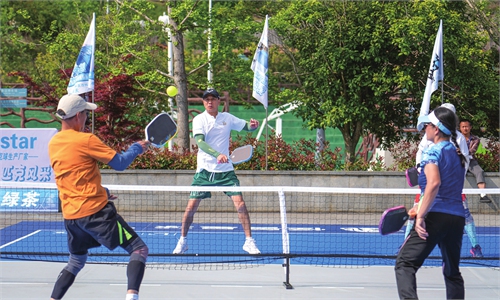
On the Liangma River in Beijing, young office workers balance on paddleboards after work, while newly built climbing gyms and pickleball courts fill up on the weekends. What was once seen as a niche pastime for a small group of enthusiasts is rapidly becoming part of everyday life in China.China's outdoor sports consumption surpassed 800 million participants in 2025, with total spending exceeding 1 trillion yuan ($147 billion), according to a report titled "From Niche Sports Experiences to Mainstream Lifestyles" - 2025 Outdoor Sports Consumption Development and Trends Report" released at the recently held China International Camping Congress in Jinhua, East China's Zhejiang Province.
The lowered barriers of entry and the ability to satisfy social and emotional needs are among the reasons behind the rapid growth of outdoor sports. Yet, the expansion also posed some challenges that need to be addressed, Jiang Yiyi, dean of the School of Leisure Sports and Tourism at Beijing Sport University (BSU), told the Global Times on Tuesday.
Among the fastest-growing activities are frisbee, land surfing, urban cycling, paddleboarding, camping, hiking, flag football, rock climbing and pickleball. In particular, pickleball, land surfing and paddleboarding have experienced explosive growth in the past two years, emerging as mainstream recreational choices among young urban residents, according to the report jointly released by BSU and other institutions.
Unlike traditional extreme sports that are often highly difficult and risky, most of these activities do not require professional venues or complicated equipment, allowing ordinary people to participate on weekends or after work, Jiang noted.
Young people today not only seek exercise and stress relief, but also social interaction. Frisbee, pickleball and flag football naturally encourage team participation, while paddleboarding, camping and hiking are suited for relaxation and solitary experiences, she said.
More than 400 million people in China are now engaged in outdoor sports, according to another report released by the Economic Department of the General Administration of Sport of China (GAS) in October 2025.
For many young people facing the pressures of fast-paced urban life, outdoor sports provide a way to reconnect with nature, socialize and seek mental relaxation.
While technology and infrastructure have accelerated this transformation, internet platforms now allow users to reserve campsites, join pickleball lessons and discover hiking routes with just a few taps on a smartphone, significantly reducing information barriers and planning costs.
The rise of niche sports has also been fueled by professional competitions and celebrity influence.
The recent victories of Chinese motorcycle manufacturer ZXMOTO in the 2026 FIM Superbike World Championship, for example, has brought professional motorsports closer to the general public, inspiring many young people to view outdoor and extreme sports not as distant spectacles, but as achievable lifestyles.
Social media has further amplified the momentum. Stylish camping photos, cycling vlogs and paddleboarding videos have become highly shareable online content, turning outdoor sports into symbols of healthy living, Jiang said.
Yet the rapid expansion also exposes growing challenges.
During the May Day holiday, an unexpected snowstorm hit Mount Wutai in Xinzhou, North China's Shanxi Province, prompting rescuers to evacuate 300 hikers.
Following the incident, the Mountaineering Management Center of GAS and the Chinese Mountaineering Association jointly issued a safety advisory on outdoor mountaineering safety management and risk prevention amid extreme weather conditions.
The long-term development of outdoor sports cannot rely on popularity alone. The next stage of growth must focus on addressing shortcomings in safety management, public services, industry standards, infrastructure supply and public education, said Jiang.
The deeper value of outdoor sports lies in fostering healthier lifestyles, environmental awareness and stronger social connections.
China's outdoor sports boom reflects a broader shift in how people define quality of life. With stronger safety measures, better public services and greater environmental awareness, this momentum is poised to evolve into a more sustainable, inclusive and responsible lifestyle culture.
The author is a reporter with the Global Times. life@globaltimes.com.cn
RELATED ARTICLES