ARTS / BOOKS
From letters to screen: How a novel about ‘qiaopi’ and a filmmaker’s visit led to ‘Dear You’
How a novel about ‘qiaopi’ and a filmmaker’s visit led to ‘Dear You’

Yangqi village in Jieyang, South China's Guangdong Province serves as one of the filming locations for movie Dear You. Photo: VCG
At the end of 2023, long before movie Dear You became one of the most talked-about Chinese films in recent years, director Lan Hongchun arrived on Guishan island in South China's Guangdong Province with his team to meet writer Chen Jiming, whose novel Home Letter traces Chaoshan culture and qiaopi, the handwritten letters and remittances sent home by overseas Chinese migrants.At the time, Lan's film project was still taking shape. There was no script, no fixed storyline, only a direction he could not yet fully define.
Lan had already read Home Letter and came up with the idea of shooting a film on a similar subject, so he sought Chen's advice in the early stages of the project.
They first watched Lan's two previous Chaoshan-language films before turning to a discussion that also included Home Letter.
Both of them agreed that qiaopi is an important subject worthy of further exploration. Their discussions also touched on Chaoshan, a cultural and linguistic region in southeastern Guangdong known for its strong migration traditions.
Something in those exchanges later became part of the emotional foundation of Dear You.
Three years later, the film quietly arrived. Made on a modest budget and without major stars, Dear You has since become a cultural phenomenon. It has grossed more than 650 million yuan ($95 million) and earned a 9.1 out of 10 rating on the Chinese movie review platform Douban.
For Chen, whose novel Home Letter helped bring the history of qiaopi to the broader public, what struck him most was not only the film's success, but the way a once-niche cultural subject has entered mainstream emotional space.
In an interview with the Global Times, Chen returned to the ideas that had shaped his writing of Home Letter. At the center of it was a belief that Chaoshan culture cannot be contained by geography alone.
"To write about Chaoshan people is, in a sense, to write about Chinese people. The qualities that are deeply rooted in the Chinese character," he said.
Shared vision
Looking back on their first meeting, Chen described it as "deeply engaging" and said that they were "immediately in sync."
Lan said he had already made two Chaoshan-language films, both small-scale productions, Proud of Me and Back to Love, and did not expect audiences outside the region to respond so strongly.
"But I recommended they should be more ambitious and trust the audiences, especially those beyond Chaoshan," Chen recalled. "A subject doesn't need to be big. What matters is whether the vision is big enough."
During their conversation, Chen also reminded the filmmakers that the values embodied in qiaopi extend far beyond Chaoshan, reflecting broader Chinese cultural traditions, such as emotional loyalty, mutual support and love.
For Chen, the writing process behind Home Letter was never only about history. It was also about what he called a "literary heart": the capacity for literary and artistic expression.
When he watched the film, Chen said he felt a quiet admiration for its cinematic language. Beyond familiar Chaoshan details such as preserved olives and local textures, the film carried nuances that could only come from creators deeply rooted in the region.
He described Dear You and Home Letter as "different streams flowing from the same source."
One follows a woman who spends 18 years writing letters and sending money to support a man's family out of gratitude toward him. The other follows a man who becomes a professional qiaopi writer after traveling to Southeast Asia.
Both stories, Chen said, are ultimately about memory, the passage of time and the fate of ordinary people.
In Chen's view, the novel Home Letter helped bring qiaopi into the broader public awareness. However, he noted that a film can reach a much wider audience, making the subject more widely known.
Through qiaopi, audiences are able to see history, how difficult life once was, and how much people relied on mutual support and emotional connection to endure hardship.
At the same time, they are also prompted to reflect on the present, where rapid change and intense competition have made sincerity, patience, emotional loyalty and deep affection increasingly rare.
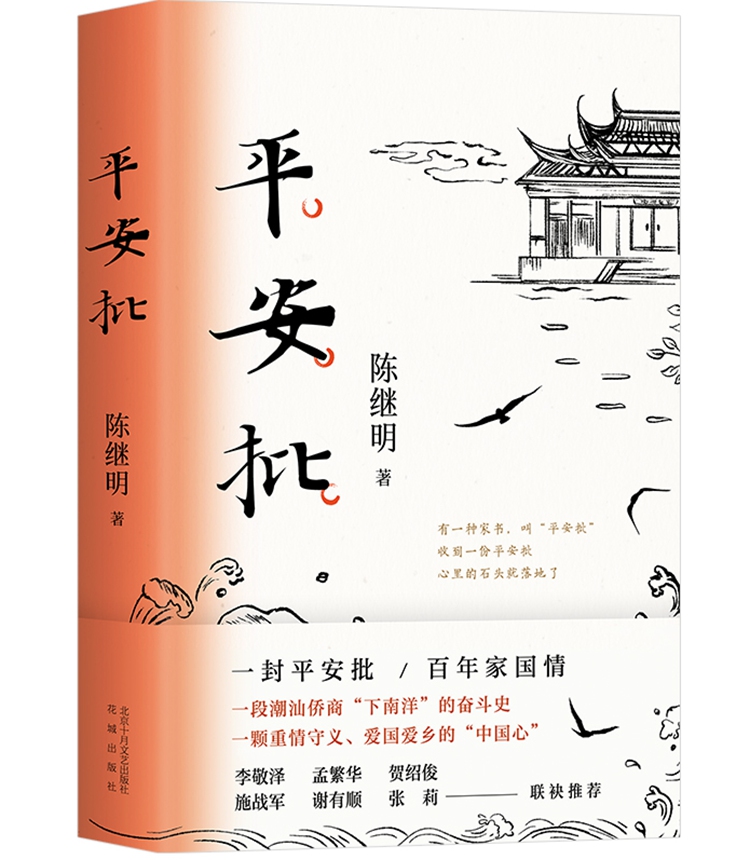
The cover of the book Home Letter by Chen Jiming Photo: Courtesy of Beijing October Art and Literature Publishing House
Path to writingChen was raised in a village nestled along a branch route of the ancient Silk Road in Northwest China's Gansu Province, a place where departure was woven into the fabric of daily life.
At 12, he left for Northwest China's Ningxia Hui Autonomous Region. From an early age, he became familiar with feelings of wandering, displacement, loneliness and life in a foreign place.
Years later, in a teahouse in Zhuhai, Guangdong Province, he came across dozens of old qiaopi letters left behind by overseas Chinese migrants. The discovery stayed with him.
Soon after, he joined a writing program that brought him to Shantou, part of the Chaoshan region, for a year of fieldwork.
Before writing began, he settled on a title: Home Letter, or Ping An Pi. In Chinese, "Ping An" means "peace," but for him "peace" was not a theme but a lens. It was something that tied the letters not only to those who left, but to those who waited.
During his stay in Shantou, he encountered many stories that later entered Home Letter, a book published in 2021 by Beijing October Art and Literature Publishing House, such as couriers carrying remittances along dangerous routes, and people who treated every letter as a moral obligation rather than a transaction.
"The sense of emotional loyalty and integrity has long been part of Chinese civilization, with examples found across the country, including Chaoshan. If I had never been there or written Home Letter," he said, "I might not have believed it."
Beyond Home Letter, Chen has recently completed a new novel set along the Meijiang River in Guangdong, focusing on Hakka communities.
Together with Home Letter and Dunhuang, he sees them as a trilogy, works centered on borderlands, movement, and the slow reshaping of civilizations.
RELATED ARTICLES