ARTS / CULTURE & LEISURE
Short drama set in 1937 Nanjing wins hearts of audience with good storytelling
By Published: May 20, 2026 11:29 PM

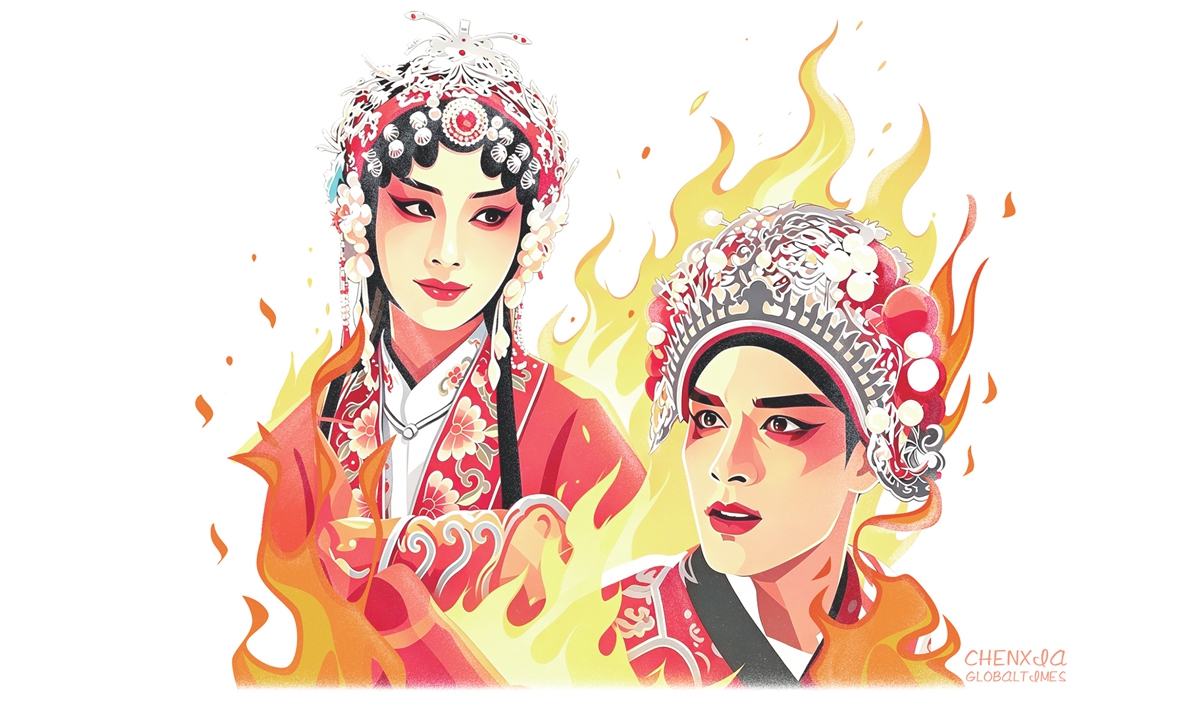
Illustration: Chen Xia/GT
In May, Chinese short drama Enemy took the internet by storm. This 13-minute low-budget work with zero promotion, set against the backdrop of the fall of Nanjing in 1937, tells a solemn and tragic story of two Peking Opera stars who sacrificed their lives on the stage to protect 30 innocent civilians.Without the support of A-list celebrities or overwhelming marketing, it achieved over 800 million views on China's Tik-Tok platform Douyin and more than 2 billion views in related topics across the internet, earning a high word-of-mouth among many audiences.
The success of Enemy hits squarely at the core pain point of today's short-drama market. In recent years, the micro-drama industry has exploded thanks to low barriers to entry and high returns, but it has also bred a toxic obsession with "traffic above all." Far too many productions rely on shock tactics with absurd plots, sloppy production, which have long caused aesthetic fatigue among audiences.
However, Enemy's setting is very much in line with the aesthetic tastes of young people today: the "infinite loop" genre. This is a mode of storytelling where characters are selected by a mysterious system and forced to enter wildly different parallel worlds or "instances" to complete missions. It's a framework that allows radical creative freedom, mashing up wuxia, sci-fi, horror, historical drama, and suspense, with characters ricocheting across time and space to live entirely different lives.
In Enemy, the two leads are bickering frenemies in real life who get pulled into an infinite-loop system, and forced to team up to defeat an ultimate boss.
The climax erupts in episode five. Here, the male and female leads are transformed into the twin stars of a Peking Opera troupe: Chen Qiaotou and Chen Xiangkou. The setting is the bitter winter of 1937, on the eve of Nanjing's fall. Japanese invaders break into the city and force the two famous performers onto the stage, ordering them to alter a classic opera, replacing the story's loyal martyrs with the invaders themselves. To buy safe passage for the trapped civilians, the two artists strike a bargain: "One performance, and you let 30 people leave the city."
That performance becomes their final act. On stage, they pretend to comply, but they have hidden poison in the drinks for the Japanese invaders. They finally set fire to the venue and die together with the poisoned Japanese soldiers in the flames, pushing tragic beauty to its extreme.
What is even more shocking is that the names and numbers of the characters in the drama are not fictional. The protagonist's name Chen Qiaotou echoes the Lugou Bridge Incident; Chen Xiangkou evokes the desperate street battles of Nanjing; the "30 people" rescued serve as a heart-piercing tribute to the 300,000 victims of the Nanjing Massacre.
The short drama Enemy is inspired from the story of Xiao Juting (also known as Gao Fugui), a male Pingju Opera singer. He is believed to have laid down his life at the age of 16 in 1938 while fighting against Japanese invaders, though no official historical records can substantiate the authenticity of his story.
This explosive popularity of the short drama forces an urgent question: In the face of the AI wave, how much space is left for live-action short dramas?
According to guidelines issued by the China Netcasting Services Association, in the first quarter of 2026, AI-generated micro-dramas accounted for over 95 percent of new releases across all platforms, and yet those assembly-line productions captured a mere 4 percent of total streaming traffic.
Li Xu, a short drama maker, told the Global Times that the growth of current short drama teams stems from a mature industrial model: focusing on fast production and consumption, using AI for mass creation, and being able to produce dozens of works a day, even completing a short drama in a week.
In terms of content, it focuses on formulaic pleasure, using intensive conflicts combined with template character settings, to pursue the short-term effects of strong stimulation, making content completely a subsidiary of traffic.
Zhang Yan, a professor at Beijing Normal University's School of Arts and Communication, has observed bluntly: "Many micro-drama creators assume audiences only crave clickbait scripts… They serve up nutritionless, even vulgar fast-food drama, while chaotic pricing and mismanagement run rampant. The industry has failed to build a healthy, rational ecosystem."
Enemy's team took a different road by making good story-telling a priority. In an era of rapid AI advancement, many creators have fallen into a kind of "traffic anxiety," getting hooked on copy-paste formulas while ignoring the true nature of content and the transmission of emotion.
Enemy, made with finite resources and infinite passion, proves that the value of a work is never measured by investment or traffic figures, but by whether it holds genuine emotion, solid details, and an uplifting moral compass.
A good story is the ultimate key to high traffic. Creators who are willing to go deep, fully commit, and bring honest emotions to their audience will never be let down.
The author is a reporter with the Global Times. life@globaltimes.com.cn
RELATED ARTICLES