ARTS / CULTURE & LEISURE
Where villages become destinations: Rural revitalization in western Hunan through local tourism
Rural revitalization in western Hunan through local tourism
By in Xiangxi Published: May 21, 2026 11:45 PM


Wu Xiuman, a tour guide, livestreams at the Miao embroidery exhibition center in Shibadong village, Xiangxi Tujia and Miao Autonomous Prefecture in Central China's Hunan Province, on May 7, 2026. Photo: Shan Jie/GT
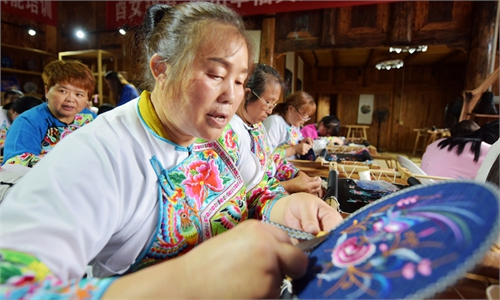
At an ethnic Miao embroidery workshop tucked in the mountains of Xiangxi, Central China's Hunan Province, the first thing visitors hear is not a guide's introduction, but the dense hum of embroidery machines.Rows of machines stitch traditional Miao patterns onto fabric. In the next room, several embroiderers sit around a table, sewing embroidered pieces into pendants, earrings, shawls and round fans.
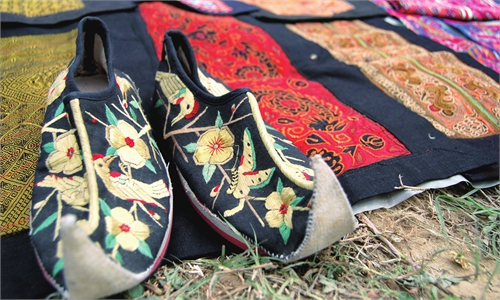
Inside the display cabinets, motifs such as butterflies, tiger-head shoes and Miao silver ornaments have been redesigned into cultural and creative products that tourists can take home.
This is Shibadong village in Huayuan county, Xiangxi Tujia and Miao Autonomous Prefecture, Hunan, the birthplace of China's "targeted poverty alleviation."
For many tourists, Shibadong used to be a name they saw only in news reports. Today, it has become a well-known stop on the Xiangxi travel route. From Miao embroidery workshops to the kiwi orchards of Changputang village, from tie-dye shops in Fenghuang Ancient Town to the Aizhai Bridge and Dehang Grand Canyon, rural tourism in Xiangxi is extending from traditional scenic spots into villages, industrial parks, intangible cultural heritage workshops and rural courtyards.
In the past, when people talked about Xiangxi, literally meaning western Hunan, they often thought of its mysterious folk customs or the romantic Fenghuang Ancient Town.
Today, tourism in Xiangxi does not only focus on ancient towns and mountains, but also involves industrial growth, how traditional skills are carried forward, and how villages reconnect with the outside world through tourism.
Embroidery-led poverty alleviation
Shibadong village is only about a 20-minute drive from Xiangxi Biancheng Airport, which sits on a hilltop. Driving along smooth mountain highways into the village, visitors can link Shibadong with the Aizhai Bridge and Dehang Grand Canyon on the same route.
The bridge and the canyon offer the visual impact of Xiangxi's mountains and waters. Shibadong offers a different experience: It shows how a once-impoverished Miao village has continued to develop industries after shaking off poverty, and how traditional craftsmanship has been transformed into marketable products.
The village's Miao embroidery cooperative is one of the most enjoyable places for visitors to linger.
In the past, Miao embroidery mainly appeared on traditional clothing by being stitched onto collars, trouser legs, shoes and hats.
Now, the cooperative has turned these patterns into brooches, earrings, fridge magnets, bags, round fans and mugwort pillows. For tourists, these products carry more stories than ordinary souvenirs. They come from a village's industrial practice, and from the needles and threads passed down through generations of Miao women.
The ethnic Miao people traditionally did not have a written language, and much of their history, migration memories and blessings are hidden in Miao songs, drums and embroidered patterns. Such stories have also attracted a growing number of international visitors.
In 2025, members of a training program for women officials from southern African countries including Angola, South Africa and Tanzania visited the Shibadong Miao Embroidery Rural Revitalization Demonstration Base. They watched the embroiderers work and asked about their pattern design, stitching techniques and product sales, according to Hunan-based Women Today Weekly.
A visitor said that seeing these practices in a remote Chinese village helped her understand a real path through which women can participate in development and earn income.
This on-site sense of participation is also part of Shibadong's appeal to ordinary tourists.
Meanwhile, visitors can tour the targeted poverty alleviation exhibition hall to learn how the village moved from deep poverty to prosperity, and walk into the embroidery workshop and see how traditional patterns go through design, machine embroidery and hand sewing before becoming products for the tourism market.
For families with children or study-tour groups, this is a more direct way to learn about local history and culture than simply "listening to a story."
Shibadong is a place worth exploring slowly: wooden houses, village gates, mountain roads and terraced fields. The villagers find new job opportunities in cooperatives, tourism companies, honey production and mountain spring water projects. What is truly worth seeing is the life of a village in motion.
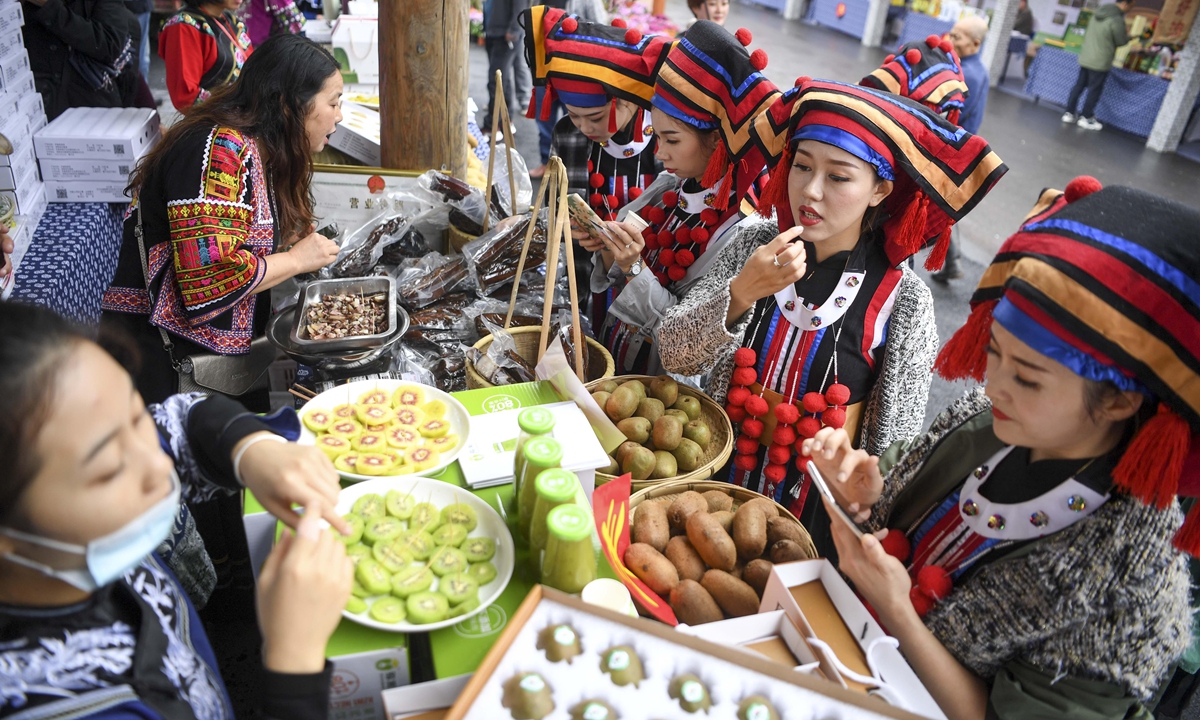
Women dressed in traditional Miao attire sample local specialties in Xiangxi, Central China's Hunan Province. Photo: VCG
Orchard toursOn the way back toward Fenghuang from Shibadong, Changputang village can serve as another rural travel stop. This resource-rich village has long stood along an important traffic route. Today, it is not far from Fenghuang Ancient Town, yet it offers an entirely different experience.
The ancient town boasts attractions such as the Tuojiang River, stilted buildings, stone-paved lanes and stunning night views.
Changputang takes visitors into orchards, grafting nurseries and agricultural technology courtyards. In Changputang, kiwi fruit and pomelo plants spread across the hillsides. In May, the fragrance of pomelo blossoms drifts through the air.
A local official told the Global Times that the village now has more than 5,000 mu (333 hectares) of kiwi plantations and has built a kiwi technology courtyard, where variety trials, intercropping experiments and cultivation techniques are being promoted.
For tourists, these seemingly technical agricultural practices have already become concrete travel experiences. In the orchards, visitors can see how kiwi flowers are being hand-pollinated, how grafting is carried out, and how different rootstocks and fruit varieties are combined to adapt to market demand. This turns the orchard into more than just a photo backdrop. It becomes an open-air agricultural classroom.
For ordinary weekend travelers, Changputang can easily be paired with Fenghuang Ancient Town on the same day. Visitors can spend the day in the village, touring orchards and hearing stories of local industries.
In autumn, they can add fruit-picking to the itinerary. By evening, they can return to Fenghuang to stroll through its old streets and alleys, and enjoy the night views of the Tuojiang River, pavilions and towers.
Amid the mountains and waters of Xiangxi, visitors can not only enjoy the scenery, but also experience the rural changes taking place behind it.
These villages are no longer places to be viewed only from a distance. They are places where visitors can walk in, stay for a while, listen to a story, take home a handmade object, and leave with a better understanding of the new life unfolding in China's countryside.
RELATED ARTICLES