Building computing power in space
New development paradigm helps address surging market demand: analysts
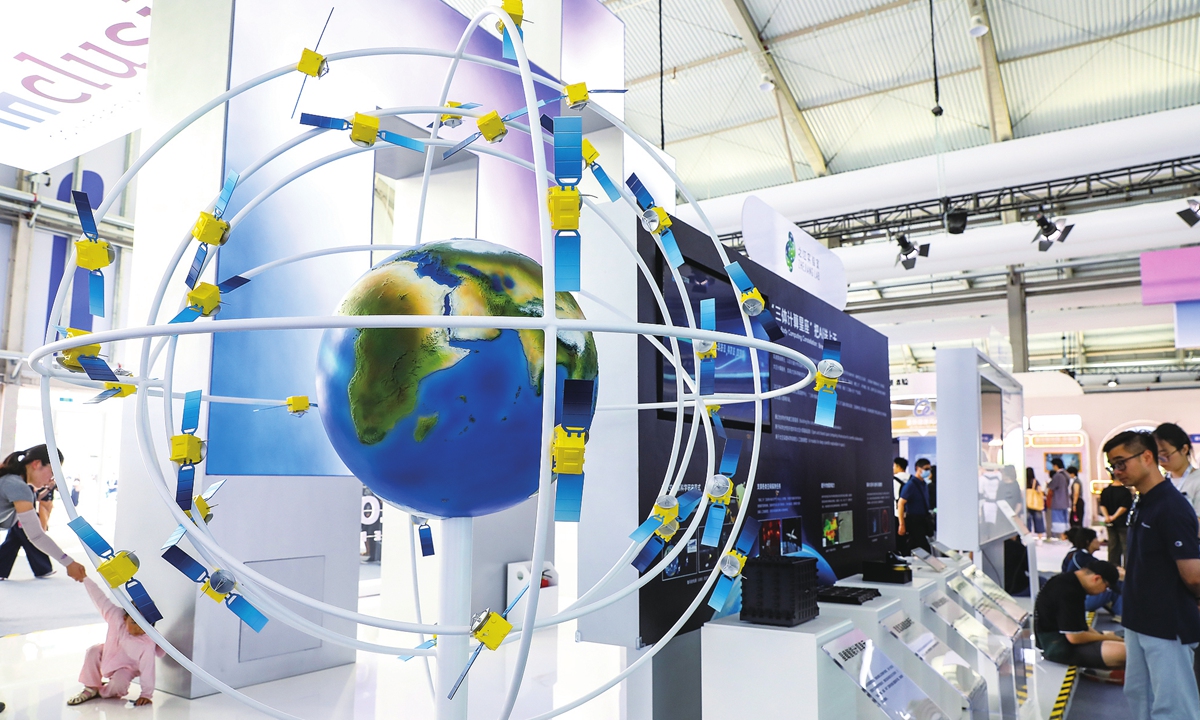
A view of the "Three-Body Computing Constellation" exhibition booth at the 2025 Inclusion Conference on the Bund in Shanghai on September 12, 2025 Photo: VCG
The "FuXi" meteorological artificial intelligence (AI) model, capable of forecasting 60-day weather patterns in three minutes, is processing first-hand meteorological data taken from space in real time. This is made possible by a computing satellite, part of the "Three-Body Computing Constellation" which is operating in Earth's low orbit at an altitude of about 500 kilometers.
As China's first space-based computing constellation, it has achieved in-orbit computing power of 50 petaflops (one quadrillion floating point operations per second) since its successful launch in May 2025. It can support the deployment and inference of AI models up to 140 billion parameters, making it the world's largest space-based computing constellation, the CCTV News reported.
In simple terms, space computing involves moving ground-based data centers into orbit, turning satellites into "computers with wings." Data is processed directly in space, with only critical information sent back to Earth, enabling "space data, space computing" and "space-surface collaboration."
With space computing capability, fishermen will only need to send a query via a mobile app to a satellite. Using hyperspectral cameras, the satellite can accurately locate tuna schools. The in-orbit "intelligent brain" analyzes the data and transmits practical information back to Earth, according to the Xinhua News Agency.
Operation in sky
Industry analysts predict that, by 2035, the global market for space computing-related services could exceed $1 trillion. Upstream and downstream industries, including rocket manufacturing, satellite development, and space data center operations, are expected to create a massive "space-based digital economy."
Analysts noted that the push to move computing power into space is driven by realities, as ground-based computing power is under immense pressure.
The proposal of "space computing power" was driven by multiple factors, including explosive growth in demand for computing power, the breakthroughs in reusable rocket technology, said Xie Lina, deputy director of the Cloud Computing & Big Data Research Institute of the China Academy of Information and Communications Technology, CCTV News reported.
With the rapid growth of AI industry in China, market demand for computing power has surged. Ground data centers are facing multiple challenges related to energy, land, and heat dissipation. In 2025, China's computing centers consumed 196 billion kilowatt-hours of electricity, a year-on-year increase of 18.1 percent, far exceeding the growth rate of China's yearly electricity consumption, official data showed. From 2024 to 2030, data center electricity usage is projected to grow at an average annual rate of about 20 percent.
And, space offers a uniquely computing-friendly environment, analysts said.
Abundant solar energy and the natural vacuum with ultra-low temperatures make space a "green server room," industry practitioners said. Once networked, space computing systems are no longer constrained by ground fiber optics and base stations. More importantly, processing data in outer space saves transmission resources, improves efficiency, and meets demands for low latency and real-time performance.
"We regard AI integration as the backbone of the space industry. In the long run, space-based computing will evolve into universal public infrastructure," Chen Junrui, a spokesperson for Hangzhou-based STAR.VISION, a Chinese AI-driven satellite company, told the Global Times on Thursday.
The company envisions a future where orbital computing networks achieve the same accessibility and sophistication as Earth's internet. Once fully mature, this space infrastructure will serve a broad spectrum of users, such as governments, corporations, research institutions and individuals alike, said Chen.
The world is experiencing a wave of space-based computing deployment. US companies like SpaceX and Google are accelerating efforts, Russia is upgrading its satellite constellation, and the EU is exploring the possibility of building data centers in space. China, through strategic guidance, technological breakthroughs, and ecosystem development, ranks among the world's leading players, according to a report published on Qiushi Journal.
In terms of technology, China has progressed from the "TianSuan Constellation" to the successful launch of the first 12 satellites of the "Three-Body Computing Constellation."
The country has also achieved on-orbit inference with the Qwen AI model and demonstrated intelligent agents using space computing to control ground robots. China leads in on-orbit networking of computing constellations and is at the forefront in engineering practice and commercial application, holding a significant first-mover advantage, industry insiders said.
Leading position
On the policy front, China's 15th Five-Year Plan (2026-30) outlined the building of an integrated space-air-ground system with fused communication, navigation, sensing, and computing services. And, the Ministry of Industry and Information Technology in April said that it would accelerate the cultivation of the space computing industrial ecosystem.
Zhang Shijie, chief scientist of Beijing-based commercial space firm Galaxy Space, told the Global Times that any breakthroughs in high-performance computing will inject strong momentum into an integrated space-air-ground service system, covering communication, navigation, sensing and computing.
Application scenarios of space computing are rising too. For example, two hyperspectral satellites from STAR.VISION are scheduled to be launched in early June. Once in orbit, they will network with an existing satellite to support emergency disaster relief, precision agriculture, and carbon monitoring.
Meanwhile, space computing enables remote control of robots in advanced manufacturing, and low-latency support for low-altitude economy applications such as autonomous driving and flying cars, according to Xinhua.
A representative from China's private space company LandSpace told the Global Times that reusable rockets are the answers to lowering operational costs. "Launching 220,000 satellites would require about 500 rockets per year over the next 7 to 10 years. Reusable rockets will be essential. If two-stage reusability is achieved, launch costs could drop by a big margin, making space-ground computing cost-competitive," said the representative.
When satellite launch costs fall to around $200 per kilogram, the long-term economics will become viable. Chinese analysts suggested that, thanks to solar power and vacuum heat dissipation technology, the 10-year operating cost of a space data center could drop to as low as 5 percent of a ground-based equivalent. And, space-based computing will become a vital engine for cultivating new quality productive forces, empowering high-quality economic and social development, analysts said.
RELATED ARTICLES