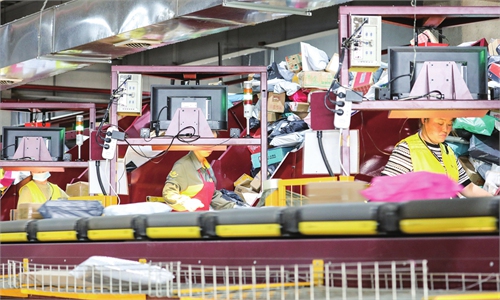
China’s ‘618’ shopping festival goes all-in on AI, generating fresh consumption growth
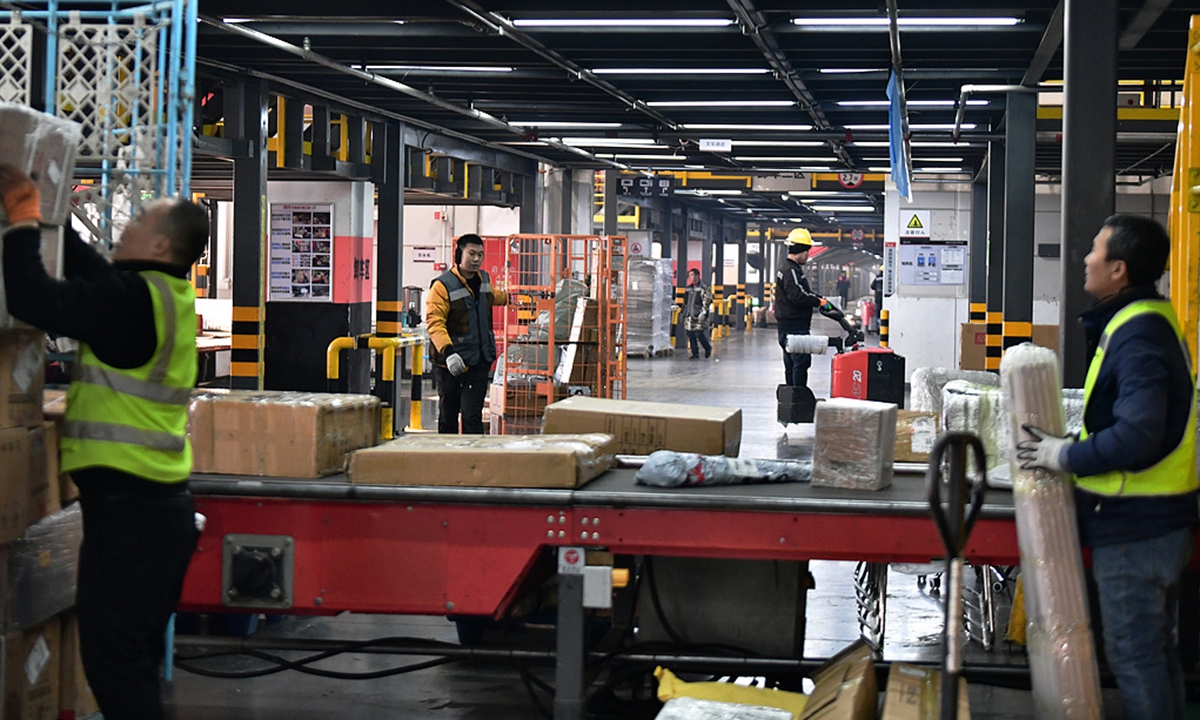
Workers are on duty at an express delivery sorting and transfer center in the development zone of Langfang, North China's Hebei Province, on December 17, 2025. Photo: VCG
China's annual "618" shopping festival, which was originally launched around June 18 but now spanning several weeks, has shown a prominent focus on artificial intelligence (AI), with major Chinese e-commerce platforms embedding AI into every link of the supply chain from logistics to customer services.
Industry experts said that 2026 is a breakthrough year for AI in online retail, as the technology has penetrated nearly every link of the supply chain, unlocking latent consumer demand, generating fresh consumption growth, and moving the sector beyond vicious price competition.
Since mid-May, leading platforms including JD.com, Taobao and Douyin have unveiled their official "618" promotion plans. Instead of flooding consumers with subsidies and rock-bottom price promotions, AI integration is the most striking trend this year.
Alibaba has made significant strides in AI-driven shopping services by connecting its Qianwen Large Language Model with Taobao. Users can select, compare and purchase goods simply by chatting with AI on the Qianwen app. The Qianwen AI shopping assistant is also accessible on Taobao, supporting virtual try-on, preferential price calculation and flash purchase assistance, the Global Times learned from Alibaba on Sunday.
The AI system can accurately capture consumer intent and deliver targeted recommendations. It can also handle vague shopping demands and offers suitable suggestions when shoppers fail to describe specific styles or lack clear purchase ideas, according to Alibaba.
JD.com said in a statement sent to the Global Times on Sunday that its "618" shopping festival this year will feature a major industrial innovation driven by AI in cost control and operational efficiency, bringing consumers an all-round upgraded shopping experience empowered by AI.
JD.com has upgraded its virtual livestreaming system, enabling AI hosts to manage the entire livestream, from planning and product promotion to post-broadcast analysis. The move is designed to reduce labor costs while boosting livestream sales performance.
On the logistics front, JD has deployed its proprietary large-language model for the shopping event. Using data from thousands of core supply chain modules, the system optimizes delivery routes, improves warehouse layout, and fine-tunes inventory scheduling, helping to minimize stockpiling and delivery delays.
During this "618" shopping season, Douyin has made its intelligent technology tools available to merchants. With access to AI tools, merchants can quickly produce short videos and product images, a development that helps shoppers make faster decisions. The platform has also allocated substantial computing resources to offer free, limited-time access to its AI-powered customer service, which reduces merchants' labor costs by approximately 70 percent, the Jiefang Daily reported.
Liu Dingding, a veteran internet observer, told the Global Times on Sunday that this year's "618" campaign will be the first time AI has seeped into every link of the supply chain, from trading to services.
"This year is a breakthrough one, with all platforms going all-in," Liu said. "At the launch conference, the platforms only spent a few dozen minutes on promotional content, but they spent two hours talking about AI, a real‑world battleground."
AI enables businesses to better comprehend consumer demands and match products and services with real market needs. This profound transformation helps generate fresh consumption growth. It delivers fundamental upgrades to the consumption sector, Liu said.
The "618" campaign will also test whether AI-powered customer service can properly handle user complaints, whether AI-powered logistics can accelerate product delivery, and whether personalized recommendation systems can accurately connect suitable goods with target buyers. Valuable data accumulated in this large-scale trial will strongly drive future industrial advancement, Liu added.
This booming trend is backed by clear policy guidance. In April, six central government departments led by the Ministry of Commerce jointly issued a guideline to advance the high-quality development of e-commerce and better serve the real economy.
The document explicitly advocates the integration of AI and e-commerce, encouraging leading platforms to scale up research and application of large-language models. It also encourages the industry to optimize consumer experiences, reduce operational costs and improve overall efficiency.
AI empowerment spanning the entire consumption chain — including personalized product recommendations, intelligent customer services and smart logistics — is essential to unlock latent consumer demand. It also drives the e-commerce sector to move beyond vicious price competition and embrace high-quality development focused on high-value-added services and customized user experiences, Hu Qimu, a professor at the Maritime Silk Road Institute of Huaqiao University, told the Global Times on Sunday.
This year represents a critical window for the deeper integration of AI into real-world consumption scenarios. The large-scale adoption of AI technologies is expected to effectively translate potential consumption capacity into tangible orders and shore up economic growth, Hu noted.
For the platform economy, this transformation is reshaping the industry's competition logic, shifting its focus from aggressive price competition to upgraded product systems and more refined demand matching for diverse consumers. These shifts will ultimately drive endogenous, sustainable growth across the entire consumer market, Hu added.
RELATED ARTICLES