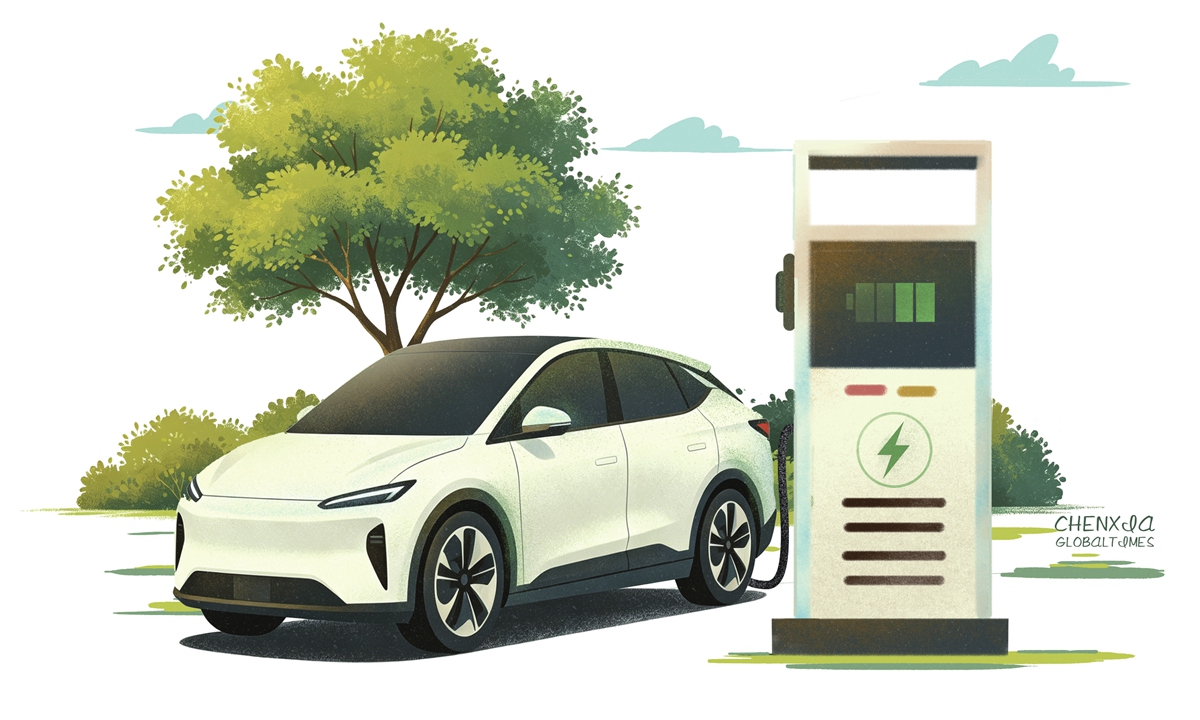
Illustration: Chen Xia/GT
Some international commentaries on China's electric-vehicle (EV) industry tend to focus on exports, pricing and China's manufacturing scale. But another set of numbers tells a different story. The People's Daily reported on Sunday that the number of EV charging facilities in China had reached 21.955 million at the end of April.
Data from the national charging infrastructure monitoring and service platform showed the number surged by 47.4 percent from a year earlier. Beyond the scale of the figures lies a broader logic that has underpinned the industry's rapid development: the view that the market "pie" can be expanded through infrastructure, convenience and wider consumer adoption.
Compared with the number of charging facilities, the more revealing truth lies in the everyday experience of using them. First is charging efficiency.
Earlier this year, at the Yangcheng Lake service area along the Beijing-Shanghai Expressway - a busy drive lane where daily traffic reportedly exceeds 100,000 vehicles - an EV driver pulled into a charging bay, scanned a QR code and plugged in. The screen showed that the battery could be charged to 80 percent in just 28 minutes. Five years ago, the same driver had waited in line there for two hours to get charged, local media outlet Yinlibo reported.
Part of that change reflects the quick expansion of charging and grid capacity. According to Yinlibo, power companies completed a large-scale electricity upgrade project at the service area in 2025 to meet rising charging demand. After the upgrade, the site's total charging capacity reached 5,120 kilowatts - 21 times the level of five years earlier - allowing 84 vehicles to charge simultaneously now.
This is far from an isolated case. They point to broader improvements in charging efficiency that has made large-scale EV adoption increasingly viable in the country.
Beyond charging efficiency, the geographic spread of the charging networks merits attention. In Dongguo village, North China's Shanxi Province, residents can now charge EVs within the village itself.
This example illustrates a broader point about the economics of EV adoption: charging infrastructure is ultimately tied to the capacity and reliability of the power grid supporting EV adoption. The People's Daily reported in January that the electricity load of a single fast charger can equal the simultaneous electricity consumption of 60 households, requiring local power companies to devise tailored supply plans to ensure reliable operation at each charging site.
The network of charging facilities is only the most visible part of a much broader build-out. Beneath it lies the expansion of an industrial ecosystem that stretches from charging networks and power grids to renewable electricity generation itself.
Over the past years, China's EV market has expanded while staying open to competition and foreign participation. In the process, it has illustrated a broader commercial logic: when investment in infrastructure and related systems enlarges the market itself - effectively making the "pie" larger - the benefits can extend well beyond any single group of market players. Even amid intense competition, domestic and foreign manufacturers alike have been able to benefit greatly from that expansion.
The auto vehicle sector remains an important part of global manufacturing, and many economies are seeking to accelerate the development of EVs. Yet one constraint on the industry remains shortfalls in charging infrastructure. Faster expansion of charging networks - alongside broader investment in electricity systems, including clean-energy generation - could effectively ramp up EV market demand.
Against that backdrop, more economies - including many developing ones - are placing greater emphasis on charging infrastructure build-up. This is where the scope for international cooperation becomes increasingly significant.
Chinese companies have developed experience across areas ranging from charging equipment and clean-energy generation to large-scale infrastructure deployment. Cooperation with overseas markets could bolster local EV development while contributing to the expansion of charging and electricity networks across those economies.
Behind EVs lies a broader story about electricity supply. The figure of China's 21.955 million charging facilities tells the development logic centered on enlarging the market size. As that market expands, the benefits may increasingly be shared among manufacturers, suppliers and consumers alike. In that sense, cooperation across the broader electricity value chain may turn out to be a key factor that helps sustain the growth of a larger EV market.
The author is a reporter with the Global Times. bizopinion@globaltimes.com.cn
RELATED ARTICLES