IN-DEPTH / IN-DEPTH
Lao delegates return from China’s border villages with valuable lessons: top-down, scientific and sustained model can benefit wellbeing
Bring rural CEO notebook home
By in Xishuangbanna Published: May 24, 2026 11:08 PM

Editor's Note:
China has consistently made poverty eradication a key priority in national governance. Over the past decades, China has lifted 800 million people out of poverty, achieving the poverty reduction goals of the UN's 2030 Agenda for Sustainable Development a full decade ahead of schedule.
This unwavering commitment, described by Chinese President Xi Jinping as the "endurance, perseverance, and striving spirit that enables water drops to penetrate rocks over time and turns blueprints into reality," has ensured both policy continuity and long-term success, according to the Xinhua News Agency.
Poverty eradication remains a global challenge. China's remarkable achievements in poverty alleviation have drawn extensive international attention. Having lifted a massive population out of poverty within a short period, China's development practices embody profound wisdom and offer valuable experience for other nations. Numerous developing countries are eager to explore the secrets behind China's victory in poverty relief, with many dispatching delegations to learn from China's experience.
In light of this, the Global Times is launching Season Two of the series "constant dropping wears away a stone" to explore how China's poverty alleviation achievements and compelling stories are benefiting populations abroad and providing inspiration to Global South countries. In this opening episode, we look at 11 village officials and representatives from Luang Prabang, Laos, who came to Xishuangbanna, Southwest China's Yunnan Province along China-Laos border to study China's rural poverty reduction and revitalization models in distinctive cultural tourism villages.
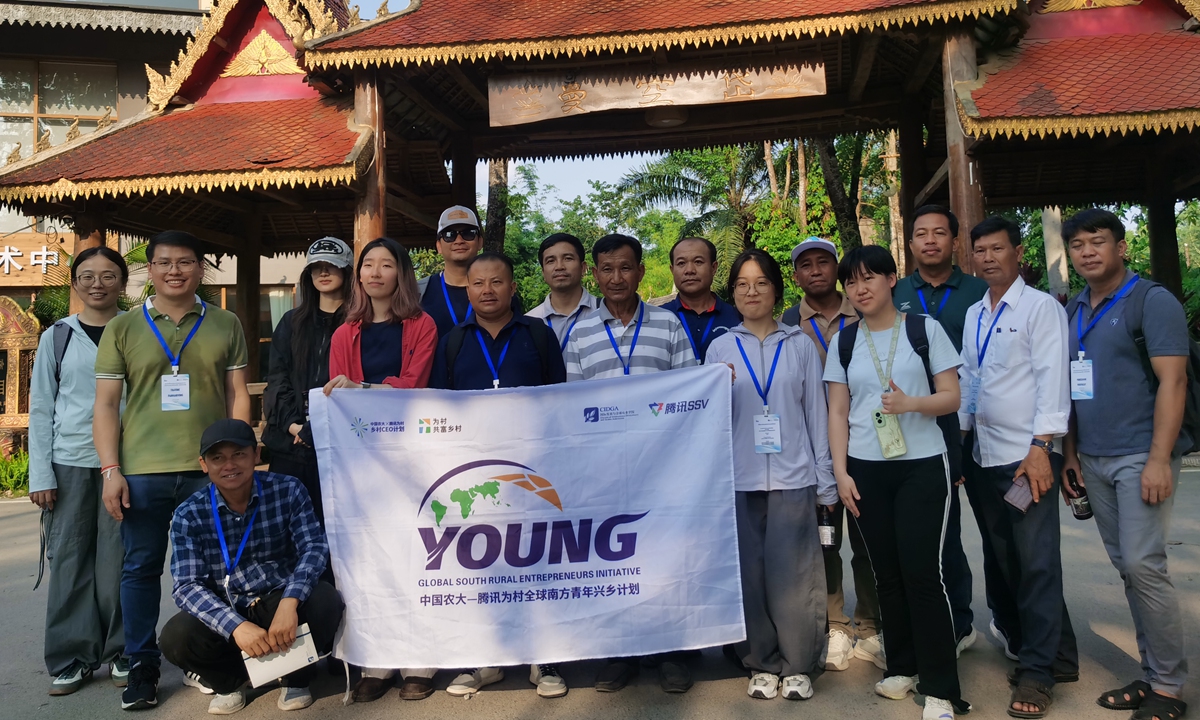
Somphone and his delegation - 11 village officials and representatives from Luang Prabang, Laos - came to Xishuangbanna to study China's rural poverty reduction and revitalization experience. Tingsong village in Luang Prabang is a demonstration site for village-level poverty alleviation and rural revitalization, developed through collaboration between China Agricultural University, the Tencent Foundation and the Luang Prabang provincial government.
The five-day training program in Yunnan offered the Lao participants a valuable, ground-level perspective on China's rural development model, enabling them to identify practical experiences and approaches that could be effectively adapted and replicated in Luang Prabang. The Lao delegates traveled to China aboard the China-Laos Railway, filled with curiosity and keen observation, jotting down in their notebooks the key to rural prosperity in China.
'Path of learning how to prosper'
In just one and a half days, Somphone had filled four pages with detailed notes. One of the most prominent words was "turning waste into treasure." In the Sanman villages (Mankongdai, Manluanzhan, Mankongmai), he saw a re-innovated water tower transformed into a popular cafe, an idle warehouse turned into a leisure teahouse, low-yield rubber forests converted into science education bases and old low-rise houses renovated into comfortable, bright boutique guesthouses.
This "miracle blooming on black soil," as Somphone described it, stems from the "Sanman villages rural tourism complex" idea promoted by Professor Li Xiaoyun from China Agricultural University, a prestigious scholar in China's rural development, and local government's strive for rural revitalization.
In 2023, at the invitation of the Xishuangbanna prefectural government, Li Xiaoyun's team supported building an experimental zone in Sanman villages for rural revitalization, and positioned the villages as a window to showcase China's rural development, ethnic unity, and overall progress to Southeast Asia and the world.
In February 2021, China announced it had secured a "complete victory" in its fight against poverty. In Laos, struggling against poverty remains a challenge. As of 2024/2025, about 15 percent of its people were living below the national poverty line of $1.10 per day, according to data of the United Nations World Food Program. Many Global South countries including Laos have thus turned to China - the developing nation that lifted the largest number of people out of poverty - to learn from its successful experience.
"We were all very excited before coming. Everyone signed up as soon as they heard there was a chance to visit China," said Khankeo Keopanya, development advisor of Tingsong village in Laos. "We started observing China's development speed and efficiency the moment we boarded the China-Laos Railway from Luang Prabang. This railway has truly taken us onto a path of learning how to prosper," he told the Global Times.
Some villagers in Manluanzhan village told the Global Times that the area used to be poor with outdated infrastructure and limited opportunities. Today, the Global Times reporter observed that the high-end guesthouses feature modern, comfortable, well-designed furniture. Villagers said Li Xiaoyun personally selected and designed things down to the plates and bowls. His team lived and worked alongside the villagers, exploring local Dai ethnic culture to find uniqueness, and provided systematic training starting from basic tasks like cleaning courtyards and landscaping. They guided villagers to develop high-end homestay tourism at their doorstep, offering an alternative to pure farming or migrating to cities for work.
The modern yet pastoral-style villages fascinated the Lao visitors. During an exchange with the local rural CEO, questions poured in. "How do you mobilize farmers to join new industries?" "How do you ensure their income?" "Where does the funding come from?"
Li Faxin, rural CEO of the Sanman villages, patiently explained: At first, many villagers were hesitant about converting traditional Dai houses into guesthouses. The team organized study tours, brought in successful enterprises as models and arranged low-interest loans. Village officials became the first to try it. Once the guesthouses generated real income and neighbors saw the profits, participation then surged. In 2025, the average annual income per guesthouse operator from accommodation alone reached 60,000 yuan ($8,830). The goal for 2026 is to maintain this level, rising to 80,000-90,000 yuan by 2028 and 100,000 yuan by 2029, according to Li Faxin.
The villages have also developed a scientific benefit-sharing mechanism. Most guesthouses are operated by the homeowners as managers under unified company oversight. All operating expenses are centrally procured. In addition to guesthouses, the village collective runs restaurants, swimming pools, conference rooms, cafes and traditional Dai medicine centers. A unified QR code mobile payment system ensures immediate revenue distribution to villagers. The majority of income goes directly to the operators, with a small portion retained by the company and returned to the village committee for collective dividends. This creates a win-win for villagers, the collective economy and the enterprise, Li Faxin introduced.
Somphone nodded frequently as he listened. He understood that this interconnected mechanism protects villagers' interests while ensuring space for collective economic growth.
Cultivating rural CEOs
During the visit, the delegation also toured the workshop of Xishuangbanna Daixian Fresh Agricultural Development Co., Ltd., a modern enterprise integrating planting, processing, and sales. Workers deftly operated automated machines that sorted, cleaned, and packaged sticky corn with impressive efficiency.
Somphone's eyes lit up. He quickly pulled out his phone and began taking photos nonstop. "In Laos, we usually steam the corn immediately after harvest and pack it in simple plastic bags," he said. "Whatever doesn't sell is often taken home as pig feed. A lot of value is lost."
The standardized, mechanized processing and refined packaging left a deep impression on him. He carefully noted in his notebook: obtain detailed technical guidance on agricultural processing and packaging from the Chinese side, with the aim of upgrading traditional farming and sales practices back in Luang Prabang. People around him jokingly say he's starting to look more and more like a dedicated rural CEO.
Somphone likes being called a "rural CEO." Village CEO, also referred to as agricultural manager, was included among 13 new professions published jointly by China's Ministry of Human Resources and Social Security, the State Administration for Market Regulation, and the National Bureau of Statistics in 2019.
Village CEOs serve as links between rural resources and the market. They use their skills to drive the rural collective economy to ensure efficient use of resources, thereby making sure rural people benefit from what they have, said Li Xiaoyun. Experts see this as a concrete embodiment of Chinese path to modernization in rural governance and economic development.
Having experienced three business failures in his hometown, Somphone realized rural development is a complex systemic issue. He found that China's approach emphasizes a top-down, scientific and sustained operational system. His dream is to build a small farm near his village, drawing on models like the Sanman villages. The trip gave him greater confidence to become a successful rural CEO.
To share its experience, China Agricultural University launched the "Global South Youth Rural Entrepreneurs Initiative" training program in 2025, inviting young people from developing countries to train in China. A key component involves hands-on experience in agro-tourism integration and modern agriculture at border villages such as Manluanzhan.
"Trainees can see with their own eyes how young people in rural China operate guesthouses, run e-commerce and manage modern agriculture," Li Xiaoyun told the Global Times.
Why China's model fits better
Since 2013, China has supported more than 40 million people worldwide escape poverty through infrastructure, agriculture and small-scale livelihood projects, the Xinhua News Agency reported.
A report released in May by China Agricultural University noted that in recent years, amid profound global geopolitical changes, Western countries' willingness to provide development aid has declined, with funding shrinking continuously. As Global South countries rise as a key force reshaping the international order, breaking reliance on old models and building a new global development cooperation system tailored to the Global South has become increasingly urgent.
Before becoming a rural CEO, Somphone worked with some small Western aid projects in Laos. He believes China's approach is more interactive, as an old Chinese saying, "Give people fish, and you feed them for a day. Teach them how to fish, and you feed them for a lifetime." As fellow developing countries, China and Laos share greater understanding and resonance.
Somchai Khampaseuth, a staff member of the Luang Prabang provincial administrative office, also told the Global Times that the modern transformation of China's rural infrastructure and living standards is impressive, viewing it as key to improving residents' quality of life. Laos hopes to learn from this transformation path. As a fellow developing country, China's experience is invaluable.
"China not only provides material support but also fosters villagers' self-reliance awareness. This philosophy has gained support from the Laotian government. Some Western NGOs often bypass government structures, while China respects local systems and emphasizes coordinated mechanisms, such as rural cooperatives, which Laos finds highly relevant," he said.
In Professor Li Xiaoyun's view, sharing China's rural development experience with Global South countries has a twofold significance: at the micro level, it focuses on the future rural transformation of the Global South, enabling young people to learn China's new rural development practices; at the macro level, it embodies the vision of building a community with a shared future for humanity.
As the training session ended, Somphone carefully packed his "rural CEO notebook" - filled with over 10 pages of closely written insights - into his phone's digital folder. Then, alongside his fellow Lao village officials, he boarded the China-Laos Railway train back to Luang Prabang, ready to plant the seeds of what he had learned in the soil of Tingsong village.
China has consistently made poverty eradication a key priority in national governance. Over the past decades, China has lifted 800 million people out of poverty, achieving the poverty reduction goals of the UN's 2030 Agenda for Sustainable Development a full decade ahead of schedule.
This unwavering commitment, described by Chinese President Xi Jinping as the "endurance, perseverance, and striving spirit that enables water drops to penetrate rocks over time and turns blueprints into reality," has ensured both policy continuity and long-term success, according to the Xinhua News Agency.
Poverty eradication remains a global challenge. China's remarkable achievements in poverty alleviation have drawn extensive international attention. Having lifted a massive population out of poverty within a short period, China's development practices embody profound wisdom and offer valuable experience for other nations. Numerous developing countries are eager to explore the secrets behind China's victory in poverty relief, with many dispatching delegations to learn from China's experience.
In light of this, the Global Times is launching Season Two of the series "constant dropping wears away a stone" to explore how China's poverty alleviation achievements and compelling stories are benefiting populations abroad and providing inspiration to Global South countries. In this opening episode, we look at 11 village officials and representatives from Luang Prabang, Laos, who came to Xishuangbanna, Southwest China's Yunnan Province along China-Laos border to study China's rural poverty reduction and revitalization models in distinctive cultural tourism villages.
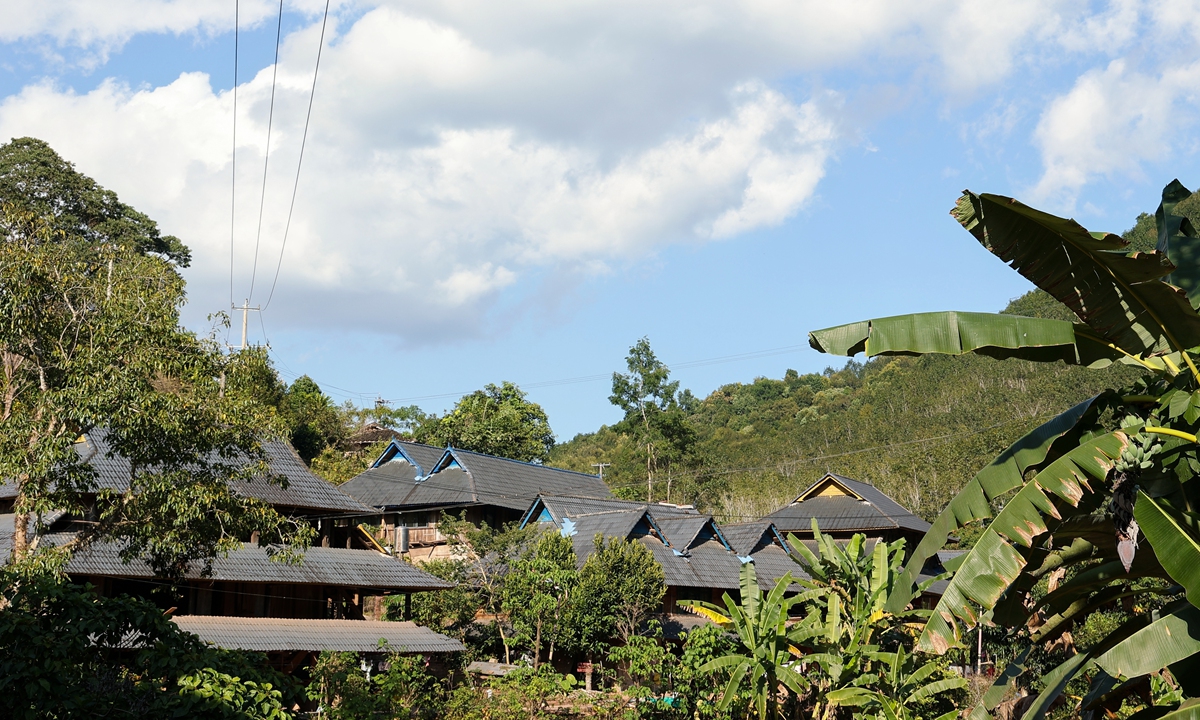
Scenery of Sanman village, which focuses on integrated agro-tourism and modern agriculture Photo: Courtesy of China Agricultural University
Stepping into the Sanman villages in Menghan town, Xishuangbanna, Southwest China's Yunnan Province - right on the China-Laos border - Lao village official Somphone Keomany's eyes sparkled with excitement. He pointed at a beautifully renovated traditional Dai ethnic group's bamboo house that had been transformed into a stylish boutique guesthouse and said enthusiastically, "This is exactly what we can try in our Tingsong village back in Laos!"Somphone and his delegation - 11 village officials and representatives from Luang Prabang, Laos - came to Xishuangbanna to study China's rural poverty reduction and revitalization experience. Tingsong village in Luang Prabang is a demonstration site for village-level poverty alleviation and rural revitalization, developed through collaboration between China Agricultural University, the Tencent Foundation and the Luang Prabang provincial government.
The five-day training program in Yunnan offered the Lao participants a valuable, ground-level perspective on China's rural development model, enabling them to identify practical experiences and approaches that could be effectively adapted and replicated in Luang Prabang. The Lao delegates traveled to China aboard the China-Laos Railway, filled with curiosity and keen observation, jotting down in their notebooks the key to rural prosperity in China.
Lao village officials and government representatives from Luang Prabang, Laos, pose for a group photo at Manluanzhan village, Southwest China's Yunnan Province. Photo: Hu Yuwei/GT
'Path of learning how to prosper'
In just one and a half days, Somphone had filled four pages with detailed notes. One of the most prominent words was "turning waste into treasure." In the Sanman villages (Mankongdai, Manluanzhan, Mankongmai), he saw a re-innovated water tower transformed into a popular cafe, an idle warehouse turned into a leisure teahouse, low-yield rubber forests converted into science education bases and old low-rise houses renovated into comfortable, bright boutique guesthouses.
This "miracle blooming on black soil," as Somphone described it, stems from the "Sanman villages rural tourism complex" idea promoted by Professor Li Xiaoyun from China Agricultural University, a prestigious scholar in China's rural development, and local government's strive for rural revitalization.
In 2023, at the invitation of the Xishuangbanna prefectural government, Li Xiaoyun's team supported building an experimental zone in Sanman villages for rural revitalization, and positioned the villages as a window to showcase China's rural development, ethnic unity, and overall progress to Southeast Asia and the world.
In February 2021, China announced it had secured a "complete victory" in its fight against poverty. In Laos, struggling against poverty remains a challenge. As of 2024/2025, about 15 percent of its people were living below the national poverty line of $1.10 per day, according to data of the United Nations World Food Program. Many Global South countries including Laos have thus turned to China - the developing nation that lifted the largest number of people out of poverty - to learn from its successful experience.
"We were all very excited before coming. Everyone signed up as soon as they heard there was a chance to visit China," said Khankeo Keopanya, development advisor of Tingsong village in Laos. "We started observing China's development speed and efficiency the moment we boarded the China-Laos Railway from Luang Prabang. This railway has truly taken us onto a path of learning how to prosper," he told the Global Times.
Some villagers in Manluanzhan village told the Global Times that the area used to be poor with outdated infrastructure and limited opportunities. Today, the Global Times reporter observed that the high-end guesthouses feature modern, comfortable, well-designed furniture. Villagers said Li Xiaoyun personally selected and designed things down to the plates and bowls. His team lived and worked alongside the villagers, exploring local Dai ethnic culture to find uniqueness, and provided systematic training starting from basic tasks like cleaning courtyards and landscaping. They guided villagers to develop high-end homestay tourism at their doorstep, offering an alternative to pure farming or migrating to cities for work.
The modern yet pastoral-style villages fascinated the Lao visitors. During an exchange with the local rural CEO, questions poured in. "How do you mobilize farmers to join new industries?" "How do you ensure their income?" "Where does the funding come from?"
Li Faxin, rural CEO of the Sanman villages, patiently explained: At first, many villagers were hesitant about converting traditional Dai houses into guesthouses. The team organized study tours, brought in successful enterprises as models and arranged low-interest loans. Village officials became the first to try it. Once the guesthouses generated real income and neighbors saw the profits, participation then surged. In 2025, the average annual income per guesthouse operator from accommodation alone reached 60,000 yuan ($8,830). The goal for 2026 is to maintain this level, rising to 80,000-90,000 yuan by 2028 and 100,000 yuan by 2029, according to Li Faxin.
The villages have also developed a scientific benefit-sharing mechanism. Most guesthouses are operated by the homeowners as managers under unified company oversight. All operating expenses are centrally procured. In addition to guesthouses, the village collective runs restaurants, swimming pools, conference rooms, cafes and traditional Dai medicine centers. A unified QR code mobile payment system ensures immediate revenue distribution to villagers. The majority of income goes directly to the operators, with a small portion retained by the company and returned to the village committee for collective dividends. This creates a win-win for villagers, the collective economy and the enterprise, Li Faxin introduced.
Somphone nodded frequently as he listened. He understood that this interconnected mechanism protects villagers' interests while ensuring space for collective economic growth.
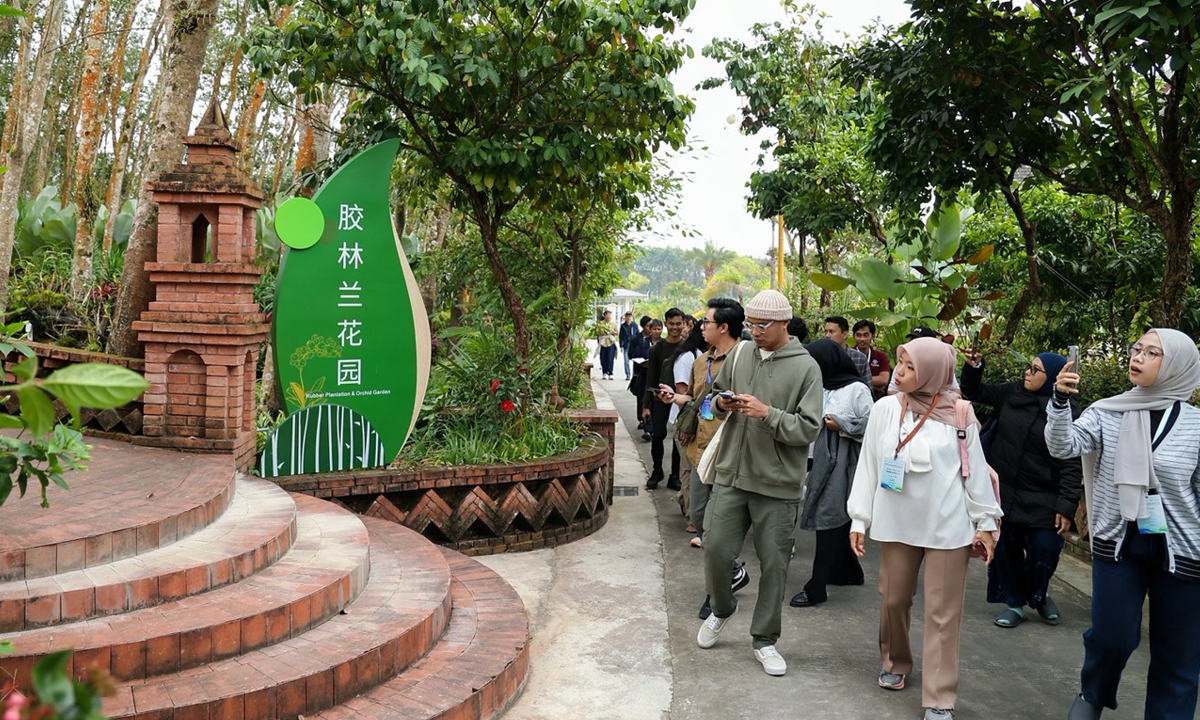
Young delegates visit Manluanzhan village during the Global South Rural Entrepreneurs Initiative in December 2025. Photo: Courtesy of China Agricultural University
Cultivating rural CEOs
During the visit, the delegation also toured the workshop of Xishuangbanna Daixian Fresh Agricultural Development Co., Ltd., a modern enterprise integrating planting, processing, and sales. Workers deftly operated automated machines that sorted, cleaned, and packaged sticky corn with impressive efficiency.
Somphone's eyes lit up. He quickly pulled out his phone and began taking photos nonstop. "In Laos, we usually steam the corn immediately after harvest and pack it in simple plastic bags," he said. "Whatever doesn't sell is often taken home as pig feed. A lot of value is lost."
The standardized, mechanized processing and refined packaging left a deep impression on him. He carefully noted in his notebook: obtain detailed technical guidance on agricultural processing and packaging from the Chinese side, with the aim of upgrading traditional farming and sales practices back in Luang Prabang. People around him jokingly say he's starting to look more and more like a dedicated rural CEO.
Somphone likes being called a "rural CEO." Village CEO, also referred to as agricultural manager, was included among 13 new professions published jointly by China's Ministry of Human Resources and Social Security, the State Administration for Market Regulation, and the National Bureau of Statistics in 2019.
Village CEOs serve as links between rural resources and the market. They use their skills to drive the rural collective economy to ensure efficient use of resources, thereby making sure rural people benefit from what they have, said Li Xiaoyun. Experts see this as a concrete embodiment of Chinese path to modernization in rural governance and economic development.
Having experienced three business failures in his hometown, Somphone realized rural development is a complex systemic issue. He found that China's approach emphasizes a top-down, scientific and sustained operational system. His dream is to build a small farm near his village, drawing on models like the Sanman villages. The trip gave him greater confidence to become a successful rural CEO.
To share its experience, China Agricultural University launched the "Global South Youth Rural Entrepreneurs Initiative" training program in 2025, inviting young people from developing countries to train in China. A key component involves hands-on experience in agro-tourism integration and modern agriculture at border villages such as Manluanzhan.
"Trainees can see with their own eyes how young people in rural China operate guesthouses, run e-commerce and manage modern agriculture," Li Xiaoyun told the Global Times.
Why China's model fits better
Since 2013, China has supported more than 40 million people worldwide escape poverty through infrastructure, agriculture and small-scale livelihood projects, the Xinhua News Agency reported.
A report released in May by China Agricultural University noted that in recent years, amid profound global geopolitical changes, Western countries' willingness to provide development aid has declined, with funding shrinking continuously. As Global South countries rise as a key force reshaping the international order, breaking reliance on old models and building a new global development cooperation system tailored to the Global South has become increasingly urgent.
Before becoming a rural CEO, Somphone worked with some small Western aid projects in Laos. He believes China's approach is more interactive, as an old Chinese saying, "Give people fish, and you feed them for a day. Teach them how to fish, and you feed them for a lifetime." As fellow developing countries, China and Laos share greater understanding and resonance.
Somchai Khampaseuth, a staff member of the Luang Prabang provincial administrative office, also told the Global Times that the modern transformation of China's rural infrastructure and living standards is impressive, viewing it as key to improving residents' quality of life. Laos hopes to learn from this transformation path. As a fellow developing country, China's experience is invaluable.
"China not only provides material support but also fosters villagers' self-reliance awareness. This philosophy has gained support from the Laotian government. Some Western NGOs often bypass government structures, while China respects local systems and emphasizes coordinated mechanisms, such as rural cooperatives, which Laos finds highly relevant," he said.
In Professor Li Xiaoyun's view, sharing China's rural development experience with Global South countries has a twofold significance: at the micro level, it focuses on the future rural transformation of the Global South, enabling young people to learn China's new rural development practices; at the macro level, it embodies the vision of building a community with a shared future for humanity.
As the training session ended, Somphone carefully packed his "rural CEO notebook" - filled with over 10 pages of closely written insights - into his phone's digital folder. Then, alongside his fellow Lao village officials, he boarded the China-Laos Railway train back to Luang Prabang, ready to plant the seeds of what he had learned in the soil of Tingsong village.
RELATED ARTICLES