‘Ironclad friendship’ embodies underlying character of a new type of intl relations: Global Times editorial
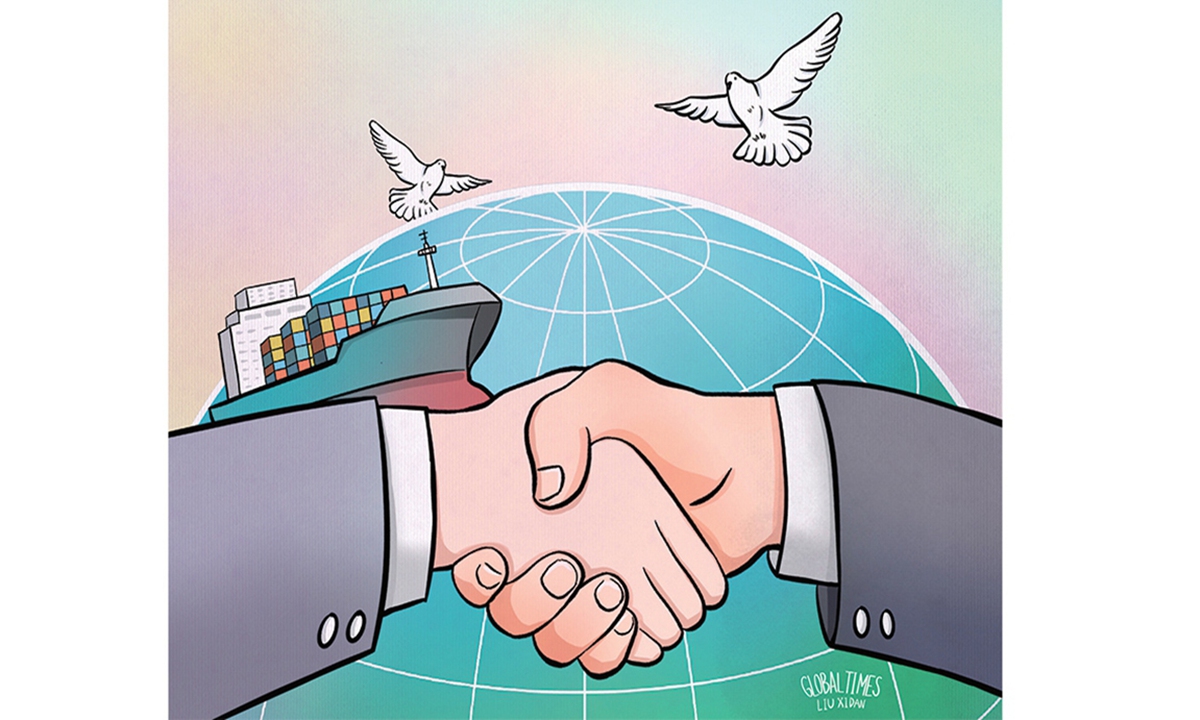
Illustration: Liu Xidan/GT
At the invitation of Chinese President Xi Jinping, President of Serbia Aleksandar Vucic arrived in Beijing on Sunday for a state visit to China. Just one day earlier, Pakistani Prime Minister Shehbaz Sharif arrived in Hangzhou, Zhejiang Province, to begin an official visit to China. As the leaders of the two countries with "ironclad friendship" with China visit the country one after another, what signal does this send to the world against the backdrop of a rapidly changing and turbulent international landscape, and what insights can it provide for observing China-Pakistan and China-Serbia relations?
The friendships between China and Pakistan, and between China and Serbia, have withstood the test of time and the storms of history. Pakistan was one of the first countries to recognize the People's Republic of China. Projects such as the Gwadar Port and the Karakoram Highway, built with China's support, have become shining symbols of the China-Pakistan Economic Corridor.
During President Xi's state visit to Pakistan in 2015, the two countries elevated their relationship to an all-weather strategic partnership of cooperation. This year marks the 75th anniversary of the establishment of diplomatic relations between China and Pakistan. Shehbaz's visit is an opportunity to carry forward traditional friendship and deepen all-round cooperation.
When the situation in the Middle East remains tense, China and Pakistan are working together to contribute to safeguarding regional peace and upholding international justice. This represents the latest example of their high-level international coordination and further enriches the concept of building a community with a shared future with neighboring countries.
Serbia is the first European country to agree with China on building a community with a shared future for the new era. This friendship, forged in the blood of their peoples, has become a shared memory of both peoples.
Despite the great distance between them, high-level interactions between the two countries are frequent. During President Xi's visit to Serbia in May 2024, China-Serbia relations achieved a new historic leap.
President Vucic is a familiar old friend to the Chinese people. Serbia is one of the few European countries to enjoy not only a free trade agreement, but also mutual visa-free travel, and direct flights with China. It is also a key hub for advancing connectivity and cooperation in the Western Balkans and across Central and Eastern Europe. President Vucic's first state visit to China will strongly promote bilateral cooperation and China's cooperation with Central and Eastern European countries.
Whether in Pakistan or Serbia, local people hold particularly warm feelings toward China. The Chinese people affectionately call them Pakistan "Iron Brother" and Serbia "Iron Brother," and have never forgotten the sincere support from these "old iron" friends.
During the 2008 Wenchuan earthquake, Pakistan sent all its military transport aircraft, even removing seats to make space, and rushed its entire strategic reserve of tents to the disaster zone. On issues concerning China's core interests, President Vucic has always taken a clear and righteous stand, repeatedly emphasizing that "Serbia supports the one-China principle with its full political strength." The friendships between China and Pakistan, and China and Serbia, are vivid examples of equality and mutual assistance in international relations.
For the moment, some Western observers, still trapped in Cold War thinking, try to distort China-Pakistan and China-Serbia friendships as "alliances" or "targeting third parties." In their logic, relations between big and small countries can only involve hegemonic interference or dependent attachment. The emergence of Pakistan "Iron Brother" and Serbia "Iron Brother" completely shatters this outdated mindset, offering the world a new paradigm of equal treatment and mutually beneficial cooperation between countries of different sizes.
A Chinese adage goes, "Interests wane and power withers; Relations endure for those who stay heart-to-heart." China has always upheld the right approach to justice and interests, treating Pakistan and Serbia as equals and pursuing common development. China consistently adheres to the principle that all countries, big or small, are equal, rejects drawing lines based on strength, and does not engage in "taking sides." China respects every country's choice of development path suited to its own national conditions, without attaching any political conditions. Serbia's former minister of defence and internal affairs Aleksandar Vulin once commented, "China knows how to talk and listen. China is a partner, not a commander. China does not dictate, China advises."
The "ironclad friendship" between China and Pakistan and between China and Serbia demonstrates the underlying character and value of a new type of international relations. It proves that countries with different civilizations, systems, and sizes can fully achieve peaceful coexistence and mutually beneficial cooperation. On multilateral cooperation level, China and Pakistan, as well as China and Serbia, hold highly aligned positions and deep resonance in their views on the international order. They are all committed to promoting global governance in a more just direction. At a time when unilateralism and power politics are increasingly dividing and destabilizing the world, the ironclad friendships that China has forged with Pakistan and Serbia over decades provide a practical reference for building an equal and orderly multipolar world.
RELATED ARTICLES