Editor's Note:
China has entered its 15th Five-Year Plan period (2026-30). What underpins the confidence in China's economic outlook and what breakthroughs are expected in the yuan's internationalization? Marc Uzan (Uzan), executive director and founder of the Reinventing Bretton Woods Committee, told the Global Times (GT) that he expects China to continue to be a major driving engine of the world economy, while he anticipates breakthroughs in three aspects of the yuan's internationalization.
Uzan: There is no doubt that China will continue to be a major driving engine of the world economy during the 15th Five-Year Plan period (2026-30). I've been coming to China very often and I'm an admirer about the capacity of China, not only to get out of poverty, but to be able to be so innovative.
I can see that advanced technologies are entering everyday life. For example, electric cars are everywhere. So, I think there is strong momentum for China to be able to be at the center of the industrial revolution. AI is transformative and would have a huge impact on productivity. There is a lot of long-term growth potential in China. AI can also be a game changer, not only for China, but for the rest of the world. So China's weight in the global economy will be higher.
China faces real structural headwinds: The property sector adjustment is still working through the economy, domestic demand has been more subdued than policymakers would like, and the demographic trajectory remains challenging over the medium term. I don't think intellectual honesty about those challenges contradicts with a broadly constructive outlook.
My confidence rests on several things. First, China has demonstrated over four decades an unusual capacity to mobilize investment into productive sectors at scale and speed. What we are now seeing in solar energy, electric vehicles, batteries and advanced manufacturing is not accidental - it reflects sustained industrial policy with a long-term horizon. Second, China's domestic savings rate provides a substantial buffer and a pool of investable capital that most economies would envy. Third, the Belt and Road framework has deepened China's economic integration with a large part of the developing world in ways that will sustain trade and financial flows.

GT: What do you see as the areas where key breakthroughs are expected for the yuan in the next one or two years?
Uzan: Amid rising geopolitical uncertainties, for example, the Middle East war, international payments using the yuan have been rising recently. The yuan's global rise supports a shift toward multipolarity, presenting China with a strategic opportunity to help shape the next era of global governance. I closely watch breakthroughs in multiple areas.
First, commodity pricing and settlement. If the yuan consolidates its position in oil, LNG and metals settlement beyond current levels, that has real structural significance because commodity-exporting nations accumulate yuan that they then need to deploy, which deepens the ecosystem.
Second, digital currency cross-border infrastructure. The multi-Central Bank Digital Currency Bridge (mBridge) - a platform jointly developed by the People's Bank of China, the Hong Kong Monetary Authority, and other central banks to facilitate faster cross-border settlements using their respective currencies - and related central bank digital currency corridors represent a potential architectural bypass of the dollar-based correspondent banking system, and the next 12 to 24 months will be critical in determining whether this scales from pilot to operational.
Third, the expansion of yuan bond markets to non-Chinese issuers. If multilateral development banks and sovereign borrowers increasingly issue bonds in yuan, it begins to create the asset base that reserve managers need.
These three together, if they progress, could produce a meaningful step change in internationalization rather than the gradual incremental progress of recent years.
GT: What role should China's Cross-Border Interbank Payment System (CIPS) play in building a safer and more diversified global cross-border payment architecture?
Uzan: CIPS should be understood as a necessary component of a more resilient global payment architecture. Its primary function to date has been to provide a yuan-denominated clearing and settlement alternative, and in that role, it has genuine value - for reducing transaction costs in yuan trade settlement, for providing an alternative when SWIFT access is constrained, and for building the institutional infrastructure required for yuan internationalization.
Its more ambitious role - as a genuine pillar of a diversified global payment system - requires CIPS to develop in several directions, including broader connectivity beyond Chinese-linked financial institutions and interoperability with other regional payment systems and emerging central bank digital currency infrastructure. If CIPS can evolve toward a genuinely multilateral governance model, it could play a structurally significant role in a multipolar financial architecture.
China has entered its 15th Five-Year Plan period (2026-30). What underpins the confidence in China's economic outlook and what breakthroughs are expected in the yuan's internationalization? Marc Uzan (Uzan), executive director and founder of the Reinventing Bretton Woods Committee, told the Global Times (GT) that he expects China to continue to be a major driving engine of the world economy, while he anticipates breakthroughs in three aspects of the yuan's internationalization.
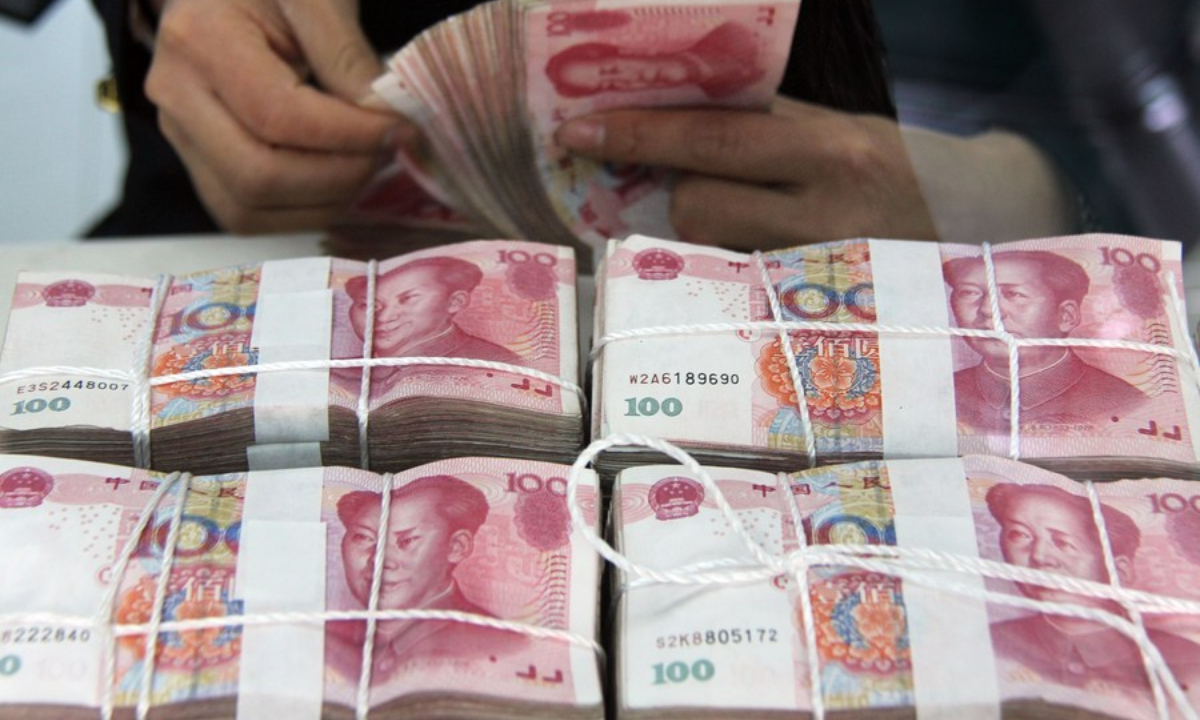
File photo shows a worker counts Chinese currency Renminbi banknotes at a bank in Tancheng County of Linyi City, East China's Shandong Province. Photo: Xinhua
GT: What is your outlook on China's economic development, and where does your confidence come from?Uzan: There is no doubt that China will continue to be a major driving engine of the world economy during the 15th Five-Year Plan period (2026-30). I've been coming to China very often and I'm an admirer about the capacity of China, not only to get out of poverty, but to be able to be so innovative.
I can see that advanced technologies are entering everyday life. For example, electric cars are everywhere. So, I think there is strong momentum for China to be able to be at the center of the industrial revolution. AI is transformative and would have a huge impact on productivity. There is a lot of long-term growth potential in China. AI can also be a game changer, not only for China, but for the rest of the world. So China's weight in the global economy will be higher.
China faces real structural headwinds: The property sector adjustment is still working through the economy, domestic demand has been more subdued than policymakers would like, and the demographic trajectory remains challenging over the medium term. I don't think intellectual honesty about those challenges contradicts with a broadly constructive outlook.
My confidence rests on several things. First, China has demonstrated over four decades an unusual capacity to mobilize investment into productive sectors at scale and speed. What we are now seeing in solar energy, electric vehicles, batteries and advanced manufacturing is not accidental - it reflects sustained industrial policy with a long-term horizon. Second, China's domestic savings rate provides a substantial buffer and a pool of investable capital that most economies would envy. Third, the Belt and Road framework has deepened China's economic integration with a large part of the developing world in ways that will sustain trade and financial flows.
Marc Uzan Photo: Courtesy of Tsinghua PBCSF Forum
GT: What do you see as the areas where key breakthroughs are expected for the yuan in the next one or two years?
Uzan: Amid rising geopolitical uncertainties, for example, the Middle East war, international payments using the yuan have been rising recently. The yuan's global rise supports a shift toward multipolarity, presenting China with a strategic opportunity to help shape the next era of global governance. I closely watch breakthroughs in multiple areas.
First, commodity pricing and settlement. If the yuan consolidates its position in oil, LNG and metals settlement beyond current levels, that has real structural significance because commodity-exporting nations accumulate yuan that they then need to deploy, which deepens the ecosystem.
Second, digital currency cross-border infrastructure. The multi-Central Bank Digital Currency Bridge (mBridge) - a platform jointly developed by the People's Bank of China, the Hong Kong Monetary Authority, and other central banks to facilitate faster cross-border settlements using their respective currencies - and related central bank digital currency corridors represent a potential architectural bypass of the dollar-based correspondent banking system, and the next 12 to 24 months will be critical in determining whether this scales from pilot to operational.
Third, the expansion of yuan bond markets to non-Chinese issuers. If multilateral development banks and sovereign borrowers increasingly issue bonds in yuan, it begins to create the asset base that reserve managers need.
These three together, if they progress, could produce a meaningful step change in internationalization rather than the gradual incremental progress of recent years.
GT: What role should China's Cross-Border Interbank Payment System (CIPS) play in building a safer and more diversified global cross-border payment architecture?
Uzan: CIPS should be understood as a necessary component of a more resilient global payment architecture. Its primary function to date has been to provide a yuan-denominated clearing and settlement alternative, and in that role, it has genuine value - for reducing transaction costs in yuan trade settlement, for providing an alternative when SWIFT access is constrained, and for building the institutional infrastructure required for yuan internationalization.
Its more ambitious role - as a genuine pillar of a diversified global payment system - requires CIPS to develop in several directions, including broader connectivity beyond Chinese-linked financial institutions and interoperability with other regional payment systems and emerging central bank digital currency infrastructure. If CIPS can evolve toward a genuinely multilateral governance model, it could play a structurally significant role in a multipolar financial architecture.
RELATED ARTICLES