IN-DEPTH / IN-DEPTH
A return to campus in Xizang, and a look at how education gives children on snowy plateau more choices in future
By in Lhasa Published: May 25, 2026 11:08 PM


Students sing together in their dormitory at Lhasa High School on May 22, 2026, in Lhasa, Southwest China's Xizang Autonomous Region. Photo: Shan Jie/GT
From the classrooms of Lhasa High School, the view of the Potala Palace is a sight to behold. For travelers, such a view might be worth buying an expensive cup of coffee for a photo. For students here, it is simply the everyday backdrop of their studies.
In the school's exhibition hall, student guides introduce visitors to its development, which began in 1956, with old campus photos, awards and records of student life on display. This year, Lhasa High School celebrates its 70th anniversary.
For me, the visit recalled years of reporting from schools across Xizang - from the historically significant Qamdo Experimental Primary School to a kindergarten in the border county of Cona, from Baingoin Primary School, often described as one of the schools closest to the sky, to Medog Complete Primary School deep in the Yarlung Zangbo Grand Canyon. These visits have shown me that in Xizang, education is not just about building classrooms, but about making them reachable.
Lhasa High School enrolls students from across the region. Some of whom live nearby, while others travel from remote counties and villages, sometimes taking two or three days to reach Lhasa. Therefore, for many families in Xizang, boarding school is not simply about "leaving home." It is about making safe, continuous and stable schooling possible.
From remote regions to class
After visiting the school history exhibition, I stopped one of the student guides, Zongcuo, a second-year high school student from a village in Biru county, Nagqu. She said that to get from home to school, she usually has to first travel from the county to Nagqu city, and then from Nagqu to Lhasa, either by coach or by train. If her parents drive her, the trip takes about eight hours.
Zongcuo said competition to get into Lhasa High School is fierce, and that it is a "dream school" for many students. Here, she studies literature, mathematics, English, history, politics and geography, while also taking part in clubs and extracurricular activities.
When I guessed that she might mention basketball, painting or photography, she instead brought up creative cultural design, microfilm production and positive psychology courses. In her first year of high school, she helped complete a short microfilm, serving as both director and actor. In the positive psychology course, she began paying more attention to her own mental health and that of her classmates.
In the future, Zongcuo said she plans to go to university, and is also considering literature or law. She hopes to bring what she learns back home one day.
This idea of "bringing it back" is not unique to Zongcuo. Teachers at Lhasa High School told me that many students today no longer limit their horizons to their local areas, but look across the country while also planning their futures in line with Xizang's development needs. Some choose education; others choose electricity, water conservancy, law, judicial work or public security.
On the playground, we interrupted several girls who were in a basketball class and asked whether we could visit their dormitory. They readily agreed.
The girls, all from pastoral families in Nagqu, Xigaze and Qamdo, had different plans for the future - to be lawyers, teachers or police officers. Two of them hoped to follow their elder sisters' paths to universities in Wuhan, Central China's Hubei Province, and Shanghai.
According to school teachers, students from remote farming and pastoral areas do not have to worry much about the basic cost of living and studying on campus. The Xinhua News Agency reported that Xizang's "three guarantees" policy covers food, accommodation and study expenses for preschool to senior high school students from farming and pastoral households and urban families with financial difficulties. In 2024, the annual subsidy standard was 5,620 yuan ($827) per student.
Some Western media outlets have produced many misunderstandings and even stigmatizing narratives about boarding education in Xizang. In 2023, I conducted an in-depth investigation into boarding schools, and saw that in many places where the land is vast, the population is sparse and commuting is difficult, boarding schools are a realistic and voluntary choice for many families.
Michael Crook, a foreign educator who has long followed education in China, told the Global Times boarding systems must be viewed in context. The key is whether they fit local realities and whether they truly enable children to access education.
For students from remote areas, stable boarding conditions, continuous teaching arrangements and relatively concentrated teaching resources make it possible for them to speak with ease about universities, majors, interests and the future.
Make their choices
If boarding schools answer the question of how children from remote areas can have access to education, Tibetan-language learning answers another equally important question: After children enter modern schools, do they still remain connected to their own language and culture?
At Lhasa High School, I interviewed a Tibetan-language teacher named Danzeng. That day, his class was about Tibetan verbs - the analysis of verbs in the language. He said the school's Tibetan-language textbooks include history, prose and fiction. In class, students learn not only words and grammar, but also Tibetan history and culture.
For most of the children, Tibetan is their mother tongue and they begin systematic Tibetan-language study in the first grade of primary school. By high school, they are already able to read and write with considerable proficiency, Danzeng said.
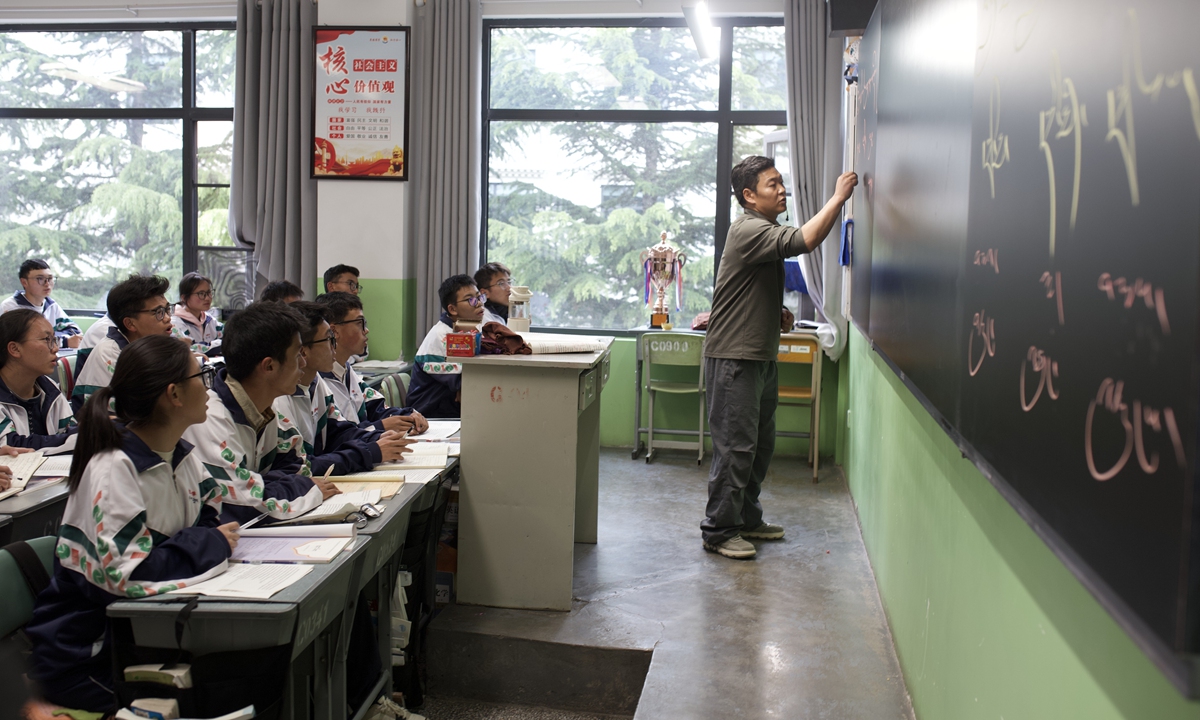
Danzeng, a Tibetan-language teacher at Lhasa High School, teaches a class on May 22, 2026. Photo: Shan Jie/GT
According to the teacher, Tibetan language is currently an elective subject in the college entrance examination in Xizang - and it should not be forgotten that children of different ethnic groups also live and study here. This means that if students want to apply for majors related to Tibetan language and literature, Tibetan medicine, or other related fields, they must provide Tibetan-language exam results.
A director at the Lhasa High School said that, taking the second-year high school grade as an example, 12 out of 17 classes offer Tibetan-language courses, accounting for about 70 percent. Some students choose the subject for exams, while others do so for personal cultivation.
This was consistent with what I had seen earlier in kindergartens, primary schools and middle schools across Xizang. In 2023, I saw children in a Lhasa kindergarten wearing traditional Tibetan clothes, telling picture-book stories in Tibetan and playing Tibetan-style table games. At Qamdo Experimental Primary School, I saw traditional aesthetic education courses such as Xianzi dance, Tibetan calligraphy and Tibetan musical instruments.
Crook also told the Global Times that during his many visits to schools in Tibetan areas, he noticed that local students learn both Putonghua and Tibetan language, while also studying English. In his view, these children possess multiple language resources.
He also said Tibetan courses include both modern Tibetan and classical literature. "What I fear most is a field of knowledge or a language becoming a 'living fossil.' It doesn't work if you only learn the old, but it also doesn't work if you don't learn the old," he said.
Another foreign scholar, Francis Stonier, who was visiting Xizang for the first time, also paid special attention to the presence of the Tibetan language. He said Tibetan is not only a spoken language, but is also written on signs and taught in schools. Local culture, he said, is not merely preserved as a performance for tourism, but remains part of many people's daily lives.
After repeatedly visiting schools in Xizang over the years, I increasingly feel that changes in education here are reflected in individual children.
Education gives them the ability to choose. Boarding schools have not cut them off from their hometowns, and multilingual education has not caused them to lose their culture. On the contrary, it allows them to see themselves in a larger world, and change their lives and contribute to the development of their hometowns.
RELATED ARTICLES