Transits through Taiwan Straits by Australian, Canadian and other extra-regional navies rose sharply in 2025: Chinese think tank
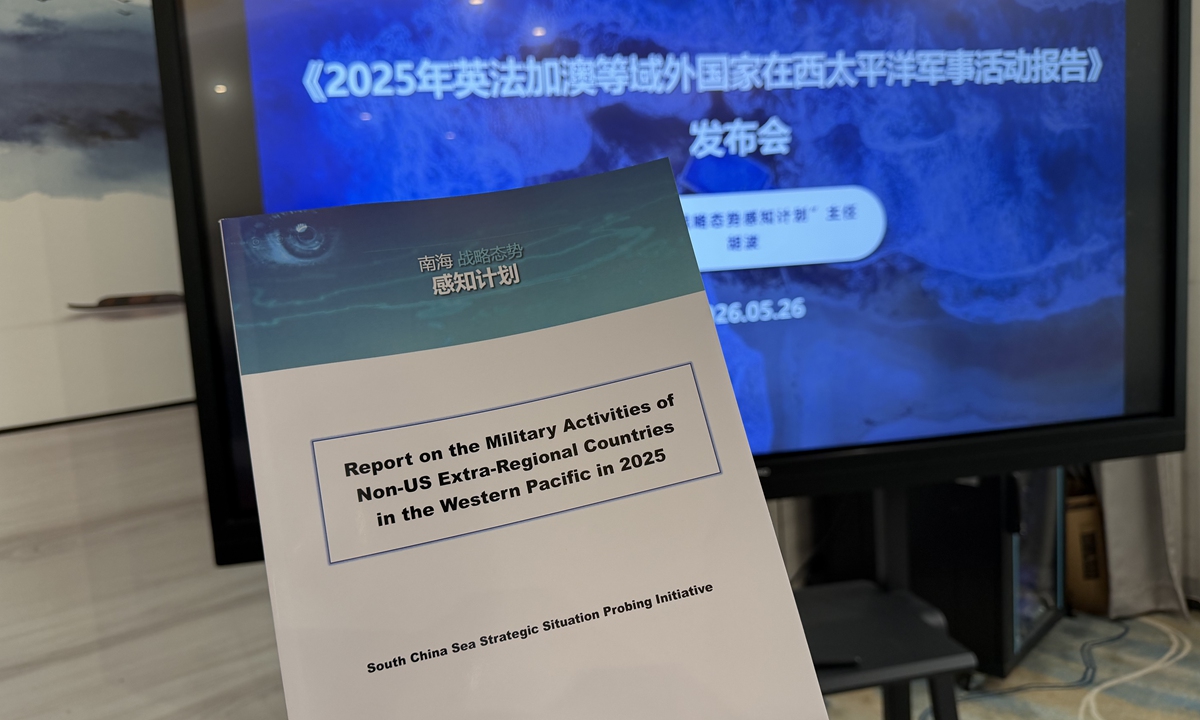
The think tank South China Sea Strategic Situation Probing Initiative releases a report titled "Report on the Military Activities of Non-US Extra-Regional Countries in the Western Pacific in 2025" on May 26, 2026. Photo: Feng Fan/GT
A latest report released by think tank South China Sea Strategic Situation Probing Initiative on a press conference on Tuesday showed that since 2024, the number of transits through the Taiwan Straits conducted by non-regional countries has increased significantly.
The initiative released a report titled "Report on the Military Activities of Non-US Extra-Regional Countries in the Western Pacific in 2025."
According to the report, amid continued tensions in the Taiwan Straits in 2025, the navies of extra-regional countries such as Australia, Canada and the UK intensified their activities in the West Pacific. Under the banner of safeguarding freedom of navigation in international waters under the United Nations Convention on the Law of the Sea, these countries demonstrated their military presence by transiting the Taiwan Straits or conducting so-called "freedom of navigation" operations in the South China Sea.
According to the report, in 2025, excluding the US, six warships from four countries - Australia, Canada, the UK and New Zealand - transited the Taiwan Straits five times, as announced by their respective governments. In previous years, such transits were largely dominated by the US, with limited participation from other extra-regional countries. Since 2024, however, the number of transits by non-regional countries has risen markedly, while participation has expanded from mainly the US and Canada to include more European and Oceanian countries. The report noted that such operations by extra-regional countries excluding the US are gradually becoming normalized, with the frequency of transits also stabilizing.
The report also said that in 2025, the UK and Australia carried out two so-called "freedom of navigation" operations in the Nansha Islands. Among them, Australia was described as the most aggressive, with incidents occurring every year involving Australian military aircraft intruding into the airspace over China's Xisha Islands.
On February 13, 2025, a spokesperson for China's Foreign Ministry made an announcement regarding "Australian military aircraft's deliberate intrusion into the airspace over China's Xisha Islands." On the same day, Australia's Department of Defence released a statement, not only avoiding mention of its intrusion in China's Xisha Islands, but also accusing a Chinese J-16 fighter jet of "intercepting" an Australian P-8A anti-submarine patrol aircraft over the South China Sea.
On October 19, an Australian P-8A anti-submarine patrol aircraft again illegally entered the airspace over China's Xisha Islands. The same day, the Australian aircraft returned overnight to Australia, flying via Darwin to its home base at Edinburgh Air Base. Australia claimed that its P-8A encountered warning flares released by Chinese fighter jets in the South China Sea.
At the press conference on Tuesday, Hu Bo, director of the South China Sea Strategic Situation Probing Initiative, said that one reason these extra-regional countries have increased military activities in the West Pacific is to capitalize on hotspots and raise their international profile, adding that "any country that considers itself a major power wants to come and put on a show."
The report also stressed that regardless of how these countries package their narratives surrounding military activities in the West Pacific, China is undoubtedly the primary target of their operations in the region. It noted that while China and these countries do have disagreements over certain maritime rules, such disputes should be resolved through dialogue and consultation rather than military means.
More regrettably, the report argued, these differences have been politicized and even demonized. It said the policies of these countries are based on exaggerated speculation inconsistent with reality, including claims that "China seeks to control the South China Sea" or "China threatens maritime shipping lanes." Because of groundless or even imagined risks, these countries have dispatched military forces from thousands of miles away to the West Pacific, increasing the possibility of military friction with China, a situation which is "highly unreasonable."
RELATED ARTICLES