ARTS / CULTURE & LEISURE
Ancient Chinese temple with Liao Dynasty wooden structures
By Published: May 26, 2026 08:20 PM

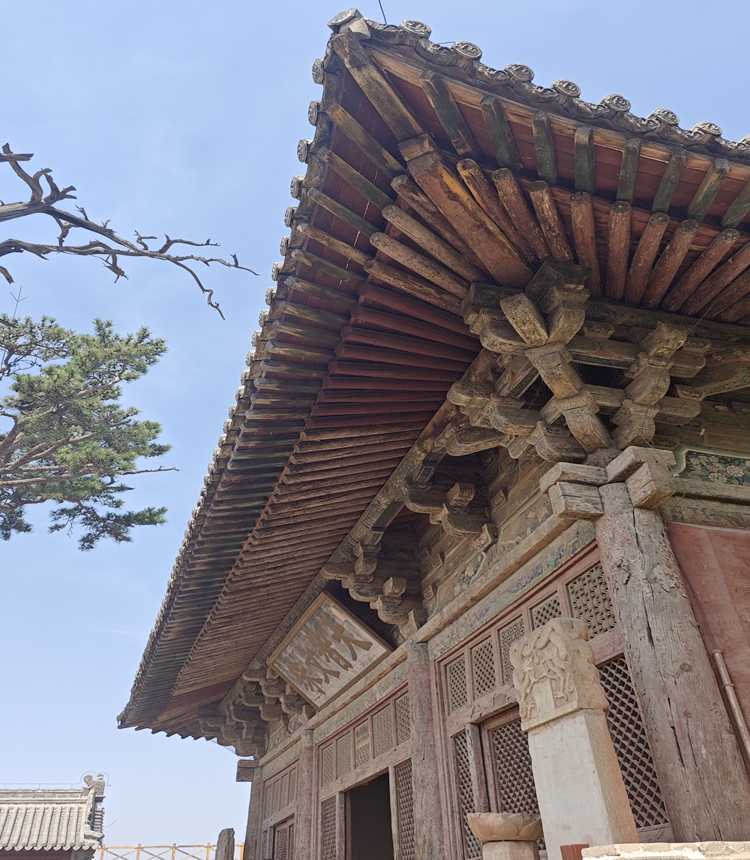
Side view of the Manjusri Hall at the Geyuan Temple Photo: Courtesy of the Communications Department of Laiyuan County
Geyuan Temple in North China's Hebei Province, reopened to the public this May, houses the wooden architecture that dates back to the Liao Dynasty (916-1125).
An Zhimin, former director of the cultural relics management office in Laiyuan county, Hebei, is now acted as a volunteer guide at the Geyuan Temple.
When groups of visitors were led into the temple, the heavy atmosphere of history could be felt all around, An said.
The Geyuan Temple is arranged from south to north with the Hall of Heavenly Kings, the Manjusri Hall, and the Sutra Repository, among which the Hall of Heavenly Kings and the Sutra Repository date back to the Ming Dynasty (1368-1644). The Manjusri Hall, in the center, is especially time-honored and dignified.
During his tours, An often lingered at the Manjusri Hall, as many parts of the hall, from doors and windows to murals, preserve many features of its Liao Dynasty wooden style, making it worthy of deep appreciation.
An told the Global Times that Geyuan Temple has resumed normal public operations after more than one decade of closed-door restoration work. Sticking to the principle of "restoring the old as the old," experts numerically labeled and checked every architectural component of the Manjusri Hall.
Ding Yao, a professor at the School of Architecture of Tianjin University, who has long studied Chinese Liao Dynasty architecture including the Manjusri Hall, told the Global Times that the most valuable aspect of the protection work is the overall caution from both management authorities and professionals.
Simply put, "very little was repaired or altered." As a result, not only the wooden framework but also the original earth, clay, and tiles remain in their original condition.
"Such careful and complete protection demonstrates the Chinese tradition of 'earth-and-wood' construction. This represents a higher state of cultural awareness, treating relics with utmost care and showing deep respect for cultural heritage," Ding said.
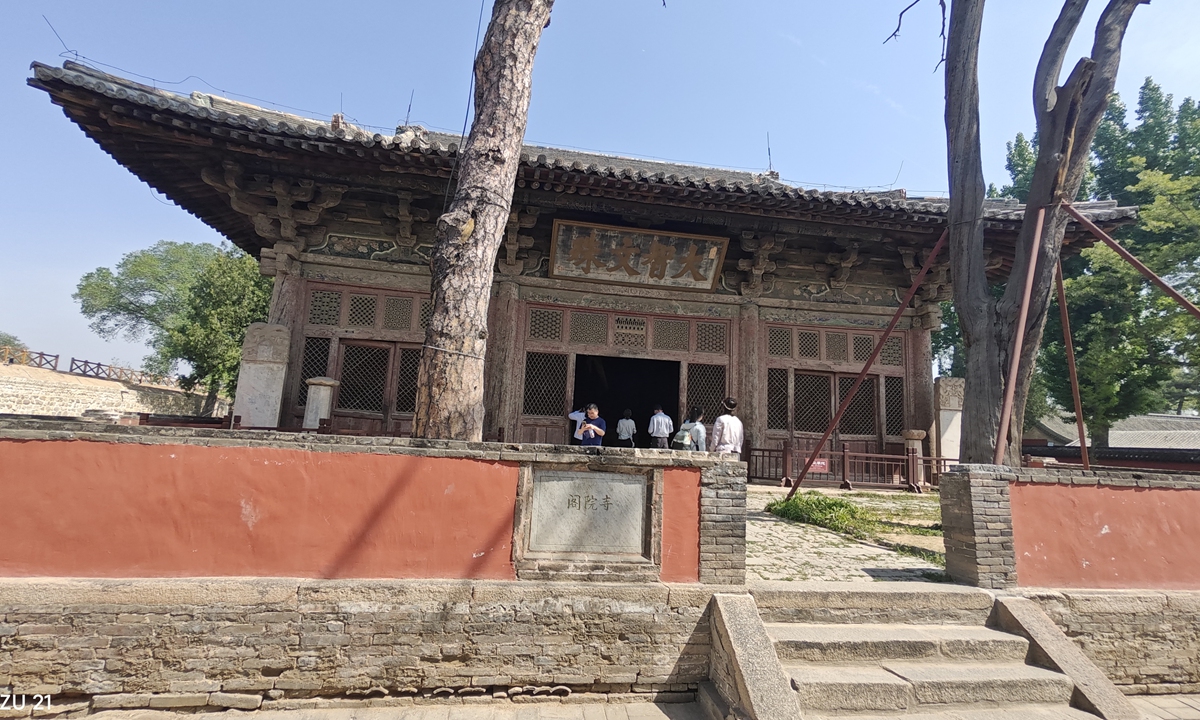
Tourists visit the Geyuan Temple in Laiyuan county on May 13, 2026. Photo: Courtesy of the Communications Department of Laiyuan County
Treasures among ancient structuresThe Manjusri Hall, a Liao Dynasty relic, is one of the most researched and valued buildings in the Geyuan Temple.
Ding explained that the hall's greatest value does not lie in its size or its age, but rather in its exceptionally intact preservation as a great work of Chinese Buddhist art. As a Buddhist hall, especially with its original, richly designed ancient doors and windows on the front, it stands as a rare surviving example.
In ancient Chinese wooden buildings, doors and windows are typically the most difficult parts to preserve. Yet, the Manjusri Hall has retained substantial portions of its ancient doors and windows, especially on the front, in elevated, less accessible sections, where much of the early woodwork still survives.
Ding stressed that the value of these front doors and windows is particularly significant. They are not just simple wooden boards, but carefully crafted and assembled with distinct patterns and symbolic meanings. The use of wooden components to create such intricate and meaningful designs, rich in religious symbolism, is extremely rare among the surviving relics around China.
Moreover, the patterns on the doors and windows could not be understood as mere decoration. They have deep roots in Buddhist art and culture.
Motifs like the vajra scepter and blue lotus affixed to the temple in architectural language serve to make Buddhist imagery a permanent part of the temple. This visual language is not only intentional but enduring, a constant form of religious expression seldom seen elsewhere in East Asian Buddhist art.
Ding concluded that the Manjusri Hall is not only vital for the architectural studies of Liao Dynasty temples, but is also a pivotal case in the history of Buddhist and East Asian architecture.
In addition, the structural design of the Manjusri Hall also attracts enthusiasts of ancient Chinese architecture. An Zhimin explained that the hall uses the typical "column reduction" style of Liao Dynasty design. Originally, it had only two interior columns, which greatly improved the open space inside; the other two columns were added later for structural protection. Over more than one thousand years, the hall has been preserving its original Liao Dynasty features.
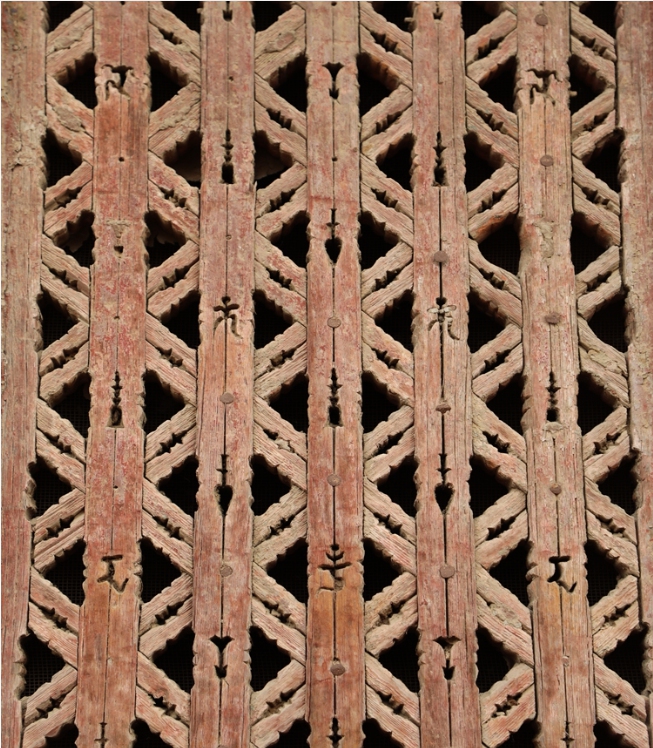
A part of a door is seen to be decorated with motifs on the Manjusri Hall. It dates back to the Liao Dynasty (916-1125). Photo: VCG
The Geyuan Temple's ancient structures have survived for centuries thanks to both geography and historical factors. Laiyuan county is located in a mountain basin in the Taihang Mountains, a region where Central Plains and northern ethnic cultures have long met and mixed. The region's high altitude and dry climate, as well as its distance from large-scale warfare or destruction, helped preserve the buildings. As long as deliberate destruction is avoided, the architecture has survived remarkably well.
From what remains today, of the 12 ancient doors on the facade of the Manjusri Hall, one on the low level survives, and 14 out of 15 high-position doors remain. Although partially damaged, the main wooden structure and core components are original Liao Dynasty material, an exceptionally rare survival, according to Ding.
Ding noted that buildings like the Manjusri Hall, though larger in size, should be treated like museum relics. They should not be "repaired like an ordinary house," nor should there be an urge to "make old things look new." Every period of repair has left its mark, and these marks are themselves part of history.
For example, the massive murals on the east, west, and north walls of the Manjusri Hall are mostly covered with yellow clay, with only a large exposed area on the north wall's east side remaining, where visitors can see the vivid mural outlines.
An Zhimin explained that, for now, the murals will remain covered by clay, since removing it with current technology risks exposing the artwork to wind erosion.
The temple received over 5,000 visitors during the May Day holidays, according to the Xinhua News Agency.
With reopening and more tourists, relic protection faces new challenges. Ding said that more visitor services are necessary after reopening, but these services should be minimized and kept in the background, so as not to interfere with visitors' experience of the heritage and its historical setting.
He further noted that, as a famous Liao Dynasty site which opened to the public relatively late, the Geyuan Temple has the advantage of learning from others' management.
The site is also part of Laiyuan's old town, so its future development should not be limited to "visiting a main hall" or "admiring doors and windows," but can be fully placed in the context of the ancient city's space and historical environment.
RELATED ARTICLES