BUSINESS / PRESS RELEASE
How Ningbo is building a smarter city
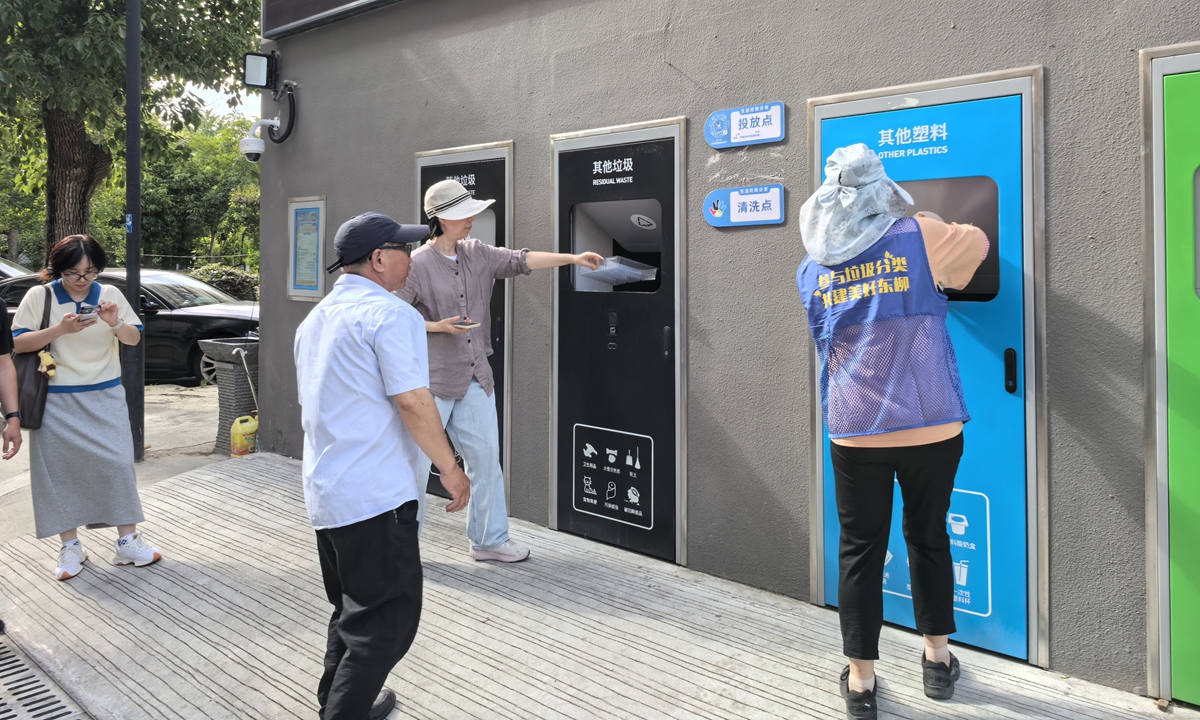
Residents sort waste at an intelligent recycling station in Ningbo. Photo: Zhang Yiyi/GT
At an intelligent recycling station in Ningbo's Xingfuyuan residential community, residents scan in, sort their recyclables and drop them into automatically opened bins, with the waste converted into reward points redeemable for cash.Nearby, Zhao Zengbiao, deputy property manager of the Xingfuyuan community, occasionally helps remind residents how to sort their waste properly.
"Many residents used to see waste sorting as a hassle, but that's changing as we've continued raising awareness of the community," he told the Global Times. "The more carefully people sort, the more points they earn, so participation has become much more active."
As one of China's 46 key cities for waste sorting, Ningbo has since 2018 developed an integrated recycling system combining waste sorting and resource recovery through technologies including IoT, big data and AI. The city now has more than 4,000 smart recycling stations and over 1.88 million registered users.
But Ningbo's push into waste sorting began much earlier. Chen Shuai, head of the Business Supervision Section at the Ningbo Environmental Sanitation Guidance Center, told the Global Times the city began working with the World Bank on waste sorting projects as early as 2013.
"At that time, many Chinese cities had not yet adopted waste sorting, but Ningbo had already begun drawing on international experience," Chen said.
A second World Bank cooperation project was launched in 2023 to further explore recyclable resource recovery models in Ningbo, Chen added.
Today, many recycling bins can automatically signal when they are full, while the backend system dispatches collection vehicles and optimizes routes. The city's recyclable sorting accuracy now exceeds 90 percent.
Similar digital systems are being applied to other areas of city management, including bridges and urban lighting.

Dazzling neon lights and laser beams illuminate the city skyline in Ningbo. Photo: Courtesy of the Ningbo Municipal Facilities Center
At the Ningbo urban bridge monitoring center, real-time data on bridge vibrations, water levels and ship traffic flashes across large screens, while the backend system automatically analyzes anomalies and issues alerts."We are now effectively monitoring the 'heartbeat' and 'pulse' of the city's bridges in real time," Chen Bo, deputy secretary of the Ningbo Municipal Facilities Center, told the Global Times.
More than 2,500 urban bridges in Ningbo have been connected to the monitoring platform, including 38 key bridges under round-the-clock health monitoring. The system can also automatically identify and warn risks such as ship collisions and overloaded vehicles.
Meanwhile, Ningbo's urban lighting system is also becoming smarter. The backend platform automatically adjusts lighting time and brightness based on weather, traffic and pedestrian flow, helping reduce energy consumption. When faults occur, the system can quickly locate the problem and dispatch repair crews, significantly improving response efficiency.
Around 3.2 million lighting facilities across the city have now been connected to the smart management platform.
The same digital approach is also reshaping business services. In the past, companies often had to contact multiple government departments for business services. Now, many services can be handled online through Ningbo's integrated business service platform, where corporate requests are automatically matched with relevant policies and departments.
"Speed used to matter most. Now, companies care more about whether their problems can actually be solved," Xu Qi, deputy director of the business services division at the Ningbo Government Service Center, told the Global Times.
Xu said companies only need to enter basic information online for the system to match relevant policies and identify which requirements have been met and which still need to be fulfilled. Some regular matters can even be handled directly online, while more complex requests automatically transferred to relevant departments for processing within set time limits.
During a period of heightened uncertainty in external trade in 2025, the platform saw a surge in requests from foreign trade companies, Xu said. Ningbo launched a dedicated foreign trade service section and organized a series of offline events to help businesses access market and policy information and navigate challenges.
From intelligent recycling bins in residential communities to the constantly updating data at bridge monitoring centers and the steady flow of requests on business service platforms, many aspects of city management that once relied heavily on manual coordination are now running quietly in the background.
For many Ningbo residents, the changes may simply mean steadier street lighting, smoother traffic and fewer trips between government offices. But behind those daily routines, the city is steadily exploring new ways of "smart governance" as it works toward becoming a more efficient and responsive modern metropolis.
RELATED ARTICLES