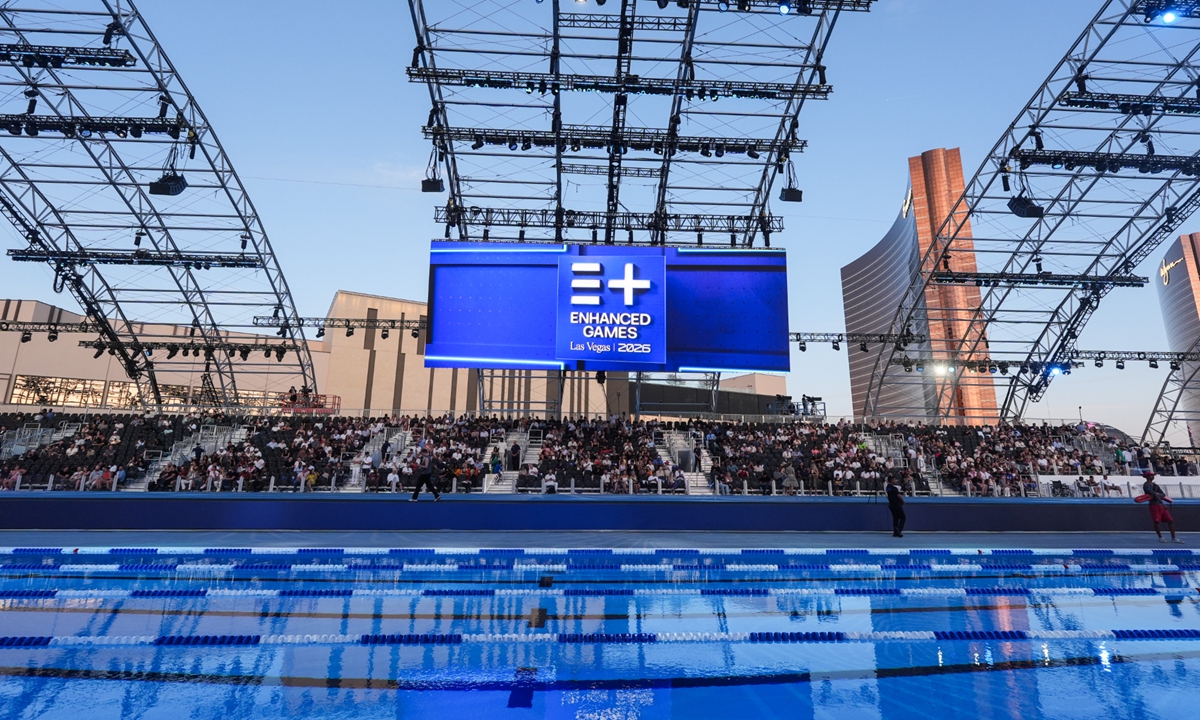
The inaugural Enhanced Games concluded in Las Vegas Photo: VCG
The inaugural Enhanced Games concluded in Las Vegas on Sunday, but debate surrounding the controversial competition continued this week, as the event permitted the use of performance enhancing drugs (PEDs) that are fundamentally rejected in global sports.Marketed as "a new model of sports embracing science, technology and enhancement," the Enhanced Games competition featured swimming, athletics and weightlifting, while offering lucrative prize money and bonuses for athletes capable of surpassing official world records.
Yet despite months of hype surrounding the possibility of "superhuman" performances, the inaugural edition produced only one unofficial world-best mark, while several athletes who claimed they competed without banned substances still defeated their "enhanced" rivals.
The biggest headline came in the men's 50-meter freestyle, where Greek swimmer Kristian Gkolomeev clocked 20.81 seconds, faster than the officially recognized world record of 20.88 set earlier this year by Australian swimmer Cameron McEvoy at the China Open.
However, Gkolomeev's performance, achieved with the aid of PEDs and the now-banned sharkskin swimsuit technology, will not be recognized by any major international swimming governing body.
The unofficial mark still earned him a bonus worth more than $1 million, highlighting the enormous financial incentives the event used to attract athletes from traditional sports.
Elsewhere, the performances largely fell short of the standards organizers had promised.
US sprinter Fred Kerley, a two-time Olympic medalist who was banned from competing after failures in doping tests, won the men's 100 meters in 9.97 seconds. The result is far from Usain Bolt's official world record of 9.58 seconds, which Kerley had claimed before the event he would "destroy."
In swimming, even enhanced competitors remained well behind the men's 100-meter freestyle world record of 46.40 set by Chinese swimmer Pan Zhanle. US swimmer Hunter Armstrong, who claimed he did not use banned substances, also finished first in the men's 50m backstroke.
The results fueled widespread discussion online, with many observers teasingly saying that the Games ultimately failed to prove that openly permitting doping could fundamentally redefine elite sports.
Analysts noted that elite performance still depends on years of training, talent development and competitive systems rather than simply pharmaceutical enhancement.
Some Chinese swimming fans also questioned the validity of Gkolomeev's 50m freestyle performance after the broadcast clock appeared to stop before he touched the wall. Swimming news website SwimSwam similarly noted there were questions surrounding the timing display during the race.
But Chinese sports commentator Zhang Bin said the controversy over timing ultimately missed the larger issue surrounding the event.
"I was expecting the athletes who took performance-enhancing drugs would do something rather astonishing in terms of athletic performance, as the organizers had branded the event as setting new human limits," Zhang told the Global Times.
"But fundamentally, it is wrong to take banned substances for enhancing performance in sports, as it goes against the sportsmanship that we cherish."
The World Anti-Doping Agency (WADA) has strongly condemned the Enhanced Games since its launch in 2025, describing the concept as "dangerous and irresponsible" and warning that promoting PED use could create serious long-term health consequences for athletes.
WADA also expressed concerns about the message such an event could send to younger generations.
"The beauty and popularity of sports is based on the ideal of clean and fair competition," WADA spokesperson James Fitzgerald told the Global Times ahead of the Enhanced Games. "Athletes serve as role models and WADA believes that this event sends a dangerous message to young people around the world."
The International Olympic Committee (IOC) also noted to the Global Times that "any events encouraging the use of performance-enhancing substances and methods are a betrayal of everything that athletes stand for."
The Enhanced Games, founded by Australian entrepreneur Aron D'Souza and backed by several high-profile investors, has faced criticism since its announcement. Organizers argued that their model simply made enhancement transparent and medically supervised. But anti-doping authorities warned that medical supervision does not mean the use of such substances is risk-free.
"Just because a drug is FDA-approved or is provided under medical supervision, does not mean it can be used without risk," Fitzgerald said. "Sports medicine still does not fully understand the long-term consequences of combining multiple substances together at the doses elite athletes might use to chase records."
For many critics, the inaugural Enhanced Games ultimately reinforced rather than challenged the foundations of elite sports. Despite relaxed anti-doping rules, significant financial incentives and openly enhanced athletes, the competition failed to produce the wave of historic performances that organizers had promised.
"Openly permitting doping undermines the principles of fairness and athlete welfare that international sports has spent decades trying to protect," sports commentator Mao Jiale told the Global Times.
"Glorifying drug-assisted performances sends the wrong signal to young athletes and creates dangerous pressure on competitors still pursuing success through clean sports."
RELATED ARTICLES