Japan seeks to revive ‘Tokko,’ threatening more than just East Asia: Global Times editorial
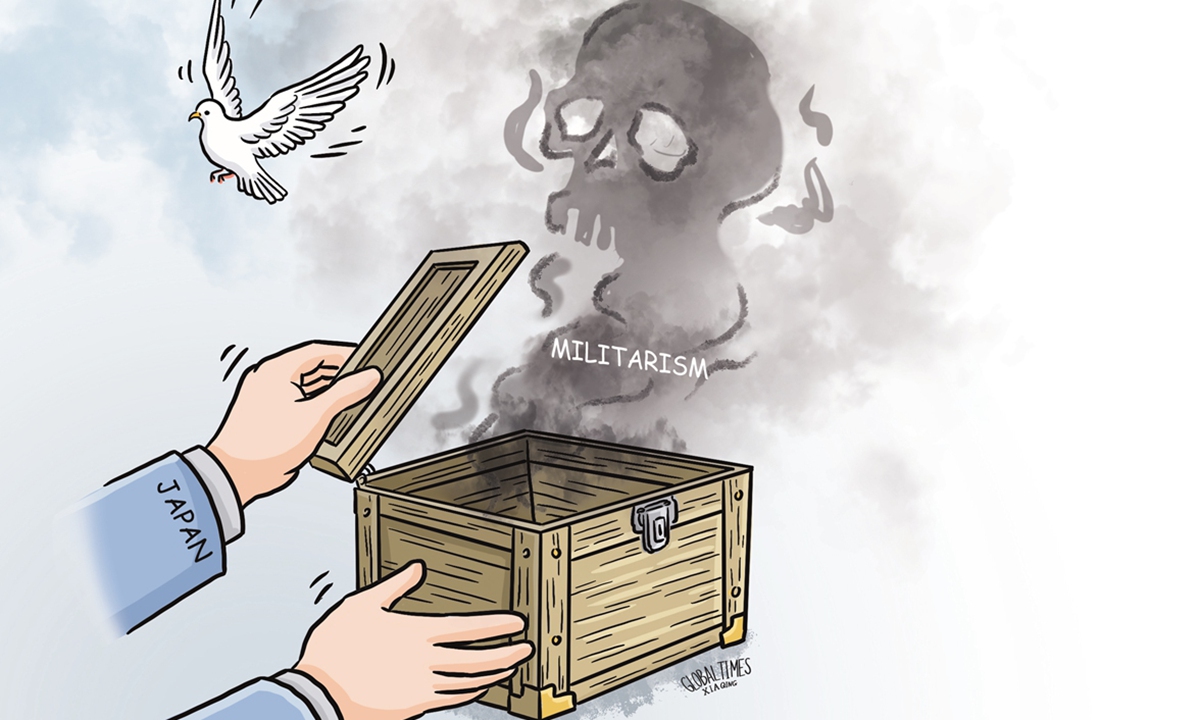
Illustration: Xia Qing/GT
On Wednesday, a law to establish the "National Intelligence Council" was passed during a plenary session of Japan's House of Councillors. The introduction of this legislation not only marks a fundamental overhaul of Japan's postwar intelligence system, but also drives a dangerous institutional wedge that will enable Japan to fully break free from its postwar peace framework and accelerate its "remilitarization."
The Sanae Takaichi government's restructuring of the intelligence apparatus is far from a mere administrative adjustment - it is a systemic transformation designed to propel the militarization of the Japanese state apparatus at full speed. The new bill will create a planned "National Intelligence Council" led by the prime minister as the supreme decision-making center, supported by a newly established "National Intelligence Bureau" as its executive body, thereby establishing a centralized and vertically integrated intelligence system.
This not only dismantles the postwar system of checks and balances deliberately maintained across the Japanese Ministry of Foreign Affairs, the Ministry of Defense, the police, and other agencies - a system born from reflection on past militarism - but also grants the National Intelligence Council extraordinary powers to compel all government departments to share intelligence.
Even more dangerously, the bill explicitly incorporates "foreign intelligence activities" into its mandate, shifting Japan's intelligence functions from a domestic security focus to the collection of overseas military and security intelligence - and even permitting espionage and infiltration operations abroad.
This highly centralized intelligence restructuring, which serves Japan's "remilitarization" ambitions, has drawn strong criticism within Japan itself. Some Japanese scholars have pointed out that the new intelligence body lacks effective oversight and checks and balances, and could become a modern reincarnation of the notorious pre-WWII "Special Higher Police" (Tokko). It risks becoming a tool for right-wing conservative ruling authorities to abuse executive power - not only severely infringing on citizens' privacy and freedom of speech, but also serving as an instrument to monitor and suppress dissent.
Regrettably, despite strong concerns and opposition from various sectors of Japanese society - including some opposition parties, local bar associations, civic groups, mainstream media, and scholars - the bill passed with relative ease. This reveals a significant weakening of the checks and balances within Japan's increasingly right-leaning political landscape.
Japan repeatedly claims that its "exclusively defense-oriented" principle remains unchanged. But what does "exclusively defense-oriented" actually mean? It should mean refraining from preemptive strikes, responding only with the minimum necessary self-defense after coming under armed attack, not attacking others' bases, and not possessing strategic offensive weapons. Yet today, Japan is deploying long-range missiles with so-called "counterstrike capabilities" against enemy bases, building what are effectively "aircraft carrier" battle groups, lifting restrictions on the export of lethal weapons, and openly discussing the possession of "counterattack capabilities." Which of these is not an offensive military posture? The Japanese government may repeat the phrase "exclusively defense-oriented" countless times, but the range of its missiles has not shrunk by a single kilometer because of it. Expanding military capabilities in concrete terms while simultaneously claiming adherence to the path of a "peaceful nation" is a contradiction that cannot deceive the international community.
In fact, Japan's growing concentration of intelligence and security powers is closely linked to its expanding military activities abroad. The Takaichi government has actively promoted military aid and arms sales to the Philippines, sent the Self-Defense Forces to participate in the US-Philippines "Balikatan" military exercises, and even fired its Type 88 coastal surface-to-ship missile system. These actions reveal increasingly assertive ambitions for external expansion. If Japan once again becomes a country capable of waging war, the Asia-Pacific region will face escalating arms races, greater risks of strategic miscalculation, and a sharp rise in the danger of conflict.
More importantly, the dangers of this "remilitarization" extend far beyond East Asia. It signals that a key pillar of the postwar international order is beginning to erode. Documents such as the Potsdam Declaration and the Japanese Instrument of Surrender clearly stipulated that Japan should be "completely disarmed," while Japan's Peace Constitution imposed strict limits on military force and the right to wage war. Japan's current trajectory represents an attempt to break free from the constraints of the postwar order. The harder it pushes in that direction, the more vigilant other countries should become.
Japan is once again attempting to race down the old path of domestic centralization of power and external expansion. This resurgence of militarism will not only seriously undermine regional stability and order, but will ultimately backfire on Japan's own security and development.
The Asia-Pacific region should remain a highland for peaceful development and cooperation, not a geopolitical arena where a handful of countries stir up division and confrontation. Japan should squarely face the concerns voiced both domestically and internationally, deeply reflect on its history, genuinely uphold the commitment of its Peace Constitution, and stop moving further down the dangerous road of remilitarization and bloc confrontation. Any attempt to overturn the postwar international order will inevitably face firm opposition from countries in the region and the broader international community.
RELATED ARTICLES