ARTS / BOOKS
A vendor-writer turns daily life into stories of ordinary people
Between market and page
Editor's Note:
In the age of information overload, reading remains a necessary channel to invigorate mind, provide inspiration and cultivate virtue. Everyone's reading journey carries unique emotions and life experiences.
The Global Times has specially launched the "100 Avid Readers" series, inviting a variety of guests to share their connections with books, stories of growth and sparks of thoughts.
In this installment, Chen Hui, a vendor-writer who has published five works since 2018, shared how reading has shaped her inner world, laid the foundation for her writing, and given her the opportunity to see the world more broadly.
Usually, Chen Hui starts her workday before sunrise. Pushing a cart stocked with everyday essentials, including lighters, steel wool scrubbers, plastic household goods and small toys for children, she makes her way through the vegetable market in Liangnong town, Yuyao city, East China's Zhejiang Province.
By the afternoon, back home, the 49-year-old settles into a quieter world of her own, spending time on personal interests such as reading and writing, far removed from the bustle of the marketplace.
For decades, this has been Chen's daily routine.
Over the past several years, Chen has published five books, all centered on the lives of ordinary people she encountered in small towns and marketplaces. Many of her subjects are vendors, factory workers, divorced women and elderly residents living on society's margins.
To Chen, an ordinary life can itself become an epic story, depending on how it is observed and understood. And writing and selling goods at the market exist side by side.
"Life itself is the most important thing," she said. "Selling goods at the market is part of making a living, while writing is simply something I love to do. The two do not conflict with each other."
Drawn from life
Born in Rugao, East China's Jiangsu Province, Chen was adopted at the age of 3 and returned to live with her biological parents at 13. In 1999, she was diagnosed with an illness that required lifelong medication.
At 28, she was married and moved to Liangnong town in Zhejiang Province. Years later, following her divorce in 2017, she remained there with her child.
The pressure of daily life became part of Chen's reality. She told the Global Times that there were times when she had to head to the market alone at two or three o'clock in the morning to secure a spot for her stall, and that she, too, had moments of fear. Yet those years of experience also gradually shaped her writing.
"You see people swaying in empty spaces," she wrote. "But when I write, I use words to fill people up again, to make them stand firmly on the ground."
Chen published her first book A Person Who Will Come to You No Matter How Long It Takes, in 2018, one year after her divorce. By then, she had already spent more than a decade living in Liangnong town and had become fluent in the local dialect. Many of the characters and stories in her books are drawn directly from the town around her.
There are street vendors working long hours to support their families, women who gave up love to follow family expectations, and elderly people quietly enduring loneliness.
The market itself has become both her source of income and the inspiration for her works.
Even after gaining recognition as a writer, Chen continues to describe herself first as a small vendor rather than an author.
In the interview with the Global Times, she often says that publishing books has changed little about her life. She still gets up early every morning to set up her stall, and insists that selling goods remains the foundation of her livelihood.
She does not see herself as distant from the people she writes about. Instead, she believes her experiences are deeply connected to theirs.
"The market is my way of connecting the human world, and writing is how I return to myself," Chen said.
"With whatever little cleverness and resilience I have, I can stitch together a life that feels broken and worn and even embroider it with flowers."
Reading as foundation
Her relationship with reading began in childhood when her adoptive family operated a mill. One of the workers living there loved books and often kept novels by his bedside, so Chen began reading them out of curiosity. From ancient Chinese mythology such as the Classic of Mountains and Seas to martial arts fiction, she spent long afternoons immersed in stories.
As she grew older, Chen began to read widely, including magazines such as the Youth Literary Digest and Duzhe.
Later, on the advice of a senior scholar, she began to explore more canonical literary works, with recommendations that included Wang Zengqi and Li Juan. She also read books by renowned authors such as Yu Hua and Mo Yan. Over time, those years of reading gradually became the foundation of her own writing.
Yet Chen speaks about reading in an unusually practical and unpretentious way. She rejects the idea that books must always serve a clear purpose or lead directly to success.
"You read simply because you want to read," she said. For Chen, reading is less about acquiring knowledge than about understanding life itself.
"Reading lets you see different sides of the human world," she said. "After experiencing enough stories through books, you begin to accept the uncertainty of life."
She believes years of reading quietly shape a person from within. "Reading is like the foundation of a house," she said. "Without that foundation, the house above cannot be built."
Chen never recommends books to others. In her view, reading is like eating: Everyone has different tastes. As she explained, there is no need to follow "must-read" lists suggested by others.
Today, despite having published five books and preparing the sixth, Chen still spends every morning in the market. She does not deliberately search for stories there, but believes daily interactions naturally reveal the complexity of human life.
Now, she enjoys the balance her life has found over the years.
"In the morning, I stay among people and experience the hurly-burly and liveliness of the world," she said. "In the afternoon, I return to myself and enter my own world. It feels balanced, like day and night."
In the age of information overload, reading remains a necessary channel to invigorate mind, provide inspiration and cultivate virtue. Everyone's reading journey carries unique emotions and life experiences.
The Global Times has specially launched the "100 Avid Readers" series, inviting a variety of guests to share their connections with books, stories of growth and sparks of thoughts.
In this installment, Chen Hui, a vendor-writer who has published five works since 2018, shared how reading has shaped her inner world, laid the foundation for her writing, and given her the opportunity to see the world more broadly.
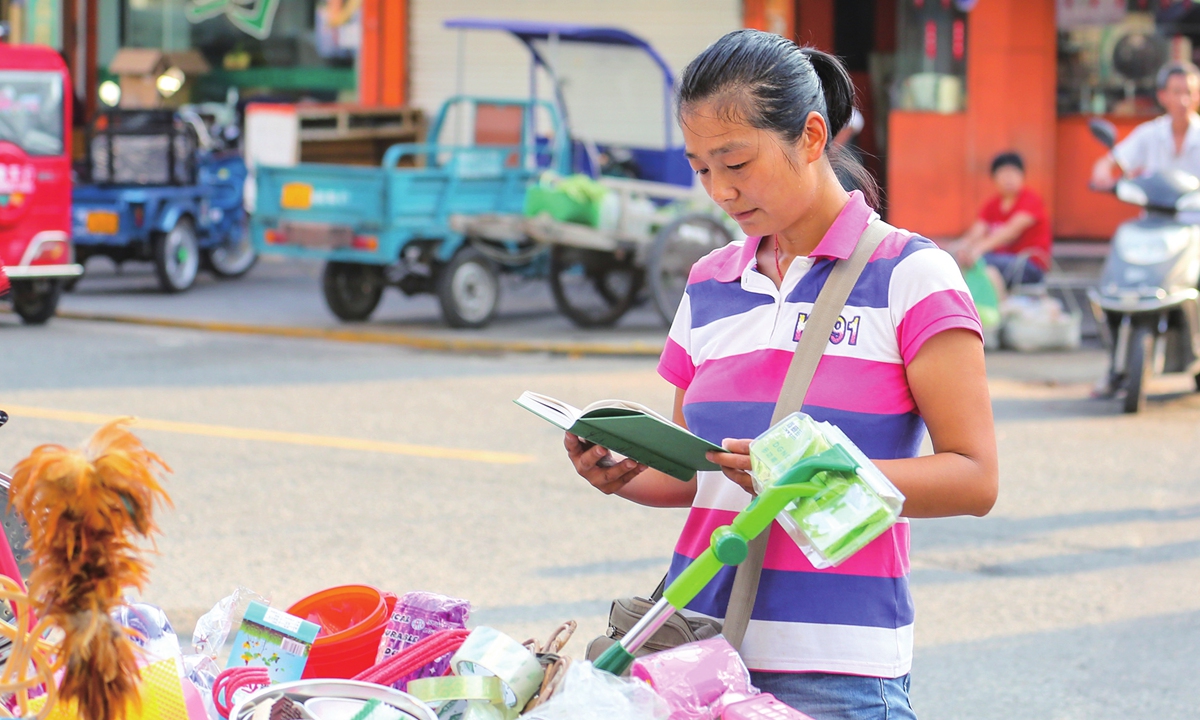
Chen Hui reads a book at the Liangnong market in Yuyao, East China's Zhejiang Province. Photo: Courtesy of local photographer Xu Xuedong
Usually, Chen Hui starts her workday before sunrise. Pushing a cart stocked with everyday essentials, including lighters, steel wool scrubbers, plastic household goods and small toys for children, she makes her way through the vegetable market in Liangnong town, Yuyao city, East China's Zhejiang Province.
By the afternoon, back home, the 49-year-old settles into a quieter world of her own, spending time on personal interests such as reading and writing, far removed from the bustle of the marketplace.
For decades, this has been Chen's daily routine.
Over the past several years, Chen has published five books, all centered on the lives of ordinary people she encountered in small towns and marketplaces. Many of her subjects are vendors, factory workers, divorced women and elderly residents living on society's margins.
To Chen, an ordinary life can itself become an epic story, depending on how it is observed and understood. And writing and selling goods at the market exist side by side.
"Life itself is the most important thing," she said. "Selling goods at the market is part of making a living, while writing is simply something I love to do. The two do not conflict with each other."
Drawn from life
Born in Rugao, East China's Jiangsu Province, Chen was adopted at the age of 3 and returned to live with her biological parents at 13. In 1999, she was diagnosed with an illness that required lifelong medication.
At 28, she was married and moved to Liangnong town in Zhejiang Province. Years later, following her divorce in 2017, she remained there with her child.
The pressure of daily life became part of Chen's reality. She told the Global Times that there were times when she had to head to the market alone at two or three o'clock in the morning to secure a spot for her stall, and that she, too, had moments of fear. Yet those years of experience also gradually shaped her writing.
"You see people swaying in empty spaces," she wrote. "But when I write, I use words to fill people up again, to make them stand firmly on the ground."
Chen published her first book A Person Who Will Come to You No Matter How Long It Takes, in 2018, one year after her divorce. By then, she had already spent more than a decade living in Liangnong town and had become fluent in the local dialect. Many of the characters and stories in her books are drawn directly from the town around her.
There are street vendors working long hours to support their families, women who gave up love to follow family expectations, and elderly people quietly enduring loneliness.
The market itself has become both her source of income and the inspiration for her works.
Even after gaining recognition as a writer, Chen continues to describe herself first as a small vendor rather than an author.
In the interview with the Global Times, she often says that publishing books has changed little about her life. She still gets up early every morning to set up her stall, and insists that selling goods remains the foundation of her livelihood.
She does not see herself as distant from the people she writes about. Instead, she believes her experiences are deeply connected to theirs.
"The market is my way of connecting the human world, and writing is how I return to myself," Chen said.
"With whatever little cleverness and resilience I have, I can stitch together a life that feels broken and worn and even embroider it with flowers."
Reading as foundation
Her relationship with reading began in childhood when her adoptive family operated a mill. One of the workers living there loved books and often kept novels by his bedside, so Chen began reading them out of curiosity. From ancient Chinese mythology such as the Classic of Mountains and Seas to martial arts fiction, she spent long afternoons immersed in stories.
As she grew older, Chen began to read widely, including magazines such as the Youth Literary Digest and Duzhe.
Later, on the advice of a senior scholar, she began to explore more canonical literary works, with recommendations that included Wang Zengqi and Li Juan. She also read books by renowned authors such as Yu Hua and Mo Yan. Over time, those years of reading gradually became the foundation of her own writing.
Yet Chen speaks about reading in an unusually practical and unpretentious way. She rejects the idea that books must always serve a clear purpose or lead directly to success.
"You read simply because you want to read," she said. For Chen, reading is less about acquiring knowledge than about understanding life itself.
"Reading lets you see different sides of the human world," she said. "After experiencing enough stories through books, you begin to accept the uncertainty of life."
She believes years of reading quietly shape a person from within. "Reading is like the foundation of a house," she said. "Without that foundation, the house above cannot be built."
Chen never recommends books to others. In her view, reading is like eating: Everyone has different tastes. As she explained, there is no need to follow "must-read" lists suggested by others.
Today, despite having published five books and preparing the sixth, Chen still spends every morning in the market. She does not deliberately search for stories there, but believes daily interactions naturally reveal the complexity of human life.
Now, she enjoys the balance her life has found over the years.
"In the morning, I stay among people and experience the hurly-burly and liveliness of the world," she said. "In the afternoon, I return to myself and enter my own world. It feels balanced, like day and night."
RELATED ARTICLES