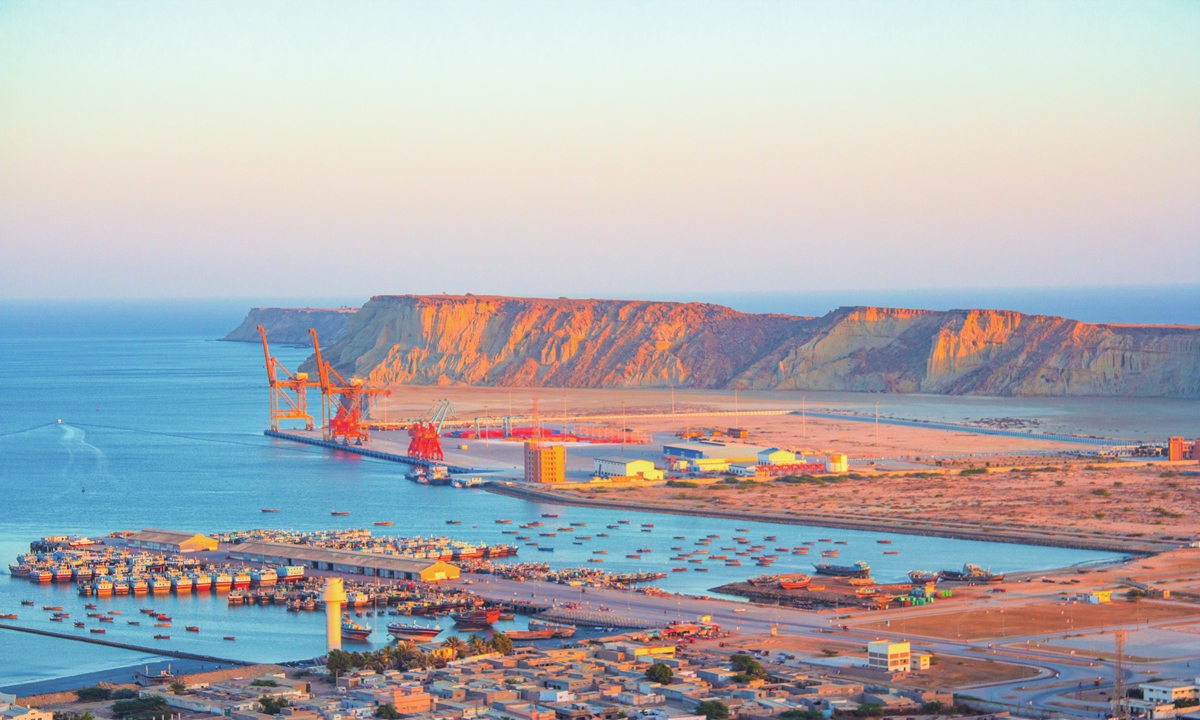
A view of the Gwadar Port Photo: VCG
This year marks the 75th anniversary of diplomatic relations between China and Pakistan. Over more than seven decades, the bilateral relationship has remained steadfast despite regional and global volatility. As a flagship project of the China-proposed Belt and Road Initiative (BRI), the China-Pakistan Economic Corridor (CPEC) has become a vivid embodiment of the all-weather strategic cooperative partnership, firmly anchored in the principles of equality, mutual trust, and respect.
Leveraging the opportunities presented by CPEC, Chinese companies have partnered closely with their Pakistani counterparts. In the past years, this dynamic collaboration has placed Pakistan on a path of sustainable development by significantly enhancing its energy sector, road infrastructure, transportation network, and various other key areas.
As BRI enters its second decade of high-quality development, CPEC has also advanced into its second phase. The leaders of China and Pakistan have agreed to accelerate the development of the upgraded version 2.0 of CPEC.
CPEC serves as a model of resilient development and economic growth under BRI cooperation. It has helped Pakistan overcome its energy crisis, while significantly upgrading its road, aviation, and port infrastructure. Pakistan's Minister for Planning, Development and Special Initiatives Ahsan Iqbal has highlighted the role of CPEC in driving Pakistan's economy during a media interview. Iqbal said CPEC has strengthened Pakistan's energy security, infrastructure, and connectivity, while laying the foundations of a modern economic architecture. As a developing country that has overcome numerous economic, bureaucratic, and security challenges, Pakistan has achieved remarkable results under the CPEC framework. This BRI-driven progress offers valuable lessons and sets an inspiring example for other BRI partner countries.
In my view, a key focus of this new phase of CPEC development lies in the full implementation and industrialization of the Special Economic Zones (SEZs). These SEZs are expected to play a vital role in strengthening Pakistan's industrial capacity and attracting foreign investment.

Yasir Habib Khan Photo: Courtesy of Yasir Habib Khan
Also, as CPEC enters the "2.0 upgrade phase," both sides will pour more efforts to jointly build the five new corridors - growth corridor, livelihood corridor, innovation corridor, green corridor, and openness corridor - to better unlock Pakistan's development potential and enable it to share the opportunities of Chinese modernization.
In terms of green development, Pakistan's electric vehicle market grew significantly in 2025, driven by Chinese brands, with government targets aiming to achieve 30 percent of new-energy vehicles sales in total auto sales by 2030. Households and commuters are also embracing Chinese clean technology faster than policy can keep up.
For Pakistan, the green potential of CPEC offers a valuable opportunity to harmonize economic progress with environmental protection and sustainable development goals. By prioritizing renewable energy, advancing eco-friendly infrastructure, supporting environmental conservation, and fostering green innovation, CPEC can deliver meaningful environmental improvements across the country. As the initiative continues to expand, it is crucial to fully harness its transformative power to build a cleaner, greener, and more sustainable future for future generations.
To realize environmentally sustainable development under CPEC, strong commitment to robust environmental policies, alignment with global sustainability standards, and continuous monitoring and evaluation of projects are essential. Through deepened cooperation and active participation of all stakeholders, CPEC can emerge as a leading model of green development within the broader BRI framework.
It is also noteworthy that during Pakistani Prime Minister Shehbaz Sharif's recent visit to China, the leaders of both countries agreed to forge an upgraded bilateral free trade agreement and explore deeper cooperation in artificial intelligence (AI), digital economy, agriculture, and other emerging fields.
In my view, AI will become the next powerful engine driving the high-quality development of the BRI in the coming decade. China has already put forward the Global AI Governance Initiative, contributing Chinese wisdom and solutions for the responsible development and governance of AI. Under this initiative, all countries, including Pakistan, stand to benefit. China has been playing a leading role in helping Global South countries, including Pakistan, strengthen their AI capacity building.
Yasir Habib Khan is the president of the Institute of International Relations and Media Research in Pakistan.
RELATED ARTICLES