ARTS / CULTURE & LEISURE
Chinese archaeology offers Eastern lens on civilizations
CASS releases achievements in joint projects
By Published: May 28, 2026 09:28 PM

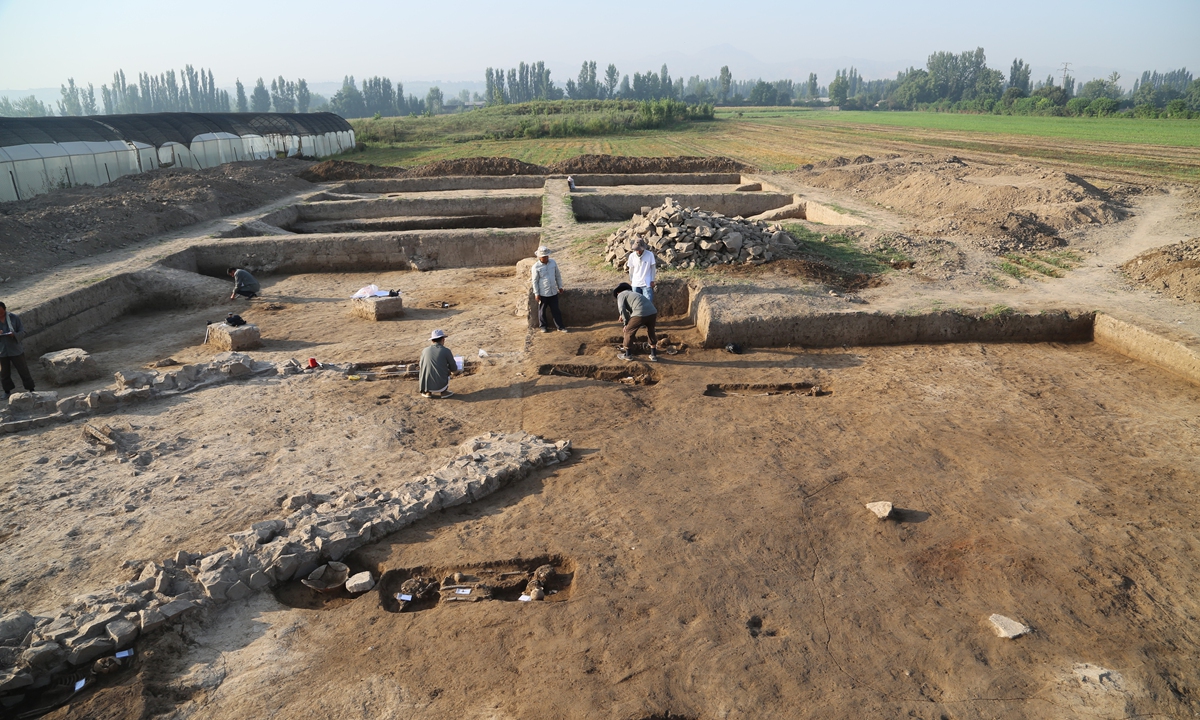
Chinese archaeologists work at the Mingtepa site in Uzbekistan Photo: Courtesy of Liu Tao
China's overseas archaeological efforts have offered a distinctive "Eastern perspective" to global civilization studies, helping break Western-centric narratives and build a more inclusive framework for interpreting ancient human societies, Chinese archaeologists from the Institute of Archaeology, Chinese Academy of Social Sciences (CASS), said on Wednesday.CASS, widely regarded as China's national archaeological research powerhouse, unveiled a slate of research achievements at the civilization exchange achievements conference in Beijing on Wednesday, including 13 archaeological reports, 21 publications covering monographs, research datasets, popular science books and archaeological catalogs, as well as more than 30 influential papers published in key Chinese and English academic journals.
One of the flagship volumes focusing on China's overseas archaeological endeavor was prominently released at the conference, titled Way of Wisdom that Bridges the East to the West: A Compendium of Overseas Archaeological Projects of the Institute of Archaeology, Chinese Academy of Social Sciences. It showcases decades of fieldwork and research by Chinese archaeologists across key ancient civilization sites worldwide, marking a major milestone in the country's expanding global archaeological footprint.
Jia Xiaobing, a research fellow from the CASS Institute of Archaeology, told the Global Times that China's overseas archaeology has evolved from marginal participation to systematic leadership, delivering unique academic value and global contributions.
Jia, the Chinese head of the Chinese-Egyptian Montu Temple joint archaeological mission, said that overseas archaeological initiatives represent a "powerful East wind" for global archaeological research. "They enable Chinese scholars to move beyond the traditional Western 'center-periphery' narrative and adopt a rigorous, equal and inclusive academic approach rooted in the pluralistic and integrated view of civilizations."
The newly released compendium catalogs key overseas projects conducted by the institute across five core ancient civilization regions.
These include field investigations at Romania's Dobrovat site, survey work along Pakistan's Indus River basin, joint excavation projects in Egypt as well as at Uzbekistan's Mingtepa site, and archaeological research at the Copan ruins, one of the most important sites of the Mayan civilization in Honduras.
According to Jia, these cross-border collaborations stand as exemplary practices of China's global archaeological outreach, laying a solid foundation for continued overseas research and demonstrating the core academic philosophy of Chinese archaeology in global civilization dialogue.
He stressed that China's overseas archaeology has achieved transformative progress over years of continuous practice, shifting from sporadic participation to systematic leadership, from technical export to conceptual co-construction, and from following global trends to leading innovative research in certain fields.
"Chinese archaeologists are no longer mere observers of world civilization research," Jia said. "We have become co-builders of diverse civilization narratives and promoters of cross-cultural dialogue."
Experts attending the conference said that archaeology serves as a vital bridge connecting the past, present and future. China's continuous overseas archaeological cooperation delivers tangible cultural support for international people-to-people connectivity and global civilizational mutual learning, while enriching the cultural connotations of building a community with a shared future for mankind, according to a China News report.
Jia noted at the conference that the country will continue to pursue a dual-track approach of "bringing in international resources and going out for global cooperation" focusing on key heritage sites in Belt and Road partner nations and major ancient civilization regions worldwide. Through high-standard field excavation, multi-disciplinary technological support and improved overseas research platforms, China seeks to elevate its international academic discourse and contribute more to global civilizational dialogue.
Shi Jinsong, deputy director of the CASS Institute of Archaeology, noted at the conference that promoting global civilizational exchange is a core mission of modern archaeology.
Over the past decade, the institute has launched sustained archaeological operations in Egypt, Honduras, Uzbekistan, Romania and Pakistan. A new joint project at Greece's Angelokastro site, in partnership with the China Institute of Classical Civilization, kicked off in April, further extending China's global archaeological layout.
As the first installment of the institute's new world archaeology book series, the release of the compendium marks a formal step toward more open, inclusive and systematic global ancient civilization research led by Chinese academic institutions, the report said.
RELATED ARTICLES