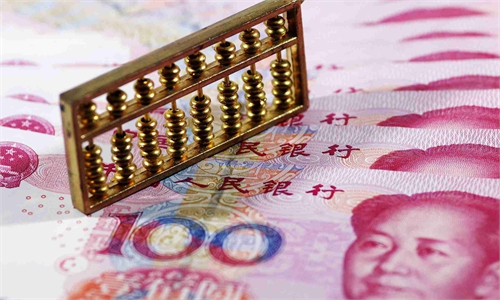
Illustration: Chen Xia/GT
Amid mounting global macroeconomic uncertainty and broad pressure on regional currencies, the yuan has distinguished itself by demonstrating steady upward momentum.The onshore yuan is on track for a 10th straight monthly gain against the US dollar. Both the onshore and offshore yuan strengthened against the US dollar to break through the 6.78 mark on Wednesday.
This performance stands in sharp contrast to the volatility gripping much of the region. Across Asia, multiple economies are navigating varying degrees of currency volatility. Tensions in the Middle East have directly pushed up international oil prices, putting pressure on energy‑importing Asian economies through imported inflation, compressing their growth potential and destabilizing their exchange rates.
Compounding these pressures, divergent monetary policies among major global economies are amplifying regional financial instability. In the US, while Kevin Warsh, the Federal Reserve's new chairperson, expressed strong interest in cutting interest rates as he sought the Fed's top job, persistent inflationary concerns have kept monetary policy on a tightening trajectory. Meanwhile, expectations of rate hikes by the European Central Bank are tightening euro liquidity, leaving emerging markets exposed to unpredictable capital flows and intensifying depreciation pressures across Asian currencies. As a result, the region's overall financial vulnerability has increased markedly.
Against this backdrop, the yuan has charted an independent market path, supported by solid economic fundamentals and an independent monetary policy framework. China's domestic price levels are generally stable, and the macroeconomy is operating within a reasonable range.
The current account continues to register a surplus and foreign trade has proved resilient, providing strong backing for exchange rate stability. Moreover, China's ample foreign exchange reserves offer substantial buffer space against external financial shocks. These factors have continuously reinforced international market confidence in the yuan, enabling it to maintain low volatility and high predictability amid global turbulence.
Such stability carries profound positive implications for the Asian financial landscape. The low volatility and high predictability of the yuan's exchange rate can effectively reduce exchange rate risks and currency conversion costs in cross-border transactions. In bilateral trade, businesses adopting yuan pricing and settlement can avoid uncertainties stemming from sharp fluctuations of other local currencies. In cross-border investment and financing, yuan-denominated instruments entail significantly lower exchange rate risks compared with volatile local currencies.
This explains the growing adoption of the yuan in cross-border trade and investment. According to the 2025 Yuan Internationalization Report released by the People's Bank of China, cross-border yuan receipts and payments handled by banks for clients reached 34.9 trillion yuan ($5.15 trillion) in the first half of 2025, a year-on-year increase of 14.0 percent. The yuan has become the world's second-largest trade financing currency and the third-largest payment currency.
Moreover, the expanding usage of the yuan across Asia rests on two reinforcing pillars. First, China's central position in regional supply chains and its expanding foreign trade create natural demand for yuan settlement as a cost-efficient currency. Second, China has systematically built financial infrastructure to support cross-border yuan circulation, including bilateral currency swap agreements.
In September 2025, the central banks of China and Indonesia officially launched a local currency settlement framework for bilateral transactions, aiming to facilitate the use of local currencies in bilateral trade and investment. The new framework was based on a memorandum of understanding signed in May 2025, which upgraded a previous cooperation framework by expanding the scope of local currency settlements to cover all balance-of-payments items, according to the Xinhua News Agency.
Taken together, these mechanisms transform the yuan's exchange rate stability into a public good for regional financial cooperation. At a time when global macroeconomic uncertainty has become the norm and regional financial risks continue to rise, the yuan's steady performance not only demonstrates China's economic resilience but also serves as a functional cornerstone for stabilizing the Asian financial landscape and deepening regional financial cooperation.
RELATED ARTICLES