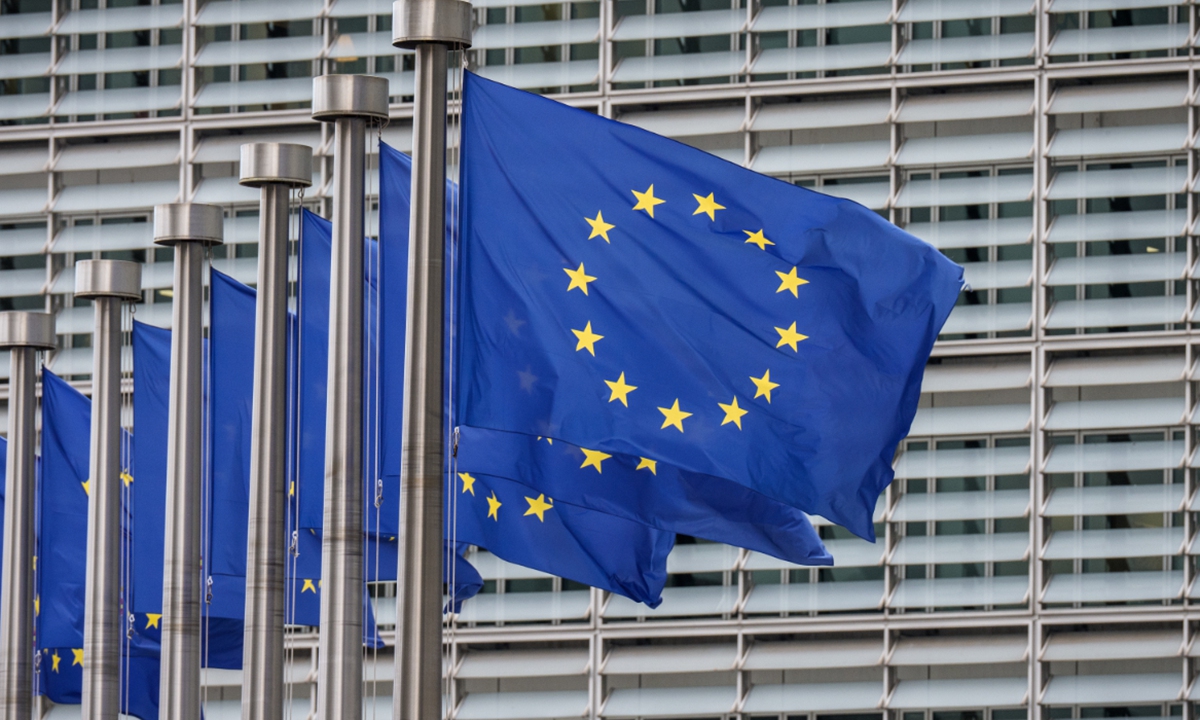
The European Union (EU) flags in front of EU headquarters in Brussels, Belgium. Photo: VCG
On Wednesday, Bloomberg, citing people familiar with the matter, reported that Germany and Spain are leading opposition to European Commission plans to ban Chinese technology suppliers from telecom networks as part of new cybersecurity rules. This means that some EU member states are openly rejecting the brainwashing-style "pan-securitization" suppression and "political" manipulation directed against China.
While certain voices in Brussels continue to clamor for higher trade barriers against China, a clear resurgence of rational and pragmatic voices on China policy is visibly gaining strength within the EU.
Restricting China-EU economic and trade cooperation will hurt the EU itself first and foremost. As two of the world's major economies and each other's second-largest trading partners, China and the EU have long seen their industrial chains deeply integrated and mutually dependent. Germany and Spain's opposition is rooted in rationality and pragmatism. Officials from both countries have explicitly called for preserving member states' "sovereign decision-making rights," warning that the EU's move could not only provoke severe countermeasures from China but would also significantly drive up the cost of building artificial intelligence infrastructure in Europe.
Over-securitizing economic and trade issues and politicizing technological cooperation artificially will inevitably inflate corporate costs, weaken industrial efficiency, and dampen investment expectations. In sectors such as telecommunications, digital infrastructure, and green transformation - where Europe already faces high construction costs and intense market competition - excluding mature and competitive Chinese suppliers through administrative means would ultimately force EU operators, businesses, and consumers to foot the bill.
The real divergence in the EU's China policy is not about whether to take a tough stance, but whether to respect common sense and the spirit of contracts. Ultimately, when politics detaches from common sense, it slides into mere performance; when rules deviate from contractual spirit, they become mere tools.
A minority of politicians in Brussels remain obsessed with geopolitical posturing, hoping to demonstrate so-called "strategic sobriety" through hardline rhetoric toward China. However, what the EU truly needs is not emotional theater, but cool-headed judgment based on industrial interests, employment, and long-term development prospects. The EU's China policy cannot remain trapped forever in the internal friction of "pressing the accelerator with one foot while pulling the handbrake with the other." Nor can it continue setting up obstacles to China-EU cooperation under the pressure of bloc politics while still expecting to enjoy the benefits of China's vast market and development dividends.
The German government's recent pragmatic statements and engagement outcomes further demonstrate that cooperation remains the mainstream demand in Europe. During her visit to China, German federal minister for economic affairs and energy clearly stated that modern economic relationship requires both cooperation and competition, and the EU should ensure that any measures it applies on Chinese trade don't harm the bloc's exports to the country.
China-EU cooperation is not a stopgap measure, but a practical choice shaped by the EU's own economic structure. Global industrial and supply chains are distributed across borders based on comparative advantages, forming a vast network linking major economies. The value of such a network rises or falls exponentially as connections increase or shrink. Estimates suggest that the EU's efforts to strengthen so-called "cybersecurity" by gradually phasing out Chinese suppliers' equipment could cost the bloc more than $400 billion between 2026 and 2030. For a European economy already grappling with inflation and recession risks, this kind of "self-destructive" hardline approach toward China is bound to be a gamble with little chance of success.
While some EU politicians continue to push rhetoric about "decoupling" from China, a US media cited the latest survey by the EU Chamber of Commerce in China, which paints a very different picture: 68 percent of respondents said they were either staying or expanding operations in China; nearly one-third said they were onshoring further in China; about three-fourths of EU companies in China said their production facilities in the country were more efficient than operations elsewhere. The growing confidence of EU businesses in China shows that so-called "de-risking" has never become a mainstream trend of European enterprises. Last year, China's direct investment in the EU and the UK also hit a seven-year high. Capital and markets do not lie. The flow of real money directly refutes those hypocritical political maneuvers.
It is hard to say exactly when it started, but the question of to what extent Brussels can still "represent Europe" has become one that demands serious reflection. Brussels should not package the hardline impulses of a small minority as the collective will of all Europe, thereby pushing manageable trade and economic differences into more dangerous directions.
On May 29, the European Commission will hold a "strategic debate" involving China. This discussion should not become a "mobilization meeting for protectionism," but rather an opportunity for a rational recalibration of the EU's understanding of China. What needs adjustment the most is the policy inertia that has been hijacked by geopolitical anxiety.
German philosopher Immanuel Kant once said, "Dare to know." For today's Europe, genuine "strategic autonomy" should begin with breaking free from inertial dependence on external political logic and returning to independent and objective judgment of its own interests. What Brussels most needs to do now is not to manufacture new confrontational issues, but to listen carefully to the increasing rational voices emerging within Europe itself. If a small minority continues to hijack trade and economic policymaking with geopolitical considerations, it is Europe's own future that will ultimately suffer.
RELATED ARTICLES