China's social logistics volume exceeds 120t yuan in first four months with resilient growth, structural optimization
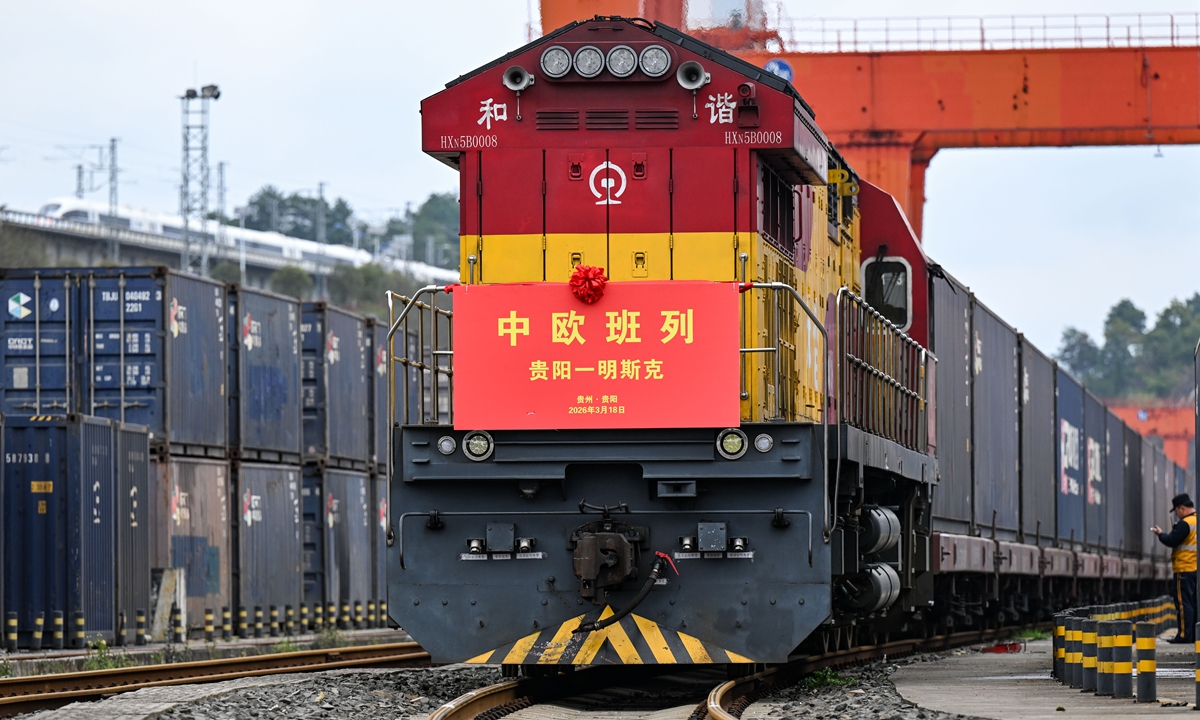
A China-Europe freight train loaded with auto vehicles and auto parts departs from Dulaying international land-sea logistics hub in Guiyang, Southwest China's Guizhou Province on March 18, 2026, heading for Minsk, Belarus. Photo: VCG
In the first four months of 2026, China's logistics demand maintained resilient growth with continuously optimized structure, forming a coordinated development pattern featuring solid industrial logistics as the foundation, vibrant consumer logistics, and steadily recovering international logistics, data from the China Federation of Logistics & Purchasing showed on Friday.
From January to April, total social logistics volume reached 121.7 trillion yuan, up 5.5 percent year-on-year, according to a report from China Media Group (CMG).
Industrial product logistics volume increased by 5.6 percent, contributing 74 percent to the overall growth of total social logistics — remaining the core pillar supporting stable industry performance. High-end manufacturing logistics showed strong momentum, with high-tech manufacturing-related logistics demand maintaining double-digit growth, said the report.
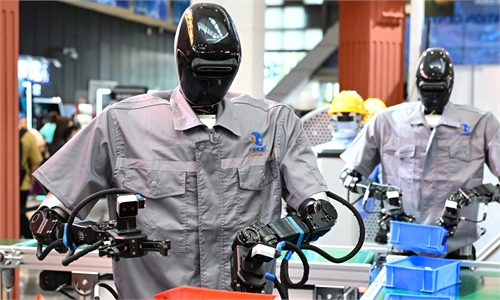
As consumption scenarios continue to expand, logistics demand from e-commerce and online retail has been further consolidated and optimized. In particular, new models such as online retail and instant delivery demonstrated strong vitality, with instant retail transaction value growing 29.2 percent. Driven by the rapid development of digital consumption, logistics demand for digital and smart products such as smart home systems and intelligent robots grew rapidly, according to CMG.
During the period, import goods logistics volume increased by 5 percent year-on-year, maintaining an overall growth trend throughout the year. Agricultural product imports maintained high-speed growth, effectively ensuring stable domestic market supply.
"The steady expansion of total logistics volume is essentially a signal of bidirectional recovery in both production and consumption. The data clearly shows that manufacturing continues to maintain its solid position as the 'ballast stone' of the economy," Wang Peng, an associate researcher at the Beijing Academy of Social Sciences, told the Global Times on Friday.
Meanwhile, the booming performance of instant retail and new e-commerce business models reflects the exceptionally strong adaptability and resilience of the domestic demand market, according to Wang.
Since the beginning of this year, China's modern logistics supply system has continued to improve, with an increasingly sound infrastructure network layout. From January to April, investment in water transport and air transport grew by 28.4 percent and 27.3 percent respectively, and investment in information transmission grew 29.2 percent, according to the report.
In addition, China's networked and multi-channel international logistics supply system has been continuously improved, with enhanced cross-border logistics service capabilities.
In rail transport, the China-Europe Railway Express completed 7,366 trips in the first four months, up 22 percent year-on-year, carrying 721,000 TEUs, an increase of 20.3 percent. In cross-border road transport, the number of customs-supervised inbound and outbound freight vehicles increased by 21.4 percent year-on-year.
He Hui, vice president of China Federation of Logistics & Purchasing, said in the report that international logistics corridors, through the coordinated operation of China-Europe and China-Central Asia railway express services and cross-border road transport, have effectively connected domestic and international supply chain cycles. Logistics internationalization has continued to improve, prominently demonstrating its core role in stabilizing foreign trade and smoothing channels, He said.
Wang noted that by leveraging a comprehensive multi-modal transportation network of railways, ports, and other infrastructure, China maintains stable and efficient transportation corridors. At the same time, the country's highly efficient distribution capabilities have significantly reduced the circulation costs of goods worldwide.
RELATED ARTICLES