Chinese localities chart tailored paths for high-quality growth under 15th Five-Year Plan
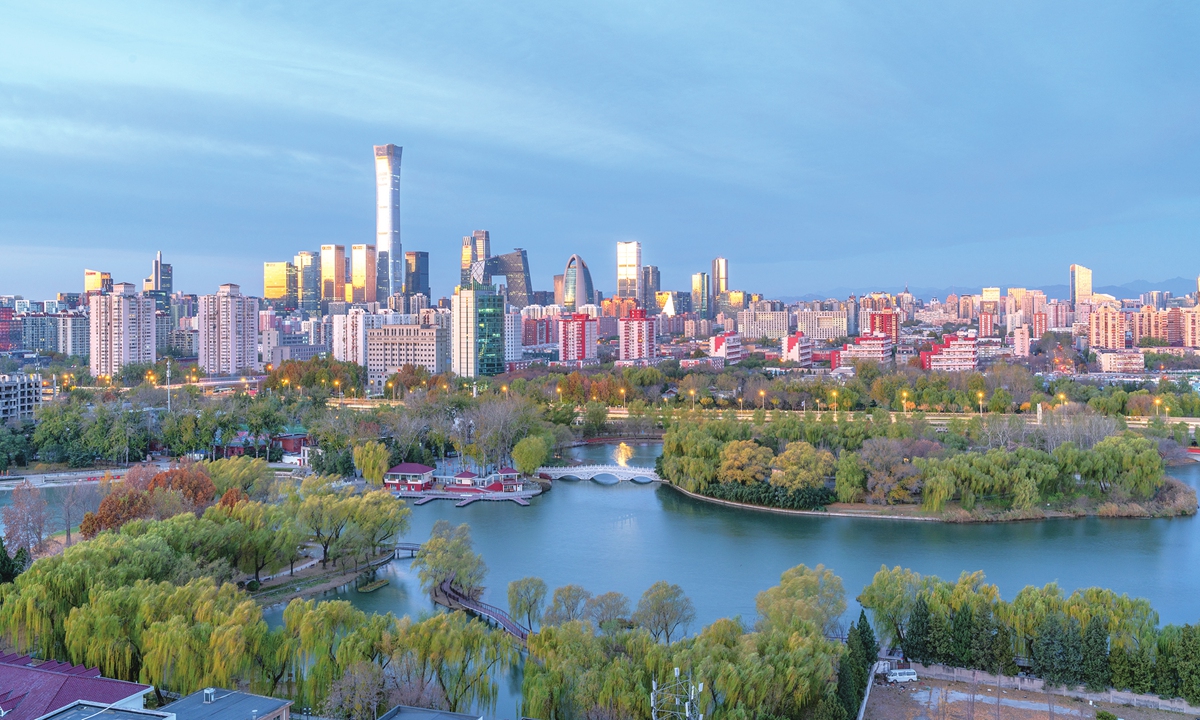
A sunrise view over Honglingjin Park and the CBD in Beijing on November 20, 2025 Photo: VCG
Many local governments across China have recently held press briefings to set out how they will launch implementation of their 15th Five-Year Plan (2026-30) outlines, as localities move to translate the national development blueprint into locally tailored action plans amid the country's broader drive to advance high-quality development.
The briefings followed the release of 15th Five-Year Plan outlines by all 31 provincial-level regions by Tuesday. The outlines clarified local economic and social development goals and pathways, and make clear that each region will work to promote effective qualitative improvement and reasonable quantitative growth of the economy, the Xinhua News Agency reported.
By setting out concrete targets and development roadmaps, these provincial-level outlines turn national strategic goals into practical measures tailored to local conditions, helping regions better align with and serve the country's overall development agenda, analysts said.
At a Friday press briefing on Beijing's 15th Five-Year Plan, Beijing Mayor Yin Yong said the capital aims to bring high-quality economic development to a new level over the next five years. Beijing's outline is anchored in the goal of taking the lead in basically realizing socialist modernization by 2035. It lays out 29 major indicators across six areas - innovation, coordination, green development, opening-up, sharing and security, Yin said, according to Xinhua.
Among its main targets, Beijing aims to maintain average annual GDP growth between 4.5 and 5 percent, while striving for better results in implementation. The city also plans to further strengthen its growth drivers and maintain average annual growth in trade in services at about 5 percent, according to Yin.
Those targets build on the hard-won gains of the just-concluded 14th Five-Year Plan (2021-2025), during which Beijing's GDP grew by an average of 5.2 percent annually
Also on Friday, the government of Southwest China's Xizang Autonomous Region held a press briefing on the launch of its 15th Five-Year Plan, focusing on writing a new chapter of Chinese modernization in Xizang. Under the regional plan, Xizang will strive to keep average annual GDP growth at about 7 percent over the next five years, according to Xizang Daily.
During this period, Xizang will work to strengthen its four leading pillar industries of specialty agriculture and animal husbandry, clean energy, cultural tourism and green mining. It will also upgrade four livelihood-related industries with local characteristics: building materials, Tibetan medicine, plateau light industry and border trade and logistics, while fostering emerging and future industries, according to the report.
In Central China, Henan Province's plan highlights efforts to build on strengths and advance its broader rise during the next five years. Provincial Governor Wang Kai told a press briefing on Thursday that the 15th Five-Year Plan period will be crucial for Henan's comprehensive development. The province has set average annual GDP growth at about 5 percent for the period, while seeking better results in implementation, the Xinhua News Agency reported.
To support that goal, Wang said Henan will accelerate the development of a modern industrial system with advanced manufacturing as its backbone, continue expanding domestic demand, and further integrate into and serve the unified national market.
Southwest China's Chongqing Municipality also put industrial upgrading high on its agenda. At a press briefing on Wednesday, local officials said the municipality will work during the 15th Five-Year Plan period to become a key strategic fulcrum for the development of China's western region in the new era and a comprehensive hub for inland opening up.
Chongqing will further expand pillar industries such as intelligent connected new-energy vehicles, advanced materials and smart terminals, while cultivating new growth sectors including aviation manufacturing and the low-altitude economy, according to the municipal government.
Local governments' formulation and implementation of their own plans based on the national 15th Five-Year Plan outline is a key way to coordinate efforts toward major national objectives, Junyang, a professor at the Shanghai University of Finance and Economics, told the Global Times on Friday.
By taking into account regional conditions, cross-regional coordination and urban cluster development, local governments can make specific plans for implementation, the expert said.
China's 15th Five-Year Plan outline, approved by national lawmakers in March, places "building a modern industrial system and consolidating the foundation of the real economy" at the top of the national strategic tasks to be pursued over the next five years, according to Xinhua.
The national focus on the real economy and new quality productive forces explains why local plans have placed industrial upgrading at the center of their development agendas, Xī Junyang said. "By tailoring development paths to local conditions, regions can better leverage their comparative advantages while exploring practical approaches that contribute to national high-quality development," he noted.
RELATED ARTICLES