Veteran Chinese diplomat Cui Tiankai says he would raise three major questions to US, Japan and Europe at Shangri-La Dialogue
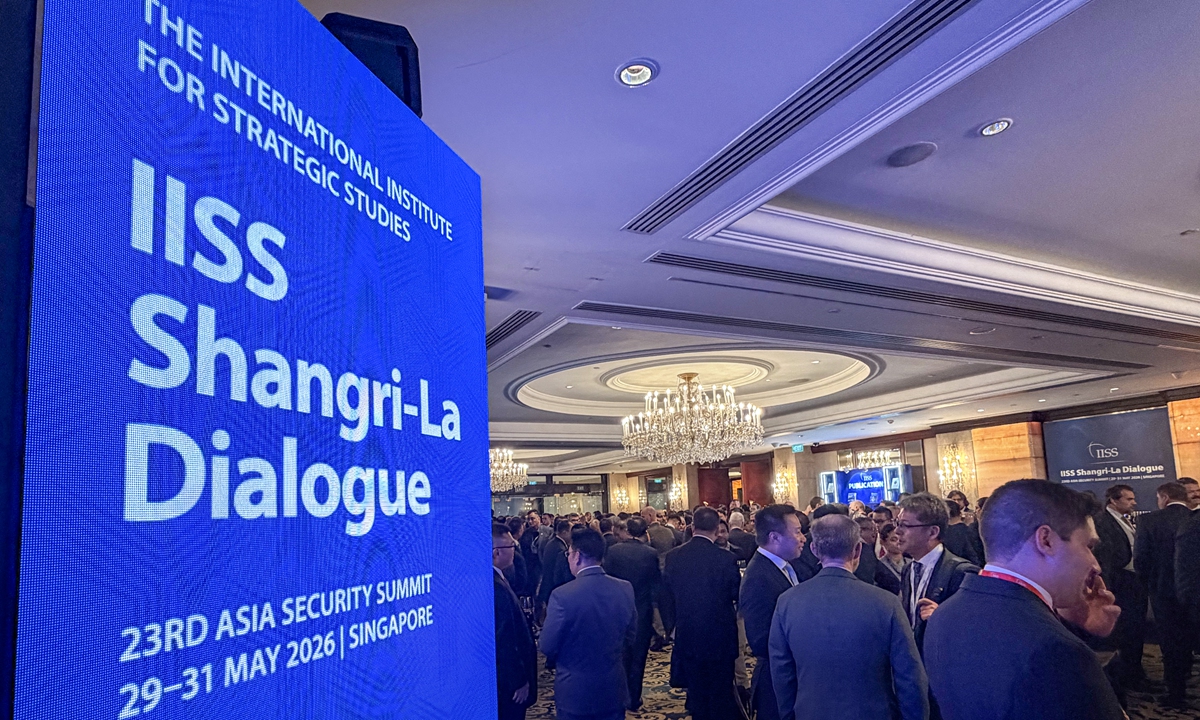
Participants attend the 23rd Shangri-La Dialogue in Singapore on May 29, 2026. Photo: Su Yaxuan/GT
As long as China and the US adhere to the correct direction, bilateral ties can continue to move forward, veteran Chinese diplomat and former Ambassador to the US Cui Tiankai told Global Times (GT) on Friday, after the opening dinner of the Shangri-La Dialogue (SLD) 2026 in Singapore.
Cui first attended the SLD in 2005. The question he raised to then US secretary of defense that year remains widely remembered even decades later. 21 years on, if given the opportunity, he said he is prepared to ask three separate questions to the US, Japan, and Europe. These three major concerns directly address China-US relations, the direction of Japan’s development, and the question of who holds dominance over Asia-Pacific security – issues that are also currently the focus of broad international attention.
Question for US secretary of defense: What specific measures will the US take to implement the consensus reached by the two heads of state?
In 2005, Cui, then director-general of Department of Asian Affairs of China’s Foreign Ministry, made his debut at the SLD. He engaged in a sharp exchange with former US secretary of defense Donald Rumsfeld on the topic of “China’s rise,” a moment that became a classic in the history of the forum.
At the 2022 SLD, John Chipman, Executive Chairman of The International Institute for Strategic Studies (IISS), which organizes the event, specifically referenced that past encounter: “You asked a very tough question of Secretary Don Rumsfeld. Here you are again 18 years later after having served your country as US Ambassador to China. The floor is yours, Cui.”
This year, when asked by GT reporters what question he would raise to the US secretary of defense if given the chance, Cui replied directly: “If the moderator gives me the opportunity, I would ask: Regarding the consensus reached by the Chinese and US heads of state in Beijing on building a ‘constructive China-US relationship of strategic stability,’ what specific measures does the US prepare to take to promote its implementation?”
This question is also a focal point of concern for China and the international community. During the dinner, Cui sat next to a US deputy assistant secretary of defense. The American official asked him whether he was optimistic or pessimistic about the future of China-US relations. GT reporters had previously posed the same question to Cui.
In his view, judging China-US relations simply as “optimistic” or “pessimistic” is overly simplistic.
“I have always maintained confidence in China-US relations. This confidence stems first and foremost from the strategic guidance of the two countries’ heads of state, which is irreplaceable. The two sides have reached important consensus on a new positioning for bilateral relations and on building a constructive and strategically stable relationship. As long as all parties make every effort to implement this consensus, the prospects for China-US relations are optimistic, and the people of both countries will ultimately make the right choice,” Cui said. From a long-term perspective, he believes this goal will eventually be realized.
At the same time, Cui is soberly aware that the path ahead for China-US relations will not be smooth. It will inevitably encounter ups and downs and even serious challenges. “The future is bright, but the road is tortuous. Without confidence in the prospects, all efforts lose meaning. It is precisely because we firmly believe the future is promising that we are willing to work tirelessly for it. And precisely because we know the road ahead is full of challenges, we must redouble our efforts and advance steadily.”
The veteran diplomat emphasized that as long as China and the US adhere to the correct direction, bilateral relations will surely continue to develop forward.
The Taiwan question is the most important and sensitive core question in China-US relations. During his recent visit to China, US President Donald Trump stated in an interview that “I'm not looking to have somebody go independent. And, you know, we're supposed to travel 9,500 miles to fight a war. I'm not looking for that.”
“Compared to the past, President Trump’s statement represents some positive progress. Of course, the road ahead is long, and everything must be done step by step,” Cui noted.
Ultimately, all US judgments and decisions are based on its own interests. Being separated from the region by vast oceans, the US should not get involved in this unnecessary conflict to begin with.
Question for the Japanese minister of defense: Can Japan remain committed to the path of peaceful development?
Cui previously served as director-general of Department of Asian Affairs of the Ministry of Foreign Affairs, ambassador to Japan, and ambassador to the US, giving him a deep understanding of the Asian situation as well as Japan and the US.
When asked about the question he intends to pose to Japanese Defense Minister Shinjiro Koizumi, Cui said: “In the past, I always believed that Japan’s post-war choice of peaceful development would not be reversed. But now, I am no longer so certain. I want to ask: Can Japan confirm that it will consistently adhere to the path of peaceful development? This commitment must not remain merely rhetorical – it must be demonstrated through concrete actions.”
Japan’s recent series of actions of militarization have drawn widespread international attention. Cui acknowledged that in today’s turbulent world, it is understandable for countries to strengthen their defense capabilities. However, the core issue lies in what worldview they hold and what methods they employ to truly safeguard national security. If a country insists on forming exclusive blocs, creating confrontation, and promoting a new Cold War mentality, it will only find itself in greater difficulty, with its security environment deteriorating further.
Cui added that the world is currently undergoing changes unseen in a century. Against this backdrop, how countries perceive their own interests, position themselves internationally, and handle external relations is of critical importance. “We hope all countries can see the trend of history clearly and make the right choices. However, at present, Japan appears unable to recognize the broader trends and may even make misjudgments, which will seriously harm its own interests. During World War II, Japan suffered greatly due to wrong choices. Repeating historical mistakes will bring no benefit to Japan.”
China remains committed to building a community with a shared future for mankind and actively promotes the implementation of the Global Development Initiative, Global Security Initiative, Global Civilization Initiative, and Global Governance Initiative. “Across these four major initiatives, the high-frequency keywords are ‘shared interests,’ ‘cooperation,’ ‘mutual benefit,’ and ‘coordination.’ We never advocate confrontation or seek hegemony. We always call on all countries to work together and pursue common development,” Cui said.
“We never force countries to take sides between China and the US, nor do we wish to see conflict and confrontation. We hope that all countries, including China and the US, will stand on the right side of history. The most critical task at present is to recognize historical trends and grasp the momentum of the times,” Cui said.
Question for Europe: Should Europe learn from Asia?
This is Cui’s fifth time attending the SLD. Over the more than 20 years since his first participation in 2005, he has clearly witnessed profound changes in the forum: China’s international discourse power has continued to rise, and the voices of Global South countries have become increasingly prominent.
What impressed him most was that several ASEAN defense ministers publicly stated at the meeting that Asian issues should be resolved by Asian countries using Asian methods. “Such voices were almost unheard of in the early years of the SLD. Now they have become consensus – a very positive change.”
However, one long-standing issue has yet to be fundamentally resolved: The forum is organized by the London-based IISS. This indicates that, from 2002 to the present, security affairs in the Asia-Pacific region have long been dominated by European countries. Europe not only takes the lead in building dialogue platforms and setting agendas but sometimes also adopts a condescending, lecturing attitude toward Asia-Pacific affairs.
“In fact, Europe itself still faces many unresolved problems. In contrast, although the Asia-Pacific has some local hotspots, the region as a whole has maintained peace and stability, with various contradictions kept under control. This fully demonstrates that Asia’s governance concepts and solutions are effective. Europe should abandon any sense of superiority. Although such lecturing rhetoric has decreased, this mindset still exists,” Cui said.
He has also had candid exchanges with European counterparts: In the past, Asia took Europe as a benchmark when developing regional cooperation. In the future, we will continue to learn from Europe – drawing on successful experiences while also learning from failures. At the same time, I would like to ask our European colleagues: Shouldn’t you now also learn from Asia?
Cui believes that even as China and Global South countries gain increasing influence, discussions on Asia-Pacific security issues remain confined within Western discourse systems. “When discourse systems are incompatible, communication naturally fails to address the essence of the issues. From this perspective, China’s decision this time to send a delegation of experts and scholars is a pragmatic and reasonable choice.”
“We do not undervalue the SDL. Rather, we have chosen a participation method that best fits the nature of the platform,” Cui emphasized. The value of participation should not be measured solely by the rank of officials. Multiple voices from military, academic, and think-tank experts, engaging in multiple sessions, can generate equally strong collective impact. In the past, high-level officials often only participated in a single dedicated session. Now, with multiple participants attending the full session and conveying China’s positions across various forums, the Chinese voice has become more multidimensional and carries greater weight.
