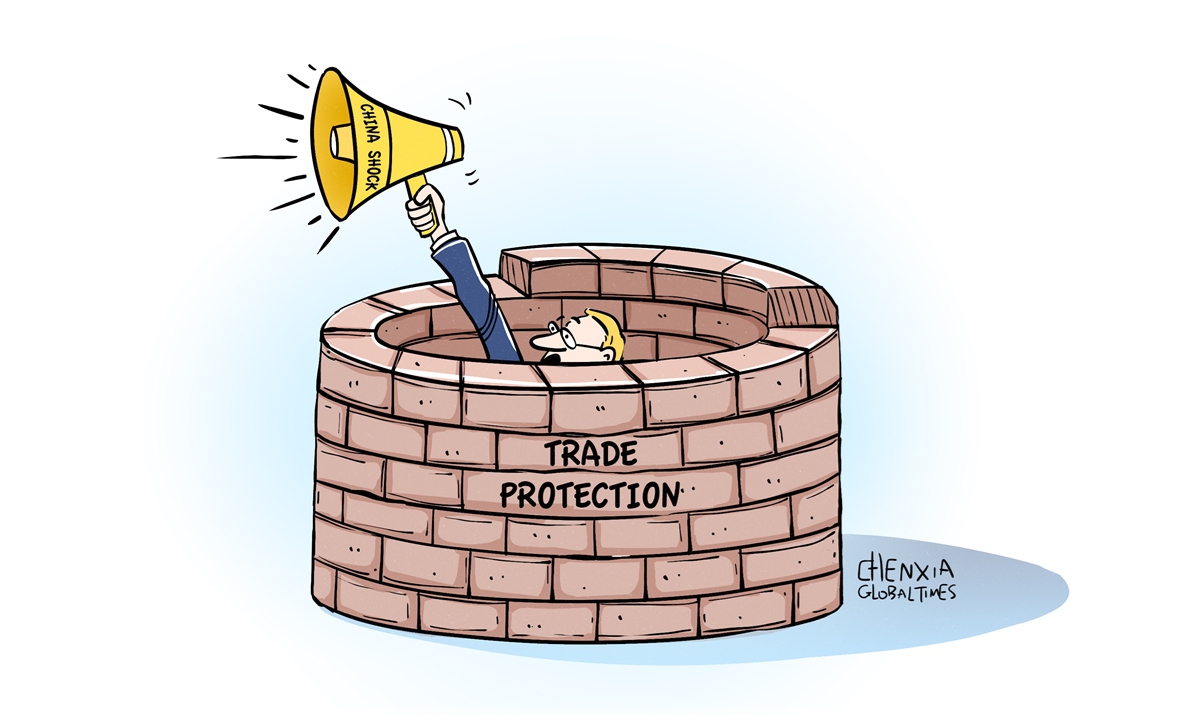
Illustration: Chen Xia/GT
Recently, some foreign media outlets have sought to portray China's outbound investment as an extension of efforts to address what they describe as domestic "overcapacity," while suggesting that a growing overseas presence by Chinese firms may intensify competition in global markets. Such arguments echo the so-called "China Shock 2.0" narrative, albeit in a new form.Yet whether the focus is China's exports or outbound investment, the argument is not persuasive. It tends to view mutually beneficial industrial cooperation through a zero-sum lens, overlooking the role of supply-chain integration, technological collaboration, and growing market demand in the host economies.
Investment is not a one-way story. China has long recognized the role that foreign capital can play in supporting its economic development and has steadily worked to improve its business environment to attract it. The country remains an important destination for global investment. Official data shows that actual foreign direct investment in China's high-tech industries reached 116.33 billion yuan ($17.2 billion) in the first four months of 2026, up 20.3 percent from a year earlier.
Why would foreign companies tend to invest in China's high-tech sectors despite the distance involved? The answer is straightforward: they see growing value.
The sustained inflow of foreign investment indicates that many international companies regard Chinese industries as commercially attractive. Viewed in this context, the overseas expansion of these sectors can fairly be mutually beneficial, creating opportunities for the host economies and supporting broader regional industrial linkages.
In this sense, the economic potential generated by China's high-tech development is not limited to inbound investment; it extends outward as well, with both capital inflows and outflows reflecting the wider diffusion of opportunities.
Chinese outbound investment creates tangible opportunities for the host economies and an efficient supply chain in the world. Equally important is the effect that Chinese outbound investments could help local industries develop faster.
Today, many emerging sectors depend on complex value chains and commercial ecosystems. Investment by Chinese companies can help fill gaps in these chains, strengthen production networks and support the development of local business infrastructure.
Chinese investment and local industries are not inherently isolated or competitive, but can be mutually reinforcing, forming integrated elements of regional industrial networks.
As high-tech innovations advance, emerging sectors often involve extensive upstream and downstream linkages, with extensive collaboration across the whole value chain. In this context, Chinese investment can create a range of opportunities for global cooperation, both within the host economies and across the wider industrial ecosystem.
Some foreign media narratives surrounding China's outbound investment appear to depart from the underlying dynamics of emerging industries and the ongoing reconfiguration of global supply chains. By casting Chinese outbound investment in a negative light, such narratives risk being used as a pretext for protectionist measures, with adverse impact on global economic efficiency and cooperation.
Global high-tech innovation has ramped up pace, with the potential to generate additional momentum and new patches of growth for the world economy. Against this backdrop, it is not technological progress itself that constitutes a shock to the global system, but the resurging protectionist thinking that poses genuine risk of hamstringing global economic growth.
As production becomes more technologically sophisticated, global value chains are likely to grow even more complex, with deeper and more intensive cross-border linkages. What the global economy requires in this context is not fragmentation, but smoother flows of goods, services and investment.
China today is both an important destination for global investment and an important source of outbound investment. In 2025, China's outbound direct investment reached $174.38 billion, up 7.1 percent from a year earlier. Outbound investment will continue to play a constructive role in supporting the economic development of the host countries, which also explains why many economies remain focused on attracting foreign capital.
In this context, a more pertinent question is how to ensure that the legitimate interests of Chinese investors abroad are adequately protected, and how to further improve the business environment in the host economies so as to remain attractive to international capital. Viewing such investment with an assumption of risk is increasingly difficult to reconcile with the realities of global economic interdependence.
RELATED ARTICLES