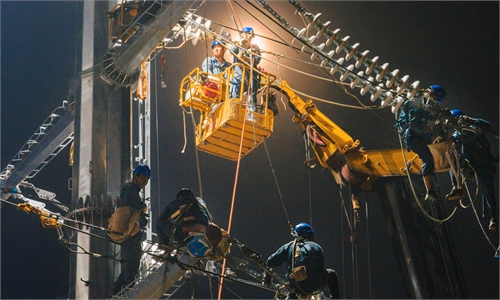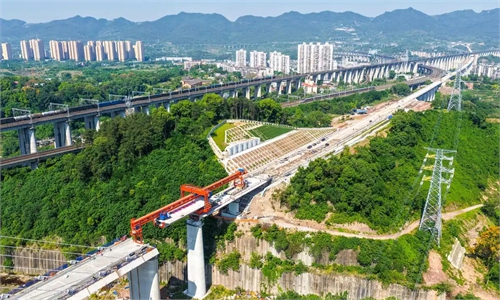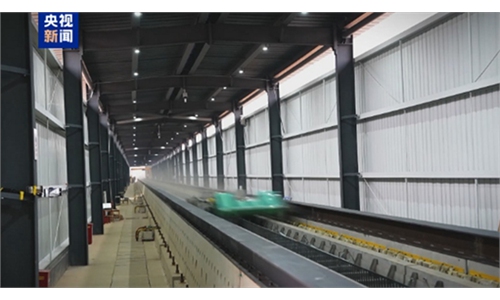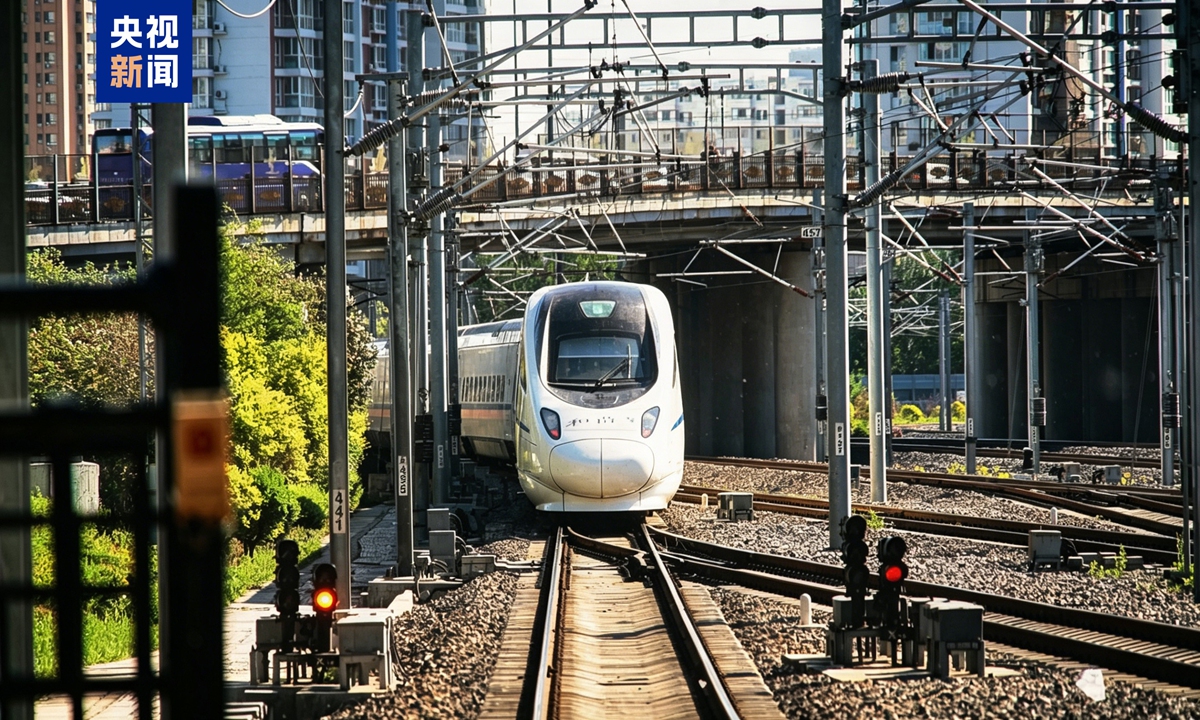
A CRH5 electric multiple unit (EMU) test train is under testing on June 1, 2026. Photo: CCTV News
A CRH5 electric multiple unit (EMU) test train on Monday departed from Harbin Station toward Yichun West Station, both in Northeast China's Heilongjiang Province, marking the launch of the first trial operation on the Harbin-Yichun high-speed railway (HSR), the highest-latitude high-speed rail line currently under construction in China, state broadcaster CCTV News reported on Monday.
The line is expected to enhance regional connectivity significantly upon its completion. The travel time between Harbin, the capital of Heilongjiang, and Yichun will be reduced from the current seven hours to less than two hours.
It is also expected to support the comprehensive revitalization of Northeast China, boost the development of winter tourism and ecological resources along the route, and further improve the regional transportation network, said the CCTV report.
The EMU trial operation comes following the launch of joint commissioning and testing of the railway starting on June 30, during which specialized inspection trains and monitoring equipment would be used to conduct dynamic examinations of the railway's track, subgrade, bridges, power supply and traction systems, communications and signaling systems, as well as passenger service information systems, according to the report.
The joint commissioning and testing steps are designed to verify and optimize operational parameters, ensuring that the integrated performance of all systems meets design specifications and safety requirements. The current round of EMU trial operations focuses primarily on testing signaling equipment and system coordination, providing critical technical support for the railway's commercial opening, the report said.
The Harbin-Yichun HSR is an extension of the Beijing-Harbin and Beijing-Hong Kong-Macao corridor, and it is part of a greater high-speed rail artery network consisting of eight vertical lines and eight horizontal lines.
The railway routes traverse permafrost regions, and so construction teams had to overcome complex geological conditions and extremely low winter temperatures associated with the high-latitude environment. The report said that the construction process has built up valuable engineering experience for the future construction of high-speed railways in even higher-latitude regions of China.
Global Times
RELATED ARTICLES