Two foreign consumers check merchandise at a duty-free shop in Guangzhou, South China's Guangdong Province, on August 26, 2025. In the first half of this year, the number of duty-free rebate stores in China surpassed 7,200, with the number of tax refund recipients up 186 percent year-on-year, while sales of tax-refunded goods and total refunds nearly doubled, according to official data. Photo: VCG
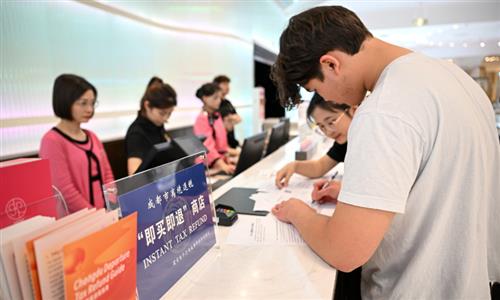
China's first online departure tax refund store was launched in Beijing on Tuesday, with the capital city's first batch of hotel-based tax refund counters also being activated, according to a press release on the official WeChat account of the Beijing Municipal Tax Service of the State Taxation Administration on Tuesday.
Chinese experts said that the move marks the expansion of the country's departure tax refund services, which will make "Shop in China" more convenient for international visitors and set a new benchmark for expanding the scale and enhancing the quality of inbound consumption.
According to the government agency, the first online departure tax refund store was jointly developed by the Beijing Municipal Tax Service, the Beijing Municipal Commerce Bureau, and Chinese e-commerce platform JD.com. By simply entering their identification and entry/exit information at checkout, the system automatically generates an electronic departure tax refund application form and invoice.
The online departure tax refund store features nearly 300 product categories across six major segments - mobile communications, consumer electronics, computers, kitchen gadgets, home appliances, and personal care - which can fully meet inbound travelers' diversified needs.
On Friday, Angela Valencia, a visitor from Indonesia, became one of the first travelers to experience this new service in Beijing. Having ordered a mobile phone for 2,319 yuan ($342.78) on Chinese e-commerce platform JD.com just a day earlier, she received it at her hotel the next day. She then brought the unopened product to the Empark Prime Hotel Beijing - one of the city's designated downtown tax refund hubs - where she swiftly completed the process on-site and received a value-added tax refund of 208 yuan, JD.com told the Global Times on Tuesday.
"The launch of China's first online departure tax refund store extends the scope of tax‑free shopping from brick‑and‑mortar outlets to e‑commerce platforms, turning policy benefits into tangible, accessible refund convenience for overseas visitors," Li Chang'an, an economist at the University of International Business and Economics in Beijing, told the Global Times on Tuesday.
In May, the Ministry of Commerce (MOFCOM)and other authorities issued a notice on further optimizing departure tax refund measures and expanding inbound consumption, which was also known as the 2.0 version of China's departure tax refund policy. The new policy package includes measures such as wider coverage of tax refund stores, random inspections for small-value refund applications, paperless processing and improved refund-upon-purchase services, according to the MOFCOM website.
Starting on July 1, customs authorities will conduct random physical inspections of tax refund application forms involving sales of less than 10,000 yuan; meanwhile, forms involving sales of 10,000 yuan or more will still be inspected one by one, a move expected to significantly reduce waiting time at ports.
China has seen growing momentum in inbound travel and shopping, supported by expanded visa-free policies, easier payment services, departure tax refund facilitation and the "Shop in China" campaign.
In 2025, sales involving departure tax refunds nearly doubled year-on-year, while inbound consumption and travel service exports rose nearly 40 percent and 50 percent, respectively, Vice Commerce Minister Sheng Qiuping told a press conference on May 18.
"Departure tax refunds represent an internationally recognized practice for stimulating consumption and serve as a key metric for assessing the globalization level of a domestic consumer market. The rollout of this 2.0 version of China's departure tax refund policy signifies that China has elevated its refund facilitation standards to almost international best practices. This advancement is expected to attract more overseas visitors to China and drive sustained growth in inbound consumption, injecting new vitality into the high-quality development of China's economy," Li said.
RELATED ARTICLES