SPORT / FOOTBALL
German Bundesliga clubs on the hunt for Chinese football talents
Taking the driver’s seat
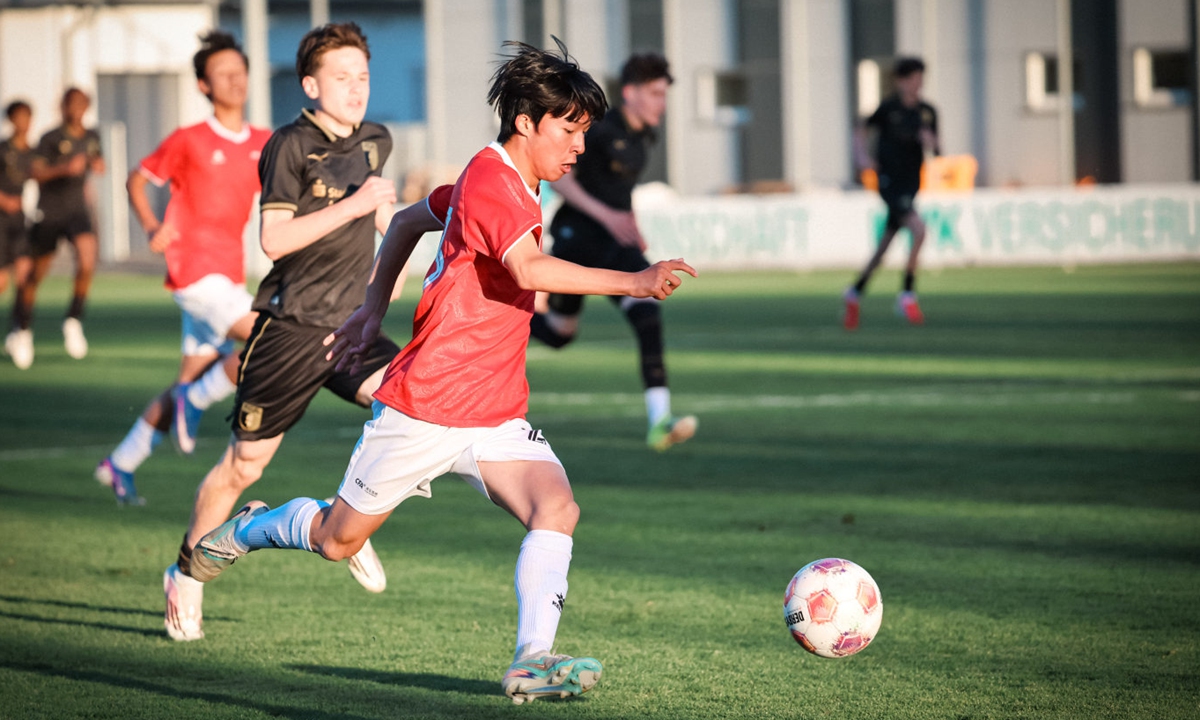
A young Chinese football player runs with the ball against a mixed FC Augsburg team made up of U-15 and U-16 players at the Paul Renz Academy in Augsburg, Germany, on April 30, 2026. Photo: Courtesy of Bundesliga International
Just a decade ago, Chinese domestic football's overseas strategy was largely defined by importing foreign stars and coaches. Today, the focus has shifted dramatically.Since the Chinese Football Association (CFA) placed greater emphasis on youth development and overseas training opportunities in 2023, an increasing number of European leagues and clubs have become involved in China's efforts to nurture the next generation of football talent. The trend has become particularly evident in the German Bundesliga.
In May, Bundesliga clubs FC Augsburg and Bayer Leverkusen hosted a CFA-selected youth team from Xi'an training center for a two-week training program in Germany under the Bundesliga Dream program.
It was not an isolated event. A total of 13 players of China's U-17 national team, which finished runners-up at the U-17 Asian Cup in May, had participated in the training programs in Germany last year.
The growing presence of Bundesliga clubs in Chinese youth development reflects a broader shift.
Rather than pursuing rapid success through expensive foreign signings, Chinese football authorities as well as grassroots entities are increasingly investing in long-term talent cultivation and international exposure.
For Felix Jäckle, an executive board member of FC Augsburg, the direction that China has chosen makes sense.
"It makes more sense to invest in the development of young talents than to spend large amounts of money bringing in foreign players who stay for a few years and then leave, without creating anything sustainable," Jäckle told the Global Times during his visit to Beijing on Monday.
"It is the right strategy to strengthen Chinese football through the development of young talents, both boys and girls," he noted.
As a result, Bundesliga clubs have emerged as one of China's most active overseas partners in youth development.
In late May, German giants Borussia Dortmund became the first overseas club since 2023 to sign a direct memorandum of understanding with the CFA, which includes training camps for Chinese youth teams in Dortmund, trial opportunities for outstanding players and coaching exchanges.
CFA President Song Kai expressed his hope that Borussia Dortmund could leverage its strengths in youth training expertise and existing project foundations to bolster China's youth football system and young talents training overseas, according to the CFA.
Elsewhere in May, Bundesliga club VfL Wolfsburg opened a permanent football academy in Hefei, East China's Anhui Province. Also notably, a partnership between Eintracht Frankfurt and a local school in Shenzhen, South China's Guangdong Province has become a model for integrating elite football training with education-based development.
By combining professional coaching methods with domestic school systems, the program aims to ensure that young players are supported not only on the pitch but also in their academic progression, creating clearer dual-career pathways for China's aspiring footballers.
At club level, German teams are increasingly viewing China not only as a commercial market but also as a source of future talent. For clubs outside the Bundesliga's traditional powerhouses, youth development has become a key competitive advantage.
"One of our focuses is to give young players a chance, because football is always a race for the next talent," Jäckle said.
Beyond one-off training camps
One challenge facing Chinese players who want to play overseas is that FIFA regulations generally prevent international transfers of minors under the age of 18, except under limited circumstances. As a result, most promising Chinese teenagers cannot simply move directly into European football club academies.
Instead, clubs and football authorities are exploring gradual development pathways.
Julian Heichele, a senior marketing official with FC Augsburg, believes regular exposure may be more valuable than immediate transfers.
"We cannot and do not want to sign players when they are very young, but we do want to help them develop and gradually adapt to European football," Heichele told the Global Times.
Heichele also suggested allowing promising players to return to Augsburg twice a year for additional training and development opportunities.
"We think it is beneficial for players to visit regularly, participate in training, get to know the club, the culture and the language. Our hope is that this will help talented Asian players adapt gradually to the European level," he said.
Such pathways may prove increasingly important as more Chinese youth internationals gain opportunities to go abroad, where the domestic football pace was often considered as a hindrance to their personal growth.
These emerging development pathways are gradually moving beyond short-term training, with a small but growing number of Chinese youth players now training or competing in Bundesliga club academies. Chinese U19 international Xie Chujun is currently playing with FC Stuttgart's U19 side, while Jiang Jingqi is part of Wolfsburg's U-17 setup, making the German Bundesliga one of the most prominent destinations for Chinese youth players in Europe's top leagues.
Building structures
While no single overseas training camp or partnership can transform a football nation, the growing network connecting Chinese youth football with Bundesliga clubs suggests a broader shift toward structured international development pathways rather than short-term exposure.
For German clubs, interest in China extends beyond individual players. Many see opportunities to share expertise in academy management, coaching education and club operations.
Heichele said Augsburg is currently discussing potential partnerships in China to focus primarily on youth football development.
The emphasis on patience and sustainability stands in contrast to the rapid expansion-and-collapse cycles that characterized sections of Chinese professional football during the previous decade.
Jäckle believes long-term thinking is essential.
"What is important for us is that any partnership must be long-term, sustainable and beneficial for all sides involved," he said. "It has to be a true win-win situation with a long-term perspective."
RELATED ARTICLES