Mass production of T1000-grade carbon fiber marks new step in China’s high-end materials push
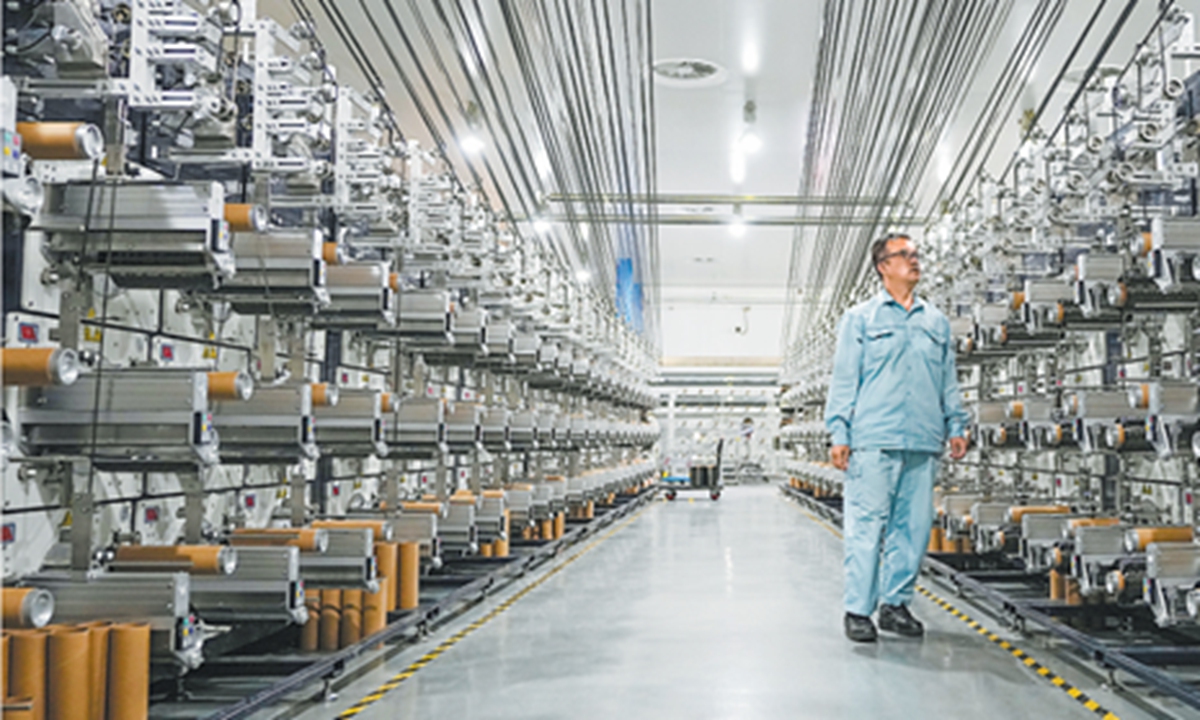
A worker patrols at Sinopec's carbon fiber factory in Shanghai. Photo: Screenshot of China Sinopec's website
A research institute under China Sinopec has achieved a key technological breakthrough in wet-process T1000-grade high-performance carbon fiber and realized mass production, marking another step in China's push to strengthen the domestic supply of strategic materials for high-end manufacturing and industries of the future.
The breakthrough, completed by Sinopec Shanghai Petrochemical Co and the Shanghai Research Institute of Petrochemical Technology, will provide core material support for key sectors including aerospace, embodied intelligence and the low-altitude economy, Sinopec said on its official Weibo account on Tuesday.
The high-performance carbon fiber developed and mass-produced by Shanghai Petrochemical is a 12K small-tow product, meaning that each bundle contains 12,000 individual filaments. Each filament is only about one-tenth the diameter of a human hair, yet carries outstanding mechanical strength, according to Sinopec.
A single tow has a tensile strength of more than 6.5 gigapascals and a tensile modulus of more than 300 gigapascals, strong enough to pull a medium-sized truck weighing about 10 tons, according to China News Service (CNS).
Carbon fiber, often called the "king of new materials" and "black gold," is less than one-fourth as dense as steel but seven to nine times stronger. It is also corrosion-resistant, making it vital for lightweight, high-strength applications.
Carbon fiber is usually divided by tow size into small-tow and large-tow products. In industry usage, "K" refers to the number of filaments in a bundle - 1K means 1,000 filaments - while "T" indicates tensile-strength grade, with a higher number meaning greater strength.
Small-tow carbon fiber, usually 24K and below, is finer, more uniform and more precise, making it suitable for aerospace, high-end equipment and other demanding uses. Large-tow carbon fiber, usually 48K and above, offers higher production capacity and lower costs, supporting large-scale applications such as wind power and energy storage, according to CNS.
Sinopec now has the capacity to produce nearly 20 carbon fiber models. Its products cover both general-purpose and high-performance grades and can be used in aerospace, high-end manufacturing, wind power, transportation, sports and leisure, the report said.
"The mass production of T1000-grade small-tow carbon fiber means equipment can become lighter, more energy-efficient and more durable. It will allow aircraft and other advanced systems to fly higher and farther, while becoming more compact, precise and flexible," Wu Chenhui, an industry analyst, told the Global Times on Tuesday.
High-performance carbon fiber is a typical strategic advanced material, Wu noted, adding "Once key materials can be supplied in a stable and reliable way, they provide a stronger foundation for China's scientific and technological innovation, helping the country move toward - and in some areas beyond - the world's leading level."
The latest achievement comes as China's carbon fiber industry is moving beyond capacity expansion toward higher performance, broader product coverage and stronger domestic supply-chain resilience.
In May, the first phase of Sinopec Shanghai Petrochemical's 30,000-ton large-tow carbon fiber project started operation and produced qualified products, according to the company's website. The phase includes two production lines, each with a designed capacity of more than 3,000 tons, marking the completion of China's largest single-line-capacity 48K large-tow carbon fiber production line, according to people.cn.
China has also made progress at even higher strength grades. In March, China National Building Material Group released SYT80, a T1200-grade ultra-high-strength carbon fiber independently developed by Zhongfu Shenying Carbon Fiber. The material has an engineering tensile strength of more than 8,000 megapascals, and it was the world's first T1200-grade carbon fiber product to achieve mass production, state broadcaster CCTV reported.
Separately, a high-performance carbon fiber production base in Datong, North China's Shanxi Province, achieved stable mass production of T1000-grade carbon fiber in November 2025, with a production line with capacity of 200 tons per year completed in 17 months, according to the Xinhua News Agency.
"China now has a clearer, more forward-looking and better-supported road map for scientific and technological development. High-quality innovation in advanced materials will be a key foundation for industries of the future, helping sectors such as aerospace, the low-altitude economy and embodied intelligence develop new products, upgrade technologies and build stronger global competitiveness," Wu noted.
RELATED ARTICLES