China's first major canal linking inland waterways with sea achieves full water filling, set for full navigation in September
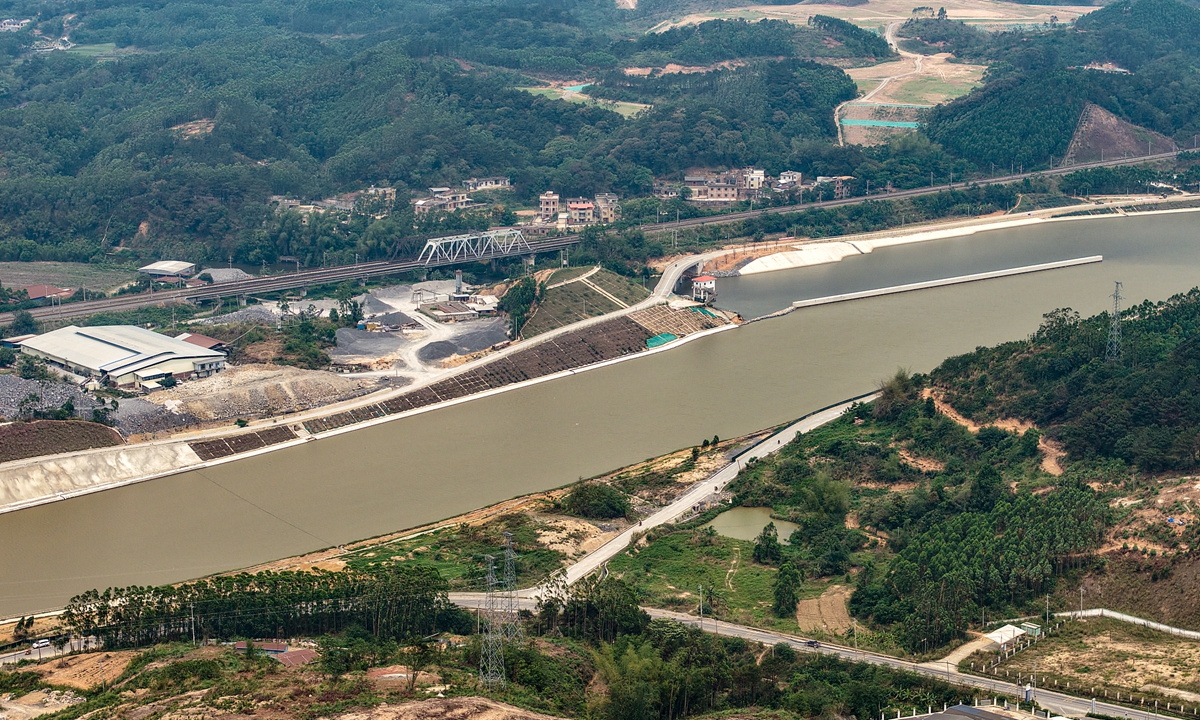
Photo: VCG
China's Pinglu Canal, a key project on the New International Land-Sea Trade Corridor, achieved full water filling on Wednesday as the Ma'dao and Qishi navigation hubs have begun to be filled with water, according to CCTV News.
The canal has entered the water-testing phase on Wednesday, with full navigation scheduled for September this year, according to the CCTV News report.
Initiated in August 2022 and scheduled to start operation by the end of 2026, the Pinglu Canal is a flagship project on the New International Land-Sea Trade Corridor, an important trade and logistics passage jointly built by provincial-level regions in western China and members of the Association of Southeast Asian Nations (ASEAN).
The 134.2-km-long waterway stretches from the Xijin reservoir in the city of Hengzhou to Qinzhou Port in South China's Guangxi Zhuang Autonomous Region, the Xinhua News Agency reported.
By establishing a convenient and cost-effective passage to ASEAN member states, the Pinglu Canal has garnered widespread acclaim as a positive advancement that will enhance maritime connectivity with the bloc, Xinhua reported.
The achievement represents a major breakthrough for the New International Land-Sea Trade Corridor, creating a direct maritime outlet for southwest China by linking the Xijiang river system to ports in the Beibu Gulf of Guangxi. The aim is to give China's less-prosperous inland regions quicker and easier access to global sea lanes, boosting local industry and strengthening trade with the country's largest export market: the ASEAN market, Hu Qimu, a professor at the Maritime Silk Road Institute of Huaqiao University, told the Global Times on Wednesday.
Once fully operational, cargo vessels from Guangxi and the broader southwest region will save more than 560 kilometers on their journey to the sea, said the report.
As the first canal built since the founding of the People's Republic of China, to connect a river system directly to the sea, the Pinglu Canal is improving access for cargo ships from southwest China to international shipping routes. Meanwhile, this project has achieved many "world firsts" and "national records."
Among them, the Ma'dao hub has set two world records. It is now the world's largest water-saving ship lock in terms of water-level difference, with a maximum upstream-downstream drop of 29.6 meters, roughly equivalent to a 10-story building. It is also the world's largest inland water-saving ship lock, with a lock chamber measuring 300 meters long and 34 meters wide. Each chamber is large enough to accommodate multiple large vessels, and the two locks together can handle 12 ships of 5,000-ton class at the same time.
The Pinglu Canal has set numerous impressive records, injecting powerful momentum into the China-ASEAN trade, Hu said. As rail, road, and waterway converge into a multimodal transport hub in the Beibu Gulf, the resilience and redundancy of supply chains connecting Southwest China to ASEAN will be markedly enhanced.
Hu noted that the project's profound impact on the China-ASEAN trade corridor, the industrial landscape of Southwest China, and inland waterway navigation technology standards will continue to unfold over the next five to 10 years. This project also represents a paradigmatic endeavor in deepening regional economic integration through infrastructure connectivity.
RELATED ARTICLES