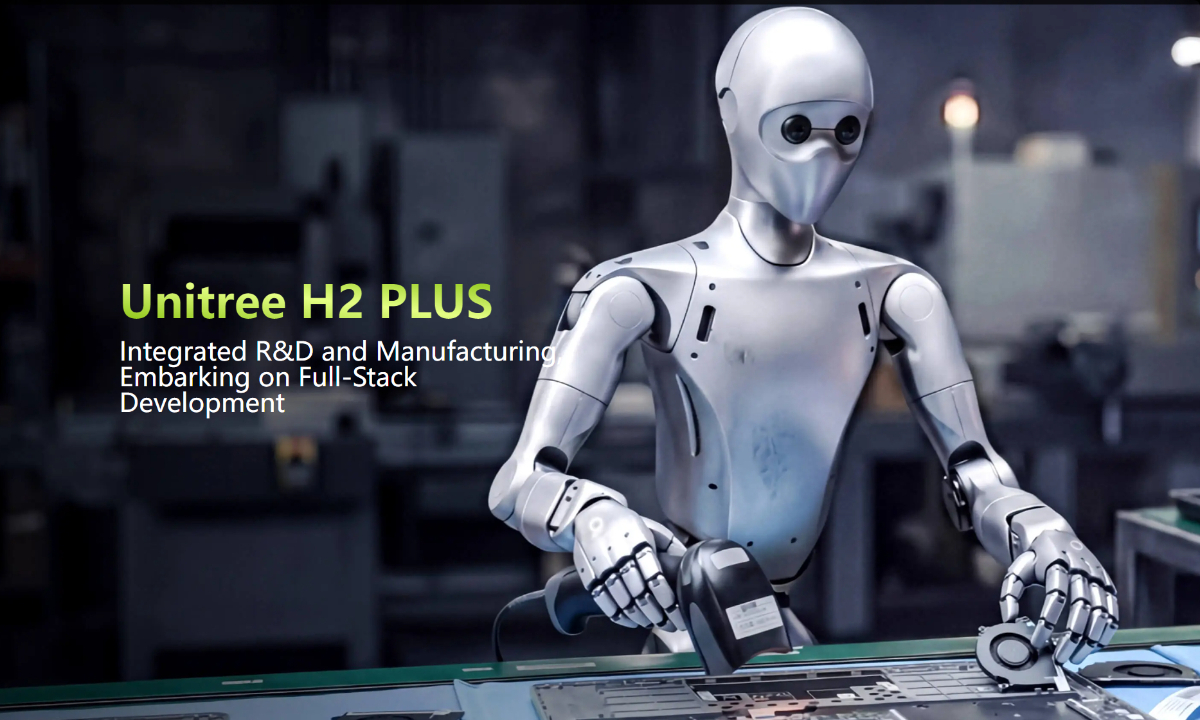
Unitree Robotics in partnership with Nvidia has rolled out a new humanoid robot reference design, the H2 Plus. Photo: Screenshot from Unitree Robotics' website
Unitree Robotics in partnership with Nvidia has rolled out a new humanoid robot reference design, the H2 Plus.
Huang Jiawei, Unitree’s Director of Marketing, told the Global Times on Wednesday the new model is set for launch in the second half of this year, with its core highlight resting on an advanced high-performance computing stack from Nvidia that powers a more capable "intelligent brain" for humanoid machines.
Officially unveiled by the two companies on Monday, H2 Plus sees marked upgrades primarily in computing capability, according to Huang.
According to details posted on Unitree’s official website, H2 Plus integrates a humanoid robot body, Sharpa five-fingered hands for dexterous manipulation, Nvidia Jetson Thor onboard compute for real-time sensor processing and robot inference, and Nvidia’s Isaac GR00T open software and models.
The Isaac GR00T development platform, spanning data capture and generation to robot model evaluation and deployment, helps researchers and developers accelerate humanoid development workflows, according to the website of Nvidia.
"Leveraging Nvidia’s computing platform, we aim to advance the whole humanoid robotics industry," Huang said.
Unitree expects relevant data to be adopted for future iterations of the computing platform, making the robot’s "intelligent brain" smarter — a core pillar of the firm’s long-term development roadmap, Huang said.
Wang Xingxing, founder and CEO of Unitree Robotics, said that "H2 Plus combines Unitree's humanoid with Nvidia Jetson Thor and Nvidia’s Isaac GR00T development platform, giving teams a validated starting point for creating more robotic skills and bringing them into real-world applications."
