ARTS / CULTURE & LEISURE
Feel Xizang’s ancient soul and youthful vitality in Lhasa
Coffee and sweet tea
By in Lhasa Published: Jun 03, 2026 08:43 PM

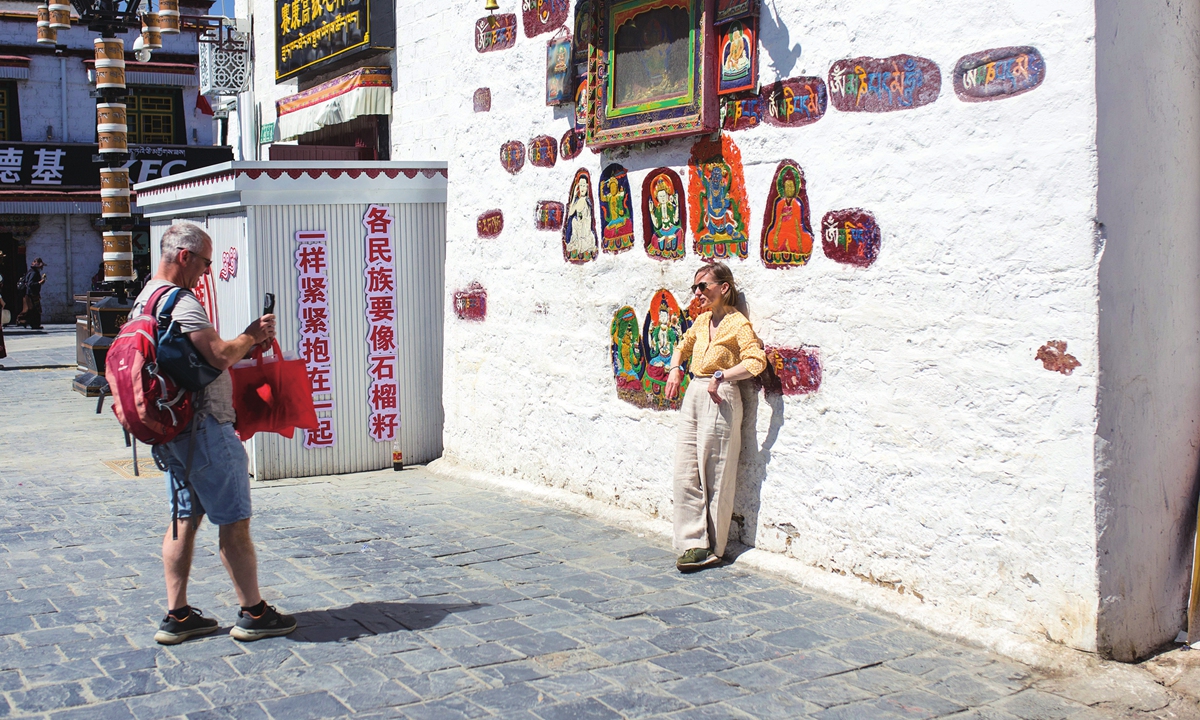
Foreign tourists visit the Barkhor Street on May 22, 2026. Photos: Shan Jie/Global Times
At one corner of Barkhor Street, a pilgrim turns a prayer wheel, a young traveler in Tibetan-style clothing poses for photos, and a shop window displays a Labubu toy beside thangka paintings, Buddhist statues and handmade crafts.
For many visitors, Lhasa, Southwest China's Xizang Autonomous Region, was once imagined through familiar images: the Potala Palace in the distance, Jokhang Temple at the heart of the old city, and pilgrims circling Barkhor Street. But during a recent visit, the Global Times reporter found a new kind of tourism appeal taking shape.
Here, history is not something preserved behind glass, it is carried forward by the people who live it.
A living temple
For worshippers, Jokhang Temple is one of the most important places of pilgrimage. For visitors, it is also an entry point to understanding Lhasa's history, architecture, religion and cultural relics.
Built in the seventh century, Jokhang Temple was added to the UNESCO World Heritage List in 2000 as part of the historic ensemble of the Potala Palace, according to the Xinhua News Agency. Walking into the temple, one can see halls, murals, statues, scriptures and wooden structures carry long layers of history.
Yet Jokhang Temple today is also responding to the arrival of modern tourism in a more detailed and open way.
Tashi, a young monk at Jokhang Temple, told the Global Times that the temple receives one of the largest numbers of worshippers and tourists in Xizang. At Jokhang Temple, monks spend their days serving worshippers and visitors, studying, debating Buddhist texts and continuing their religious training.
As more tourists from other parts of China and overseas visit Lhasa, monks also need to improve their ability to communicate in putonghua, learn about cyber security laws, and sometimes provide basic explanations for media workers and tourists, Tashi said.
He and other monks have also visited other parts of China to learn how religious venues and tourist attractions are managed, he said. Such experience, he noted, helps them think about how Jokhang Temple can better serve worshippers and visitors while preserving its own traditions.
Laba, executive deputy director of the Jokhang Temple management committee, told the Global Times that people come to Jokhang Temple from different regions and countries. Many are not only drawn by religious belief, but also by its heritage and history.
In terms of cultural relic protection, Laba said that repairs to Jokhang Temple are carried out in a way that preserves the original structure and appearance. The temple follows the principle of restoring the old as it was originally, continuing traditional techniques and ancient methods rather than simply replacing them with new technologies.
When visitors walk back out to Barkhor Street, Jokhang Temple does not feel like a distant historical site. It remains part of the city's present-day rhythm, connected to the people moving through it every day.
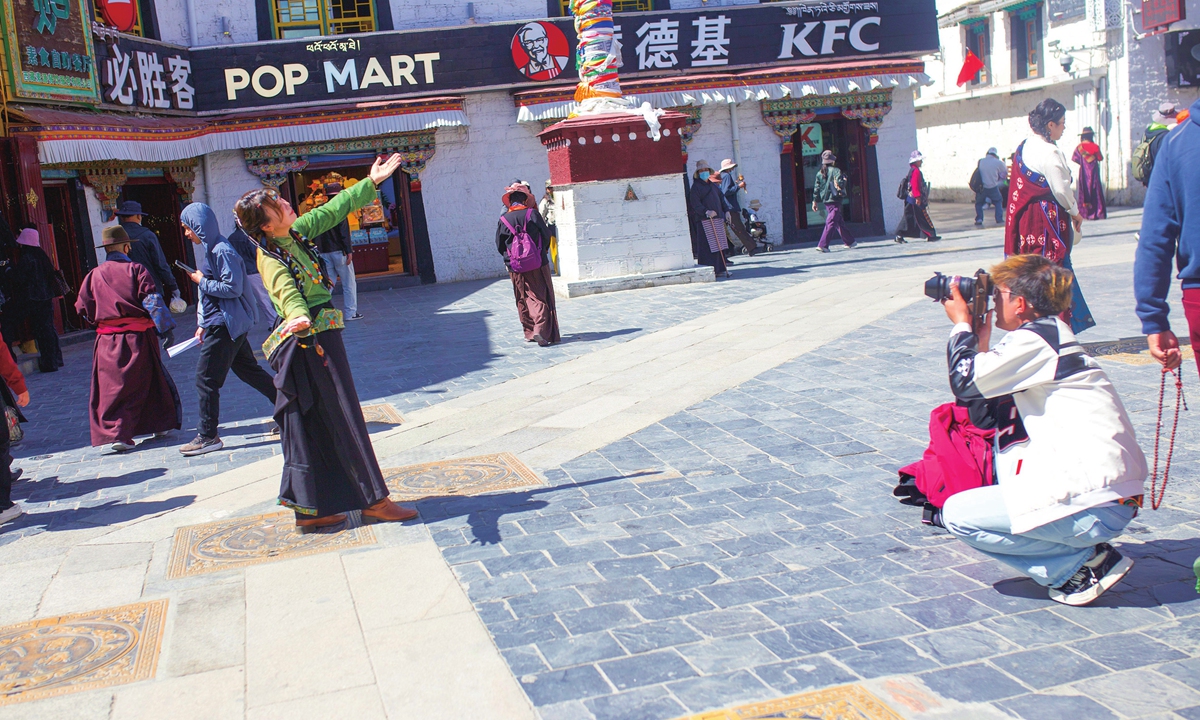
A tourist dressed in Tibetan clothing poses for photos on Barkhor Street, Lhasa, Southwest China's Xizang Autonomous Region on May 22, 2026.
Young Lhasa in alleysWalking outward from Jokhang Temple, Barkhor Street is not only a pilgrimage route. It has also become a lively urban corridor where worshippers, Tibetan-style photo studios, sweet tea houses, cultural and creative spaces, coffee shops and fashion stores appear together.
One of the surprising sights near the old city is the coexistence of familiar consumer brands such as Pop Mart, KFC and Pizza Hut with thangka shops and Buddhist statue stores.
The contrast may seem playful at first glance, but it also reflects a changing urban texture: Lhasa is both a historic city with irreplaceable cultural depth and a modern Chinese city with increasingly diverse consumer choices.
This new side of Lhasa does not feel abrupt. It is not a copy of internet-famous store models from other cities. Instead, it grows out of local materials, Tibetan aesthetics, community spaces and the lifestyle of young people.
In recent years, local fashion brands represented by NERHI have become new symbols of Lhasa's urban style.
NERHI combines Tibetan elements with streetwear and outdoor aesthetics. From redesigned Tibetan clothing and light outdoor wear to wool-felt figures inspired by yetis, its products carry a clear sense of design.
When the Global Times interviewed Nyema Droma, founder and designer of NERHI, in 2019, when the brand was still in its early stage, she said she wanted to combine traditional and modern elements in her designs to break stereotypes about Xizang.
Today, NERHI stores have become frequently mentioned destinations on Chinese lifestyle platform RedNote, and the brand has become one of the names associated with Xizang fashion. Its growth has also encouraged the emergence of more modern local brands that try to express Tibetan culture in a contemporary way.
In Xiazha Courtyard, a small handmade studio with an almost hidden storefront represents another example of how local memory can be turned into design. The shop makes bags from recycled old Tibetan woven rugs, creating one-of-a-kind items.
Some visitors compare the concept to Freitag, the Swiss brand known for recycling truck tarps into bags. But the connection in Lhasa is more direct: Old woven rugs were once part of local life. What travelers take away is not a mass-produced souvenir, but a piece of local memory that has been redesigned and reused.
In another corner of the same courtyard is Nindo Coffee. This brand can now be seen in many busy areas of Lhasa, often crowded with customers.
The name "Nindo" means close friend in Tibetan. Founded in 2018, the brand has attracted attention with its "coffee plus Tibetan culture" model. It has also established Xizang's first highland coffee laboratory and successfully processed coffee beans grown in Medog, Xizang.
Still, one should not forget the old tea houses.
Old Guangming Sweet Tea House, offering Xizang's specialty drink, is often described by visitors as one of Lhasa's most vivid "information exchange centers." Inside, local uncles and aunties talk loudly, strangers share tables without much hesitation, and a cup of sweet tea costs only one yuan.
With some cash and a free afternoon, it is easy to sit down and let the day unfold at the slow pace of local life.
By the time one walks back into the flow of Barkhor Street, the ancient and the young no longer feel like two separate sides of Lhasa. They appear in the same street, the same courtyard and the same living city.
RELATED ARTICLES