SPORT / MISCELLANY
WADA highlights education, global cooperation at regional symposium
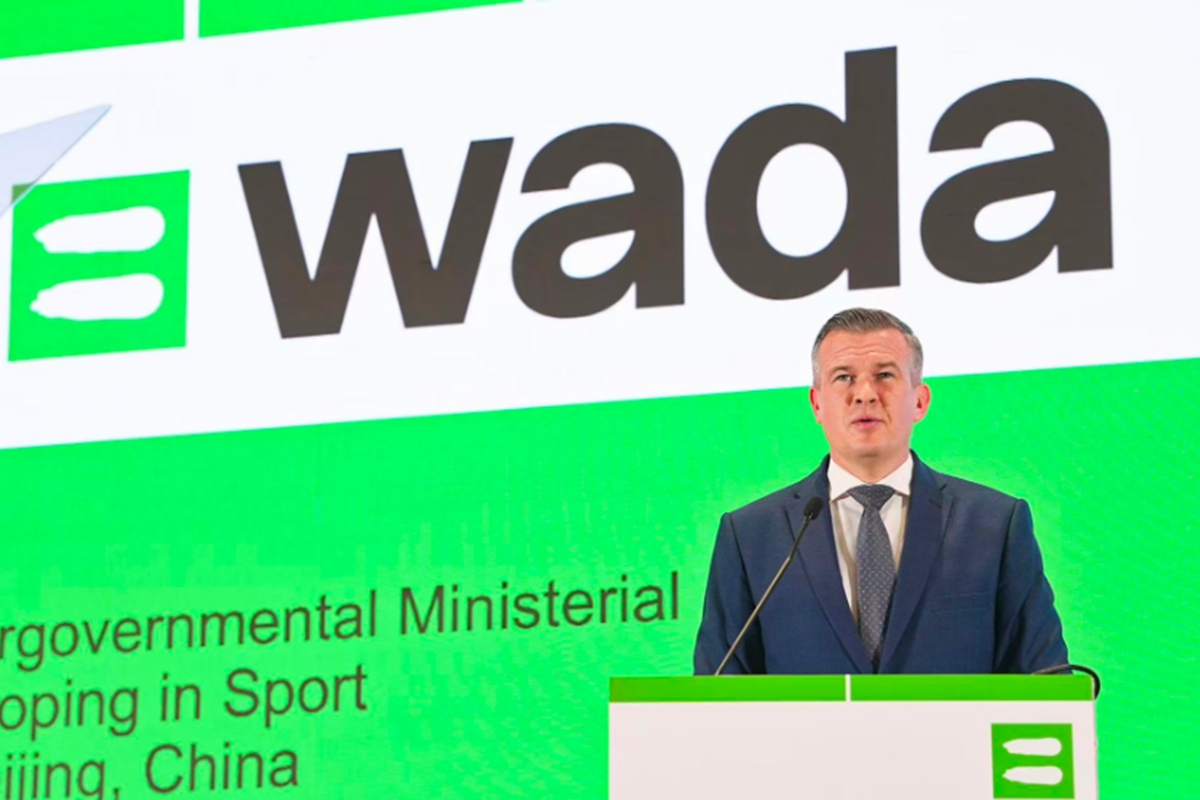
WADA President Witold Banka Photo: Courtesy of CHINADA
The World Anti-Doping Agency (WADA) reaffirmed its commitment to a harmonized global anti-doping system while highlighting the growing role of education and interna-tional cooperation during the 2026 Asia/Oceania Regional Symposium in Beijing that con-cluded on Wednesday.The symposium, hosted by WADA and the China Anti-Doping Agency (CHINADA), has brought together government officials, anti-doping organizations and sports bodies from across the region to discuss preparations for the implementation of the 2027 World An-ti-Doping Code and International Standards, which will take effect on January 1, 2027.
Speaking at a press conference on the sidelines of the symposium on Tuesday, WADA President Witold Banka described harmonization as the greatest achievement of the global anti-doping movement.
"The same rules and the same standards apply to almost all sports and all countries in the world," Banka told the Global Times when asked about WADA facing growing scrutiny in recent years.
"Fairness is the biggest value of WADA, and we will always defend it because it is funda-mental to the credibility of sport."
Banka also pointed to gaps in the global anti-doping landscape, noting that some major sports organizations, especially in the US, remain outside the World Anti-Doping Code system.
"Some sports are not Code signatories. There are private leagues, for instance in the US, which have their own programs that are quite weak when it comes to anti-doping," he said. "There is also the NCAA (National Collegiate Athletics Association in the United States and Canada) in academy sport, and it is no mystery that they are not Code signatories ei-ther."
Banka said bringing such organizations into the global anti-doping framework should be a priority for national authorities.
"It should be a mission of the US Anti-Doping Agency (USADA) to convince all stake-holders to be part of the system," he said.
Stressing the importance of a harmonized approach, Banka argued that anti-doping efforts are strongest when all stakeholders operate under the same set of rules and standards.
"For many years, we have encouraged our colleagues from USADA to focus more on their own backyard rather than focusing on other countries," he said. "I'm not sure whether they took the point."
Banka said WADA's unique role as the global regulator often makes it the target of criti-cism, but he insisted the agency applies the same standards to all stakeholders regardless of nationality or sport.
He also praised China's commitment to clean sport and said the country's zero-tolerance approach to doping aligns closely with WADA's mission.
"We have to work hand in hand to make sure the system works and that policies are in line with the Code," Banka said, noting that cooperation between WADA and CHINADA could be expanded in scientific research, new testing technologies and anti-doping educa-tion.
At the same time, he cautioned against viewing a complete absence of doping violations as evidence of a successful anti-doping program.
"Doping is everywhere in every country," Banka said. "The fact that there are positive tests or athletes violating the rules is part of the reality we live in. What matters is that the system is strong enough to detect violations and ensure appropriate sanctions."
The importance of education emerged as one of the central themes of the symposium.
WADA Vice President Yang Yang argued that anti-doping efforts should focus not only on enforcement but also on supporting athletes throughout their development.
"Athletes need more than just regulations. They need guidance, encouragement, trusted mentors and positive examples to follow," Yang said at the symposium. "Education equips them to pursue sport honestly throughout their careers."
The former Chinese Winter Olympic champion skater stressed that a young athlete's first encounter with anti-doping should come through education and support rather than testing and sanctions.
According to Yang, the 2027 Code and International Standard for Education will require anti-doping education for minors competing internationally, making government support even more important.
"Governmental support is critical to ensuring that we reach coaches, support personnel and medical professionals, all those who interact with athletes throughout their careers," she said.
Yang's remarks echoed WADA's broader message that governments play a vital role in building effective anti-doping programs and supporting national anti-doping organizations as they prepare for the transition to the revised Code.
WADA Director-General Olivier Niggli also emphasized the importance of prevention, ar-guing that anti-doping extends far beyond elite sport.
Governments, he noted, are uniquely positioned to introduce anti-doping education in schools and help instill clean-sport values at an early age. "The most effective long-term way to fight doping is prevention," Niggli said.
He warned that the misuse of performance-enhancing substances is not limited to profes-sional athletes. Large-scale seizures of prohibited substances around the world indicate that many are being purchased by recreational athletes and gym users, making the issue a broader public health challenge.
At the symposium, China's anti-doping authority also outlined the priorities ahead of the implementation of the revised Code.
Li Zhiquan, director-general of CHINADA, said China will continue to uphold a ze-ro-tolerance stance on doping while adhering to the principle of "prevention as the core and education as the base."
"We must ensure that anti-doping education reaches athletes' minds, hearts and actions," Li said.
He said particular attention would be given to young athletes, with greater emphasis placed on values-based education and the protection of minors.
Beyond domestic preparations, Li stressed the importance of international cooperation. "Anti-doping is a global undertaking," he said. "It is not enough for one country to do well on its own."
Li said China is prepared to share its experience with other countries. "We will continue to promote international exchanges and cooperation and share China's practices and solu-tions," Li said.
RELATED ARTICLES