ARTS / CULTURE & LEISURE
HK Palace Museum unveils exhibition exploring Forbidden City’s global connections
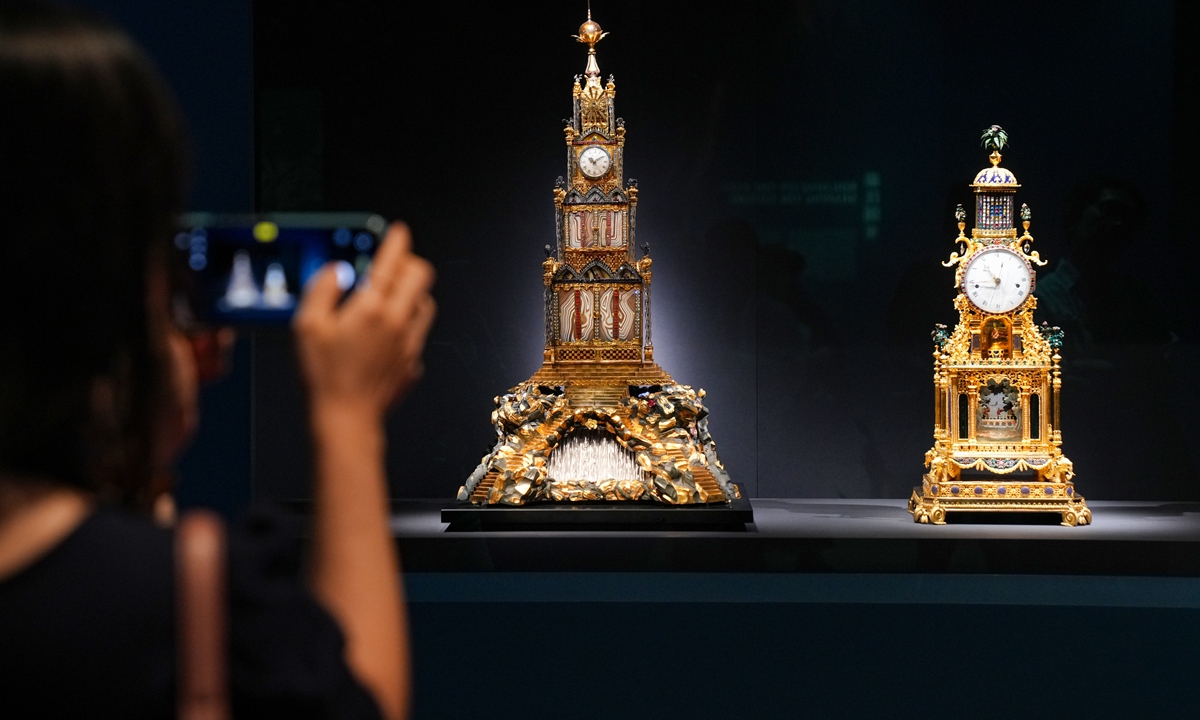
A visitor takes photos of two 18th-century musical table clocks on display at the HKPM. Photo: VCG
The Hong Kong Palace Museum (HKPM) and the Palace Museum in Beijing on Wednesday jointly kicked off in Hong Kong a major exhibition examining the historical exchanges between China and the wider world through the lens of the Forbidden City.Titled The Hong Kong Jockey Club Series: The Forbidden City and the World - Cultural Encounters, the exhibition brings together more than 130 rare artifacts from three leading institutions: the Palace Museum in Beijing, the HKPM and the Museum of Islamic Art in Doha.
Positioning the Forbidden City within a global context, the exhibition traces more than six centuries of exchanges between China, other parts of Asia and Europe across the Yuan (1279-1368), Ming (1368-1644) and Qing (1644-1911) dynasties. It explores interactions in diplomacy, trade, science, technology, philosophy and the arts, revealing how the movement of ideas, goods and knowledge across regions shaped life and culture within the imperial court.
The exhibition features over 130 treasures, including 18 grade-one national treasures, China's highest category of protected cultural relics. The exhibits encompass paintings, calligraphy, jewelry, clocks and watches, ceramics, glassware, furniture, textiles and scholars' objects.
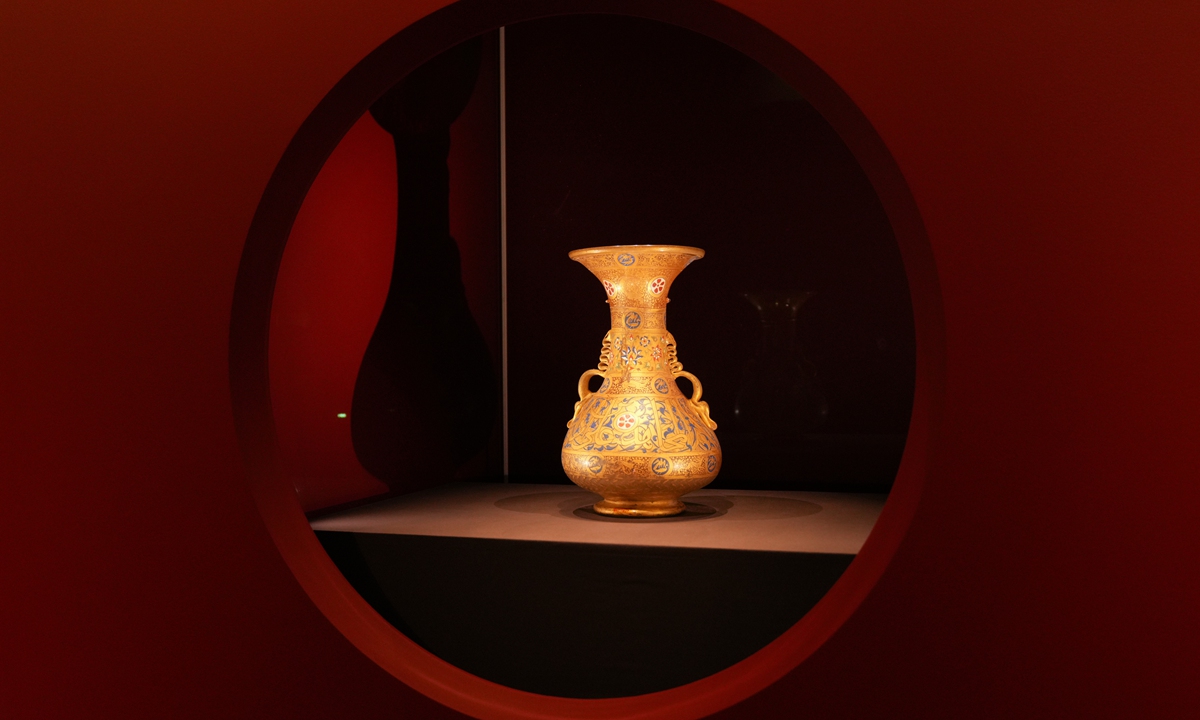
A mosque lamp made during the Mamluk Dynasty (1250-1517) at the exhibition Photo: VCG
The exhibition is organized into four thematic sections. The first section, "Routes of Exchange - Marco Polo and Zheng He," examines China's vibrant connections with other regions during the Yuan and early Ming dynasties. One of the featured artifacts in this section is a mounting fabric with patterns of cranes, deer and persimmon pedicels dating to the Hongwu reign (1368-1398) of the Ming Dynasty, reflecting cultural exchanges at that time.The second section, "Imported Treasures - Ming Court Art and New Knowledge of the World," explores the arrival of luxury goods and new knowledge from South and Southeast Asia during the late Ming period and their lasting impact on imperial artistic production, reflecting Chinese culture's inclusiveness and inventiveness.
Highlights of the section include two grade-one national treasures: a ruyi scepter in the form of a lingzhi fungus and a pendant.
The third section, "East Meets West - Artistic and Scientific Exchanges in the Qing Dynasty," focuses on the flourishing exchanges of knowledge and craftsmanship during the reigns of the Kangxi (1662-1722), Yongzheng (1723-1735) and Qianlong (1736-1795) emperors.
Among the standout exhibits is a geometric polyhedron model, illustrating the Kangxi Emperor's interest in mathematics and his willingness to engage with scientific knowledge introduced from abroad.
The final section, "The Emperor's Southern Treasury - The Canton Customs and the World," examines how the Canton Customs influenced court culture from the mid to late Qing Dynasty.
Among the most important commodities of exchange was tea, which helped spark a taste for tea drinking across Europe and even inspired the development of European tea services.
Speaking at the opening ceremony, Zhu Hongwen, deputy director of the Palace Museum, said the exhibition demonstrates both the richness of Chinese civilization and its openness to cultural exchange.
"It offers the audience a deeper understanding of the enduring and far-reaching exchanges and mutual influences between China and the wider world, while encouraging appreciation of Chinese art and culture from diverse perspectives," noted Zhu.
Leo Kung, chairman of the HKPM Board, said the exhibition holds special significance for Hong Kong.
"It is especially meaningful that this exhibition is presented in Hong Kong, as it resonates with the city's multiculturalism and echoes the core mission of the Hong Kong Palace Museum in deepening understanding and appreciation of Chinese art and culture while promoting dialogue among world civilizations."
Since its opening in 2022, the HKPM has maintained a close partnership with the Palace Museum in Beijing to promote Chinese culture and foster cultural exchange between China and the rest of the world by co-organizing numerous exhibitions and bringing a total of over 2,200 treasures from the Palace Museum collection to Hong Kong, according to the HKPM.
RELATED ARTICLES