New canal carves out a new win-win waterway for China, ASEAN: Global Times editorial
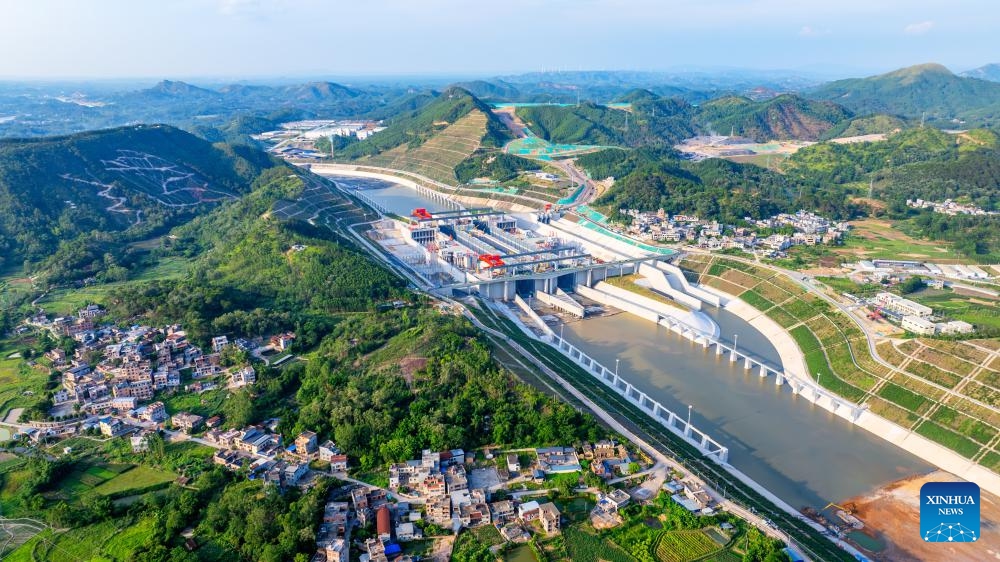
An aerial drone photo taken on June 3, 2026 shows water being pumped into the Madao hub on the Pinglu Canal in south China's Guangxi Zhuang Autonomous Region. Water began flowing through the final sections of the Pinglu Canal on Wednesday, bringing the long-awaited shortcut to the coast in south China a step closer to opening for navigation. As water was pumped into the canal on Wednesday morning, the 134.2-kilometer waterway has now achieved full-channel connectivity and entered the final phase ahead of its expected inauguration in September. (Photo: Xinhua)
On June 3, the Pinglu Canal, the first major river-to-sea canal project planned and coordinated at the national level since the founding of the People's Republic of China, achieved full-channel connectivity and entered the final phase of testing with water. Stretching 134.2 kilometers, the canal begins at the Pingtang River in Hengzhou City, South China's Guangxi Zhuang Autonomous Region, passes through Luwu Town in Lingshan County, Qinzhou, and connects to the Beibu Gulf via the Qinjiang River. It will fundamentally end Guangxi's long-standing limitation of being "connected to rivers but not to the sea," realizing the vision of "a river's spring waters flowing southward." The strategic significance of this project goes far beyond water conservancy or shipping itself; it will also become a key driver in deepening China-ASEAN cooperation.
Although the Beibu Gulf in Guangxi is the nearest maritime outlet for Southwest China, the lack of a direct river-to-sea corridor has long forced goods from Guangxi and the broader Southwest to detour eastward via the Xijiang River Waterway before reaching Southeast Asian markets. The core value of the Pinglu Canal lies in opening the shortest, most cost-effective, and most efficient sea access route for the region. According to on-site reporting by Singapore's Lianhe Zaobao, the canal is expected to shorten inland waterway transport by about 560 kilometers and reduce logistics costs by approximately 30 percent.
As a two-way corridor linking China and ASEAN across both land and sea, the Pinglu Canal holds significant importance not only for China but also for ASEAN members. In fact, it has drawn considerable attention from ASEAN. Last month, Singapore's Senior Minister Lee Hsien Loong visited Guangxi and specifically inspected the canal and the New International Land-Sea Trade Corridor. Malaysia's The Star noted that once completed, the canal could shorten the transport distance between western China and Singapore by up to 740 kilometers.
In the future, products from Southwest China will be able to reach Beibu Gulf ports directly and be transported more efficiently to ASEAN members such as Vietnam, Malaysia, Singapore, and Indonesia. At the same time, ASEAN members will also gain easier access to the Chinese market and investment, while more efficiently exporting their own resources and products to western China.
In recent years, connectivity between China and ASEAN has continued to improve.
The China-Laos Railway, now in operation for over four years, has amplified its role as a "golden corridor," transforming Laos from a "landlocked country" into a "land-linked country." The Jakarta-Bandung High-Speed Railway has cut travel time from over three hours to just over 40 minutes, boosting economic vitality along its route. Meanwhile, smart border ports between China and Vietnam, powered by autonomous container truck and AI scheduling, have increased customs clearance efficiency by 70 percent. Once operational, the Pinglu Canal will further optimize the China-ASEAN logistics network, support the deepening of the Regional Comprehensive Economic Partnership (RCEP), and enhance the resilience of regional supply chains.
China and ASEAN are each other's largest trading partners, and demand for bilateral cooperation continues to grow rapidly. Bilateral trade structure has evolved from simple resource complementarity toward deeper industrial collaboration and supply chain integration. In this context, the completion of the Pinglu Canal comes at a particularly opportune time. It is expected to further unlock regional development and connectivity between China and ASEAN. Projects such as the China-Singapore (Chongqing) Demonstration Initiative on Strategic Connectivity, the China-Malaysia Qinzhou Industrial Park, and the direct container shipping route between Brunei's Muara Port and the Beibu Gulf are all well positioned to benefit from the development opportunities created by the emerging "canal economy."
Viewed from another perspective, the opening of the Pinglu Canal is also a natural outcome of the deepening good-neighborliness and friendly cooperation, and growing strategic trust between China and ASEAN. As the canal connects directly to the Beibu Gulf, it serves as a key link in implementing the China-Vietnam "Two Corridors, One Economic Circle" cooperation framework, helping to connect infrastructure networks and facilitate coordination in trade and industrial cooperation. Regular joint coast guard patrols in the Beibu Gulf between China and Vietnam, the maturation of the Lancang-Mekong sub-regional cooperation mechanism, and the institutionalization of the China-ASEAN "10+1" dialogue mechanism have all helped form an indispensable historical backdrop for the Pinglu Canal project.
Improved waterways also boost people-to-people exchanges. The Pinglu Canal is expected to inject new vitality into people-to-people and cultural interactions between China and ASEAN. More convenient transportation will make travel easier, potentially boosting border tourism and the cruise economy. The canal integrates water supply, irrigation, flood control, and ecological improvement functions, reflecting the concept of green development and providing new momentum for sustainable regional development. In addition, the canal will strengthen the practical foundations of the China-ASEAN community with a shared future. At a time when unilateralism, protectionism, and anti-globalization sentiments are surging, a stable new land-sea transportation corridor will help China and ASEAN jointly address uncertainties in the global economy.
The Pinglu Canal has attracted international attention because it has set new global benchmarks in research and development, construction technology, and project standards. It stands as a vivid demonstration of China's current engineering and technological capabilities and a concrete example of how the New International Land-Sea Trade Corridor can empower neighboring countries. The project also effectively underscores that China's development achievements have consistently created important opportunities for development not only in the region, but also around the world.
Amid the accelerated evolution of major changes unseen in a century, the Pinglu Canal, which carries the strategic mission of China's high-level opening-up, is poised to carve out a new waterway for joint development and win-win cooperation between China and ASEAN.
RELATED ARTICLES