IN-DEPTH / IN-DEPTH
Rebirth of Guancheng River tells story of protecting ecology, fostering correct view of governance performance in Guiyang
From covered sewer to clear spring
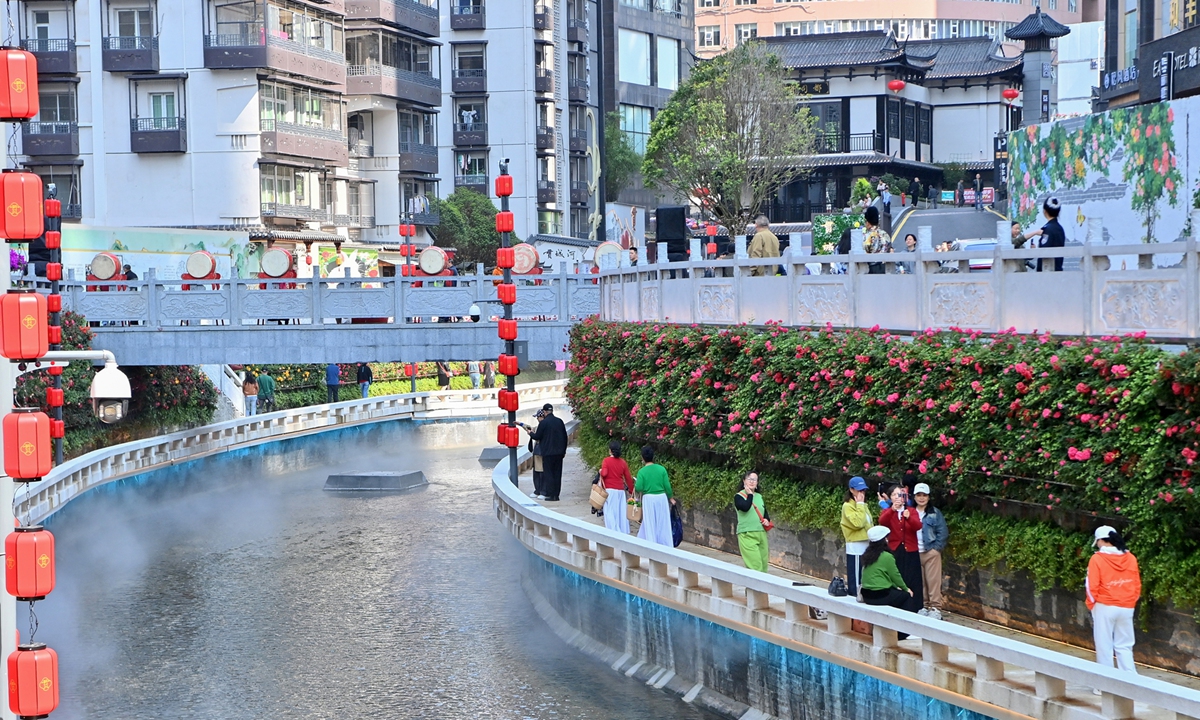
Local residents enjoy the revitalized open-channel scenery of Guancheng River's Nanming Section in Guiyang, Southwest China's Guizhou Province, on April 30, 2026. Photo: VCG
Over the past 30 years, 89-year-old Lei Yueqin has created seven hand-drawn maps documenting the revival of the Guancheng River in Guiyang, Southwest China's Guizhou Province. Her oldest faded colored drawings still bring a sparkle to her eyes whenever she flips through them.A national role model for ecological progress and an exemplary volunteer, Lei has spent decades patrolling the river on her own initiative. On her first map, drawn in 1994, she marked the Guancheng River in red to indicate pollution. In a 2004 drawing, the waterway was shaded gray and labeled as a "dead river." Between 2008 and 2015, she produced four more drafts, again depicting it as "dead river," with no sign of flowing water in the remaining stretches.
Her lifelong wish was simple: access to clean drinking water.
Stretching 7.5 kilometers, Guancheng River cuts 3.3 kilometers across old downtown Guiyang before feeding Nanming River. The Nanming winds 160 kilometers into Wujiang River, which travels another 540 kilometers to join the Yangtze River. Yet starting in the 1990s, rapid urban expansion and competing demands for land polluted the river, gradually burying it out of locals' sight. Authorities capped roughly 2,400 meters of its main channel with thick concrete slabs to build parking lots and food stalls, leaving merely 592 meters of open river.
In 2018, extra slabs were laid over tributary ditches amid central environmental inspections, turning most open water into a covered underground drain.
Officials faced a critical test of sound performance mindset: was this 7.5-kilometer tributary trivial or vital to Yangtze conservation? Would local governments keep hiding pollution under concrete or tear up covers for thorough restoration?
Xi Jinping, general secretary of the Communist Party of China (CPC) Central Committee, Chinese president and chairman of the Central Military Commission, laid out clear guidance for promoting the development of Yangtze River Economic Belt: Ecological priority, green development, joint protection and no excessive development. No economic activities should cause any damage to the environment.
Guiyang kicked off river dredging in May 2019. The all black, odorous water along the basin was eliminated by November 2020. In September 2021, the city resolved to remove concrete caps over the main channel, and in January 2024, the long-lost Guancheng River flowed in open air again.
In 2025, Lei finished her seventh map, painting clear sparkling waters across the page.
Fixing flawed development ideas
Liu Zhu, a veteran urban planning official, recalled reckless urban expansion left insufficient sewage infrastructure. Guiyang built its first wastewater treatment plant only in 2003. Its karst terrain holds little surface water, mixing rainwater and raw sewage directly into rivers. Foul odors triggered heavy public complaints, prompting hasty capping as a quick fix around 2000.
The Guancheng River's main channel has limited flow capacity. To ease flood pressure, engineers built a diversion tunnel upstream, effectively shifting the problem downstream by channeling mixed sewage directly into the lower Nanming. The flood bypass became an open sewage outlet.
In 2017, a central environmental inspection found that 400,000 tons of untreated domestic wastewater drained into Nanming River daily. A 2018 national pollution audit listed Guancheng and five feeder trenches as severely contaminated, mandating urgent rectification.
"We looked into a complete fix - citywide sewer separation - but we were concerned about the massive infrastructure backlog and the high costs," admitted Zhong Tayong, then vice mayor of Guiyang in charge of environmental protection.
"At the time, the Guancheng River's main channel had essentially become a sewage conduit; many people didn't even think of it as a river anymore. Some proposed simply integrating it into the municipal pipeline network, covering it all up - that would have been the fastest way to meet compliance targets…" recalled an official involved in drafting the remediation plan.
In 2019, Guiyang's capped, diversion-based cleanup plan failed to get approval from the central government, making it the only provincial capital missing its national pollution remediation task.
Quick-fix capping and water diversion stemmed from formalism and misplaced performance mindset.
The priority was to root out a wrong mindset. With course correction made at the leadership level, remediation of the Guancheng River and its side channels was restarted.
Guiyang revised its renovation blueprint with expert reviews and third-party oversight. Workers cleared nearly 20,000 cubic meters of accumulated sludge upstream, inspected hundreds of drainage outlets, cut off pollution sources and separated rainwater from sewage. National inspectors confirmed full removal of black odorous water by late 2020.
Uncovering the buried channel
2021 marked the centenary of the CPC, when the CPC Central Committee launched a campaign on Party history learning and education among all of its members.
Ahead of that year's Spring Festival, President Xi visited the Liuchong section of the Wujiang River in Guizhou. Xi asked Guizhou to adhere to the two bottom lines of ensuring development and ecological progress, and strive to forge a new path of giving priority to ecological conservation and pursuing green development.
That September, Guiyang officially put the Guancheng River concrete-slab removal project on the agenda.
City officials, specialists and citizen representatives held dozens of workshops to solve core hurdles. Where does the treated water go? With scarce land available in the mountainous city, conventional wastewater treatment plants were not an option. Instead, Guiyang opted for a tailor-made solution: retrofitting the city center with an underground, compact water reclamation plant.
When does the money come from? The project pooled central special funds, eco-grants, bank loans and private investment.
In July 2022, the city adopted a comprehensive plan for the full "uncovering the river."
Construction started on the first 182-meter uncovered stretch on Taiping Road. The concrete slabs were a full meter thick. Regular saws bounced off; crews had to use high-pressure water jets laced with industrial diamond grit, chewing forward inch by inch.
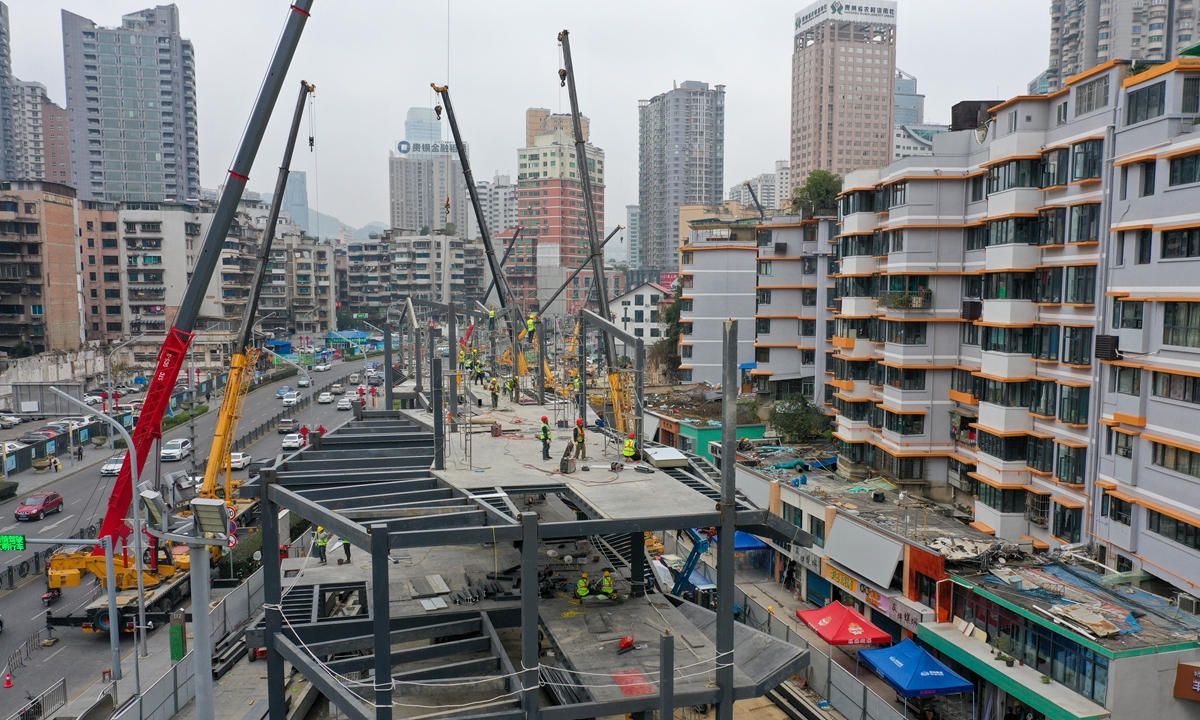
Construction proceeds on Guancheng River's urban renewal works along Taiping Road, Guiyang on Jan 9, 2024. Photo: VCG
On January 26, 2024, Taiping Road was thronged with local residents and tourists standing in dense layers of crowds. As the golden curtain covering the river was pulled aside, clean running water began to flow.Standing amid the onlookers, 68-year-old Jiang Yu wiped away his tears quietly.
Jiang grew up right by the river. He still remembers the old days when long lines of villagers queued up on Longjing Bridge to fetch and carry river water. His 34-year-old son Jiang Jinwen lives at No.80 Guanchenghe Road. For a long time, though he crosses the river's route every single day, he had never laid eyes on an open river channel before.
As a resident representative, Jiang Jinwen took part in the unveiling ceremony. Once the event wrapped up, the father and son wandered back and forth along the restored riverbank.
Watching the running water, they felt as though a fresh spring was flowing through their hearts.
Refining urban development paths
The block upgrading was designed and advanced alongside the uncovering project of Taiping Road.
Full-scale large demolition and reconstruction, or refined micro-renovation?
"The initial proposal was impressive: full river navigability allowing boat cruises through the old town downstream past 24 riverside scenic spots," said Guo Jiesi, former head of the special working group for "One River, One Corridor and Two Historic Districts" in Yunyan District.
However, the proposal was rejected upon submission.
A mountainous city, Guiyang features sharp water level fluctuations; at least three ship locks would be required for waterborne traffic. To optimize sightseeing, the river channel had to be widened by an extra 200 meters. Docks, locks and scenic sites plus land acquisition would push total investment above 10 billion yuan.
"The plan far exceeded local fiscal capacity and ran counter to national regulations restricting large-scale demolition and construction," Guo said.
Authorities at Guiyang municipal and Yunyan district levels drew practical solutions from theoretical learning.
"President Xi's remarks enlightened us," said Liu Renhao, district head of Yunyan. The renovation along Guancheng River would avoid citywide large-scale investment and blaze a new trail of cultural empowerment and featured development.
Drawing wisdom from heritage to enrich modern life, local authorities finalized the blueprint: ecological foundation plus cultural empowerment via targeted micro-renovation, to carry forward urban heritage, upgrade block functions and elevate living standards.
Renovation of the river kick-started the district's urban renewal drive. Stretching 7.9 kilometers, the riverside footpath links Wenchang Pavilion and Cuiwei Garden historic quarters. The 37-project cluster of "One River, One Corridor and Two Districts" has forged a distinctive urban cultural precinct.
On weekends, open-air roadside concerts unfold beside the over-400-year-old Wenchang Pavilion.
Professional troupes interact closely with locals and tourists amid a blend of traditional charm and modern vibes. Over 600 performances have drawn more than five million visitors, birthing Guiyang's new cultural IP as a City of Music.
Unique local signature drinks - prickly pear coffee, houttuynia cordata beer and pitaya milk tea - have made Taiping Road a trendy landmark for out-of-town visitors and a testing ground for local youth to boost cultural confidence via national chic.
Having resided riverside for 69 years, Zhou Jinhua once endured messy surroundings. At community open-air forums, he voiced his wish for downstairs leisure green space; soon a pocket garden was built nearby. Micro-renovation covering 244,100 square meters of existing buildings benefited 628 households.
In March last year, the project was listed as a national exemplary urban renewal case. The Ministry of Housing and Urban-Rural Development commented: "Through innovative practice, the project has pioneered a sustainable urban regeneration path balancing livelihood improvement, cultural inheritance, economic revitalization and governance upgrade."
Anchoring sound performance in practical results
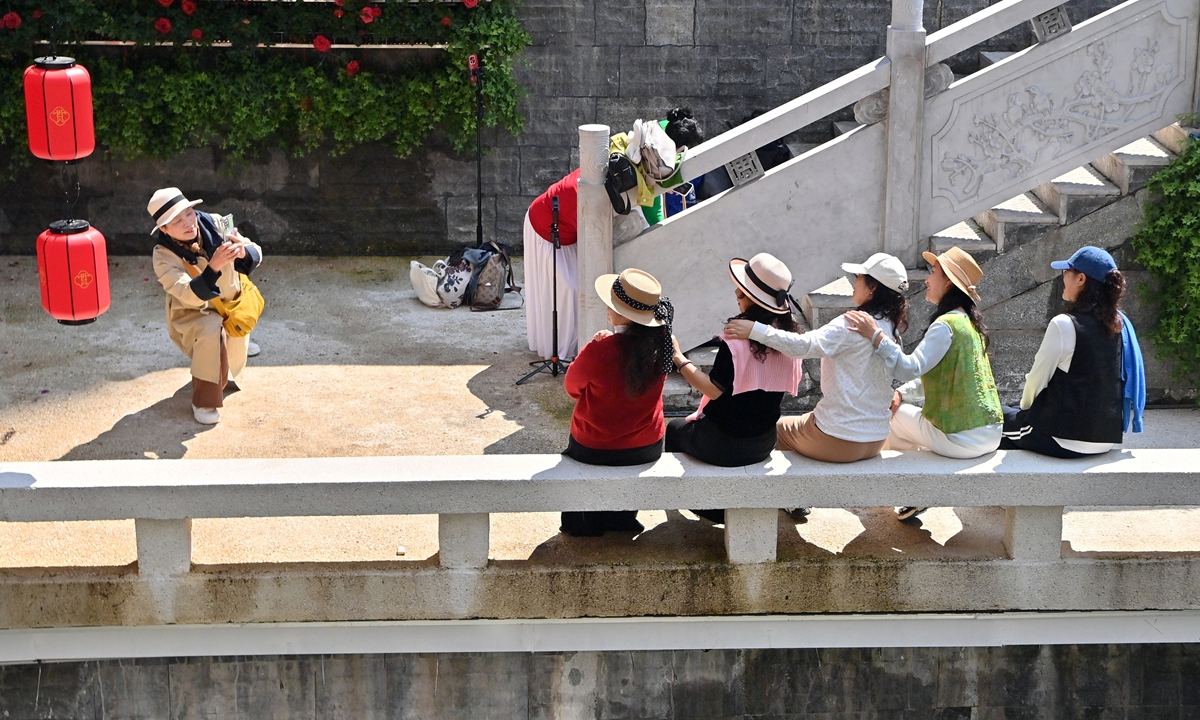
Citizens pose for photos at the revitalized Guancheng River's Nanming Section in Guiyang,on April 30, 2026. Photo: VCG
What lessons has Guancheng River's restoration brought?"It's an eye-opening masterclass: genuine governance accomplishments are delivered for the people through down-to-earth work," said Wang Hong, Mayor of Guiyang.
Construction of Liuguangmen Underground Water Reclamation Plant required excavation of a 30-plus-meter pit; to spare nearby residents from blasting disturbance, crews relied on round-the-clock crusher work amid tough construction bottlenecks.
From a macro perspective, the plant constitutes a core component of comprehensive Guancheng River remediation, a concrete action to upgrade ecological protection and fulfill Guizhou's obligation to shield the upper reaches of the Yangtze and Pearl Rivers.
"We re-mobilized the team, kept daily site inspections and pressed full steam ahead," Li Wenyu said.
Dedicated onsite delivery spawned dozens of technical innovations, turning Liuguangmen into China's deepest fully underground reclamation plant and a national benchmark for green low-carbon development.
"The Party spirit serves as the decisive underpinning for fostering a correct view of governance performance. Since the 18th CPC National Congress, all rounds of centralized Party education have highlighted pragmatic delivery as core guidance," said Huang Chaochun, Party Chief of Guizhou Academy of Social Sciences. "Guancheng River's spectacular rebirth stands as vivid proof."
Once plagued by acid rain, Guiyang now ranks among China's top-performing 168 key cities for ambient air quality; 100 percent of provincial and national monitored surface water sections meet high-quality standards.
Lei Yueqin is a familiar sight by the revitalized river. The 85-year-old joined the CPC in July 2022.
"I joined the Party witnessing tremendous new-era progress, especially in ecological civilization. My lifelong wish of access to clean drinking water has come true," she explained.
Though initially burdened with grievance and pressure, Guancheng River's transformation has changed her perspective. Lei always bears Xi's words in mind as enlightening theories illuminate reality and guide forward-looking development.
This was compiled and translated by the Global Times based on an article originally published on page 1 of the People's Daily on June 5, 2026.
RELATED ARTICLES