ARTS / CULTURE & LEISURE
Why ‘gaokao’ essays matter to the public
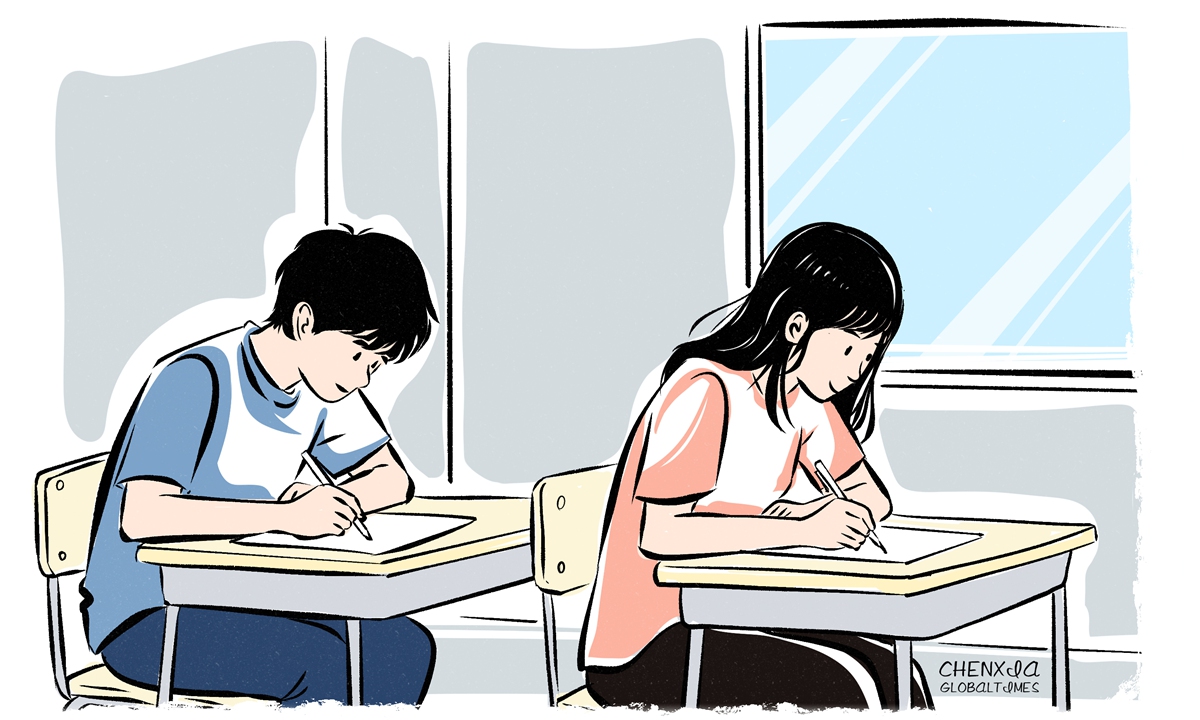
Illustration: Chen Xia/GT
Every June, as millions of students sit for China's national college entrance examinations, or gaokao, one part of the test reliably captures the nation's attention: the Chinese-language essay questions.This year is no exception. Within hours of the release of the 2026 essay prompts, discussions flooded social media platforms, generating billions of views and sparking wide discussions on China's X-like platform Sina Weibo.
On Sina Weibo, some users revisited their own gaokao essay questions from years ago, others debated how certain prompts might be approached, while many others took the opportunity to offer encouragement and good wishes to this year's examinees.
While mathematics and science questions may challenge examinees, it is the essay topic that often becomes a national conversation.
Zhang Yiwu, a professor at the Department of Chinese Language and Literature at Peking University, told the Global Times that essay topics often revolve around universal themes such as personal growth, society and life. They require no technical expertise to discuss. In this sense, gaokao essays have become one of the few examination topics that can genuinely engage the broader public.
Yet the popularity of these discussions reflects something deeper than simple curiosity. Essay questions have increasingly become a window into what society and educators hope the younger generation will be able to do.
This can be clearly seen in this year's exam.
The national paper I and II both adopted material-based writing tasks, which is also the format used in most provincial exams. In the national paper I, for example, students were asked to reflect on how their understanding of one certain word has changed during their growth, and what personal experiences shaped that shift in meaning.
Zhang Peng, an associate professor at Nanjing Normal University, told the Global Times that such a design allowed students to write about how their understanding deepens with experience, how personal events reshape meaning, or how evolving interpretations prompt reflection. Although the entry point was narrow, it connected personal experience with broader reflection, encouraging students to reveal larger social insights through small, everyday experiences.
The national paper II essay presented a different but equally reflective approach. It used imagery of struggle and resilience, moments of difficulty, setbacks, and turbulent change, to ask students to reflect on challenges.
According to Zhang Peng, this type of question requires students to draw on lived experience and personal reflection rather than relying on formulaic templates. It was designed to encourage more authentic thinking and expression, moving away from standardized, mechanical patterns in exam writing.
Compared with the national papers, Beijing's exam structure was more varied. It included a micro-writing section alongside the main essay. The micro-writing tasks asked students to design a labor practice activity, write a short promotional text for a volunteer program themed around AI and elderly well-being, or compose a short poem or reflective passage titled "Because of Longing." Students could choose one of the three options.
For the main essay, students could choose between two prompts. One asked them to discuss the importance of planning and steady efforts in personal growth and social development, while the other required them to write a narrative based on a philosophical phrase.
In practice, the first option is likely to turn out to have been the more popular choice among students, as it followed a familiar argumentative format. The second, while more creative, required students to construct a complete narrative under time pressure, which may have proven more challenging, Zhang Yiwu noted.
The Shanghai paper maintained a relatively conventional approach, asking students to reflect on how technological development reshapes human imagination.
The Tianjin paper, meanwhile, used the Chinese character "tiao," which has multiple meanings and additional pronunciations, as the entry point for reflection. Students were asked to consider how adjustment, coordination and innovation operate both in artistic creation and in large-scale engineering projects such as water diversion. Zhang Yiwu noted that while some observers have described the prompt as complex, it ultimately guided students toward a clear theme: the relationship between adaptation and innovation.
In his view, overall, recent gaokao essay prompts, especially the continued emphasis on argumentative writing, place greater weight on students' logical reasoning, independent thinking and expressive ability. The topics are often philosophical and open-ended, encouraging students to examine issues from multiple perspectives and build their own arguments.
Experts note that these skills are not only essential for university study, but also key competencies for future work and social life, which explains why essay writing has remained central to the exam in recent years.
At the same time, this year's inclusion of topics related to AI and technology reflects an effort to assess students' ability to engage with contemporary developments. Beyond critical thinking, originality and expressive clarity are also increasingly important, as students are expected to respond thoughtfully to a rapidly changing world, Zhang Peng told the Global Times.
The author is a reporter with the Global Times. life@globaltimes.com.cn
RELATED ARTICLES