ARTS / CULTURE & LEISURE
Wuhan to host 2026 Cultural and Natural Heritage Day featuring people-centered protection of heritage
By Published: Jun 03, 2026 09:53 PM

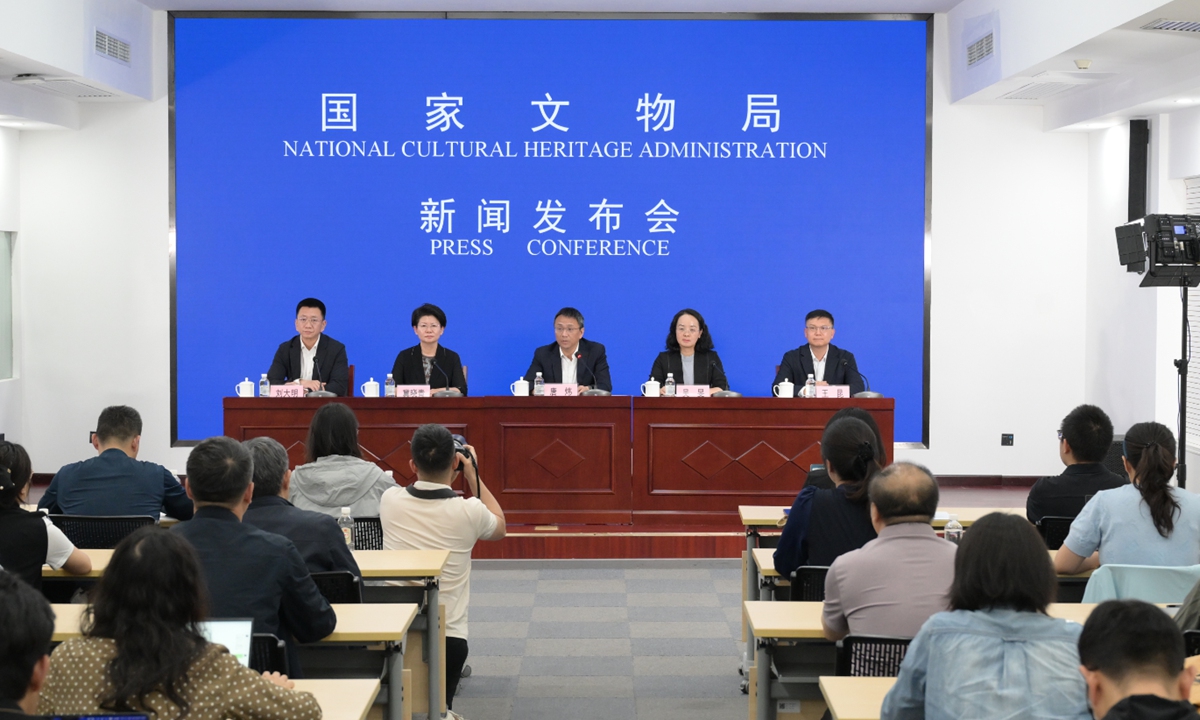
Photo: Courtesy of National Cultural Heritage Administration
China is to hold its annual Cultural and Natural Heritage Day in Wuhan, Central China's Hubei Province in 2026, centering national cultural relic protection efforts on public partic-ipation and public welfare, the country's top cultural heritage authority announced on Wednesday.
The theme for this year's event is "Cultural Relics Belong to the People and Serve the Peo-ple," aiming to anchor conservation work more deeply in everyday life as the country en-ters its 15th Five-Year Plan period (2026-30) and celebrates the 20th anniversary of the Heritage Day, officials from the National Cultural Heritage Administration (NCHA) said at a press conference.
"Cultural relics are irreplaceable and non-renewable precious resources. They do not only belong to the past; they profoundly shape the present and the future," said Liu Daming, di-rector of the NCHA's policy and regulation department. "This demands that we act with a sense of responsibility toward both history and the people, putting protection first."
The main city event, co-hosted by the NCHA and the Hubei provincial government, will mainly feature an opening ceremony, a forum on the theme of relics serving the people, and the sixth Cultural Heritage Science and Technology Innovation Forum.
In addition, a special exhibition tracing the Xia and Shang dynasties - pivotal periods in Chinese civilization - will debut during the event. The official said it would also release authoritative annual lists during the event, including outstanding cases of high-quality cul-tural relics development, national heritage safety guardians, and recognizing outstanding practices across the country's heritage sector.
Liu said the people-centered approach set for this year's Heritage Day can be understood on three levels: relics are created and safeguarded by the people, they empower the public with spiritual strength, and heritage work must contribute to people's quality of life. He cited the ongoing fourth national cultural relics census, a special safety campaign for mu-seum collections, and the enforcement of China's revised Cultural Relics Protection Law as key pillars of the current conservation effort.
Luo Jing, director of the NCHA's science, technology and education department, said the technology forum during the event would present 12 keynote reports and poster sessions showcasing outcomes from national research program.
Among the highlights, Dunhuang Academy researchers had deepened understanding of how earthen sites deteriorate through multi-field coupling simulations, while a Palace Mu-seum team had jointly developed a mobile scanning device for cultural relics.
"This forum is both a systematic review of the sci-tech advances made during the 14th Five-Year Plan period and a collective look ahead as we start the 15th Five-Year Plan," Luo said.
The host city Wuhan, a 3,500-year-old river port on the Yangtze, has prepared 12 special activities and six thematic exhibitions for the occasion, Chen Fei, head of Hubei's provin-cial bureau of cultural heritage, told the Global Times.
Offerings range from brick-rubbing workshops and lacquerware restoration youth study tours to an artificial intelligence-driven heritage protection project and a summer camp on surveying historic buildings.
Exhibitions co-organized by the Hubei Provincial Museum and other institutions will in-clude titles such as "The Yangtze River Nourishes Wuhan" and an exhibition on the Long March for commemorating the 90th anniversary of the Red Army Long March.
Across Hubei, authorities have organized more than 100 events showcasing revolutionary heritage, accompanied by free admission and complimentary guided tours, Chen said.
More than 7,000 online and offline activities will be held during this year's Heritage Day period, including more than 3,400 public-benefit services, the NCHA said. Twenty-six provinces and regions will stage their own provincial-level main events, with some offering legal lectures, knowledge competitions and mock court sessions focused on heritage pro-tection.
The Xinhua News Agency reported that China established its Cultural and Natural Herit-age Day in 2006, scheduling it for the second Saturday of June each year. The event has since grown into a major platform for promoting public awareness of heritage conservation across the country.
RELATED ARTICLES