ARTS / CULTURE & LEISURE
Classical music quietly becoming a living part of public culture
By Published: Jun 07, 2026 07:54 PM

Wang Yujia Photo: VCG
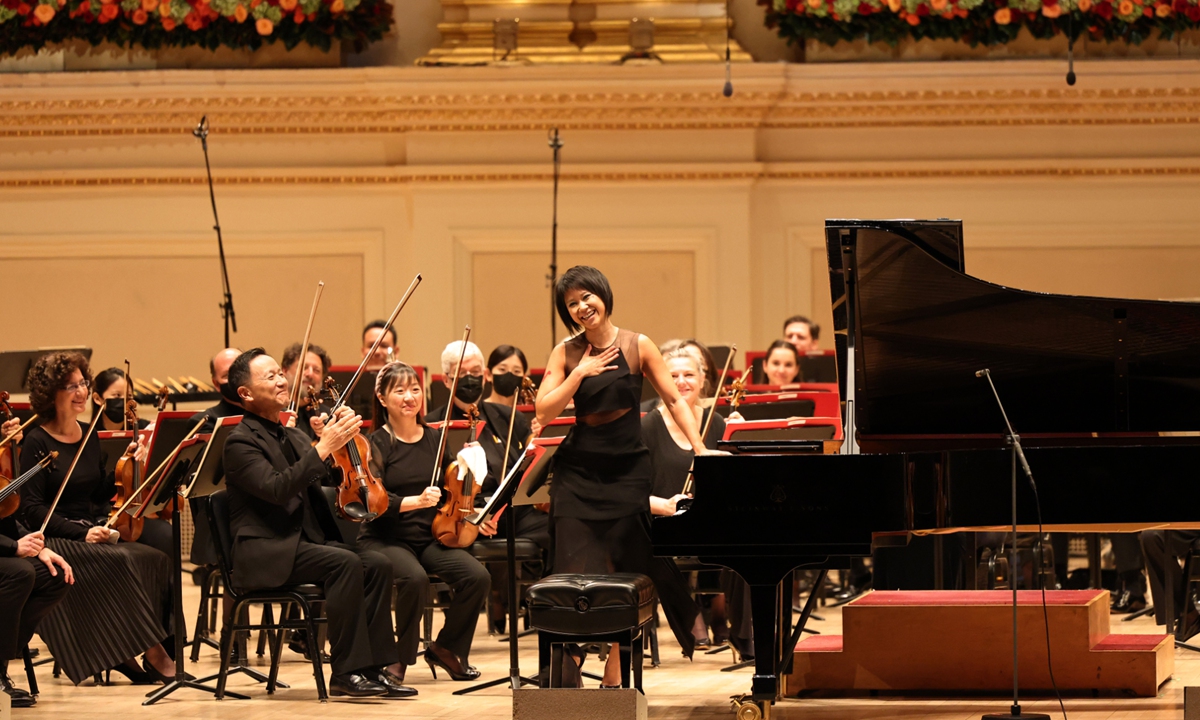
Rain was falling lightly outside the Shanghai Oriental Art Center. It was nearly 10 pm, yet the crowds on Dingxiang Road where the center is located were in no hurry to leave. Many still carried the excitement of what had just happened inside.After a demanding main program of nine pieces performed over 70 minutes, Beijing-born pianist Wang Yujia kept coming back and back again. In total, she gave 18 encores.
From the fierce energy of Sergei Prokofiev's Seventh Piano Sonata to the dazzling fireworks of Mily Balakirev's Islamey and the passionate sparkle of Vladimir Horowitz's Carmen, she poured out everything that night. Then, at the very end of the encores came a gentle surprise: He Luting's The Cowherd's Flute, with its simple, beautiful pentatonic melody. Some audience members laughed softly, then fell quiet, deeply moved.
On social media, headlines quickly called her the "Queen of Encores" and turned the night into a spectacle. But this was more than just a viral moment. If one digs deeper, Wang's Shanghai concert reflects something important: Classical music in China is quietly moving from an admired foreign symbol to a living part of public culture.
The heart of this tour was Wang's bold "blind box" concept. She decided the order and even some of the pieces according to her mood and the feeling in the concert hall that night. There was no fixed music for the encores. She chose the songs from her iPad right on the spot. At first, it may sound like clever marketing. But for those who understand the classical world, it means something deeper. For too long, classical music has been treated like a carefully protected museum piece - perfect, safe, and distant. The "blind box" breaks that wall. It brings real uncertainty and freshness back to the concert hall. It tells the audience: Tonight, you are not watching a standard product, but sharing a real, living musical conversation.
Eighteen encores also serve as a thermometer of Chinese audiences' growing maturity. In Shenzhen (May 29) she played nine, in Xi'an (May 31) and Beijing (June 1-2) 13, and in Shanghai (June 4) 18.
The rising numbers show that audiences in China's major cities are ready. They are not just there to check off "a cultural box." They listen with understanding and are willing to stay late, applauding with genuine passion. Affordable tickets of 380 yuan ($56) were offered as part of a public cultural festival and the hall sold out in just five minutes. This mix of strong market power and accessible prices points to a healthy model taking shape in China.
Wang's own journey tells a larger story. She began learning piano in Beijing at age 6 and later studied in Canada and at the Curtis Institute in the US. She rose to international fame and became a star with Deutsche Grammophon and multiple Grammy nominations. Yet in recent years, she has chosen to bring major projects and premieres to China. When she played The Cowherd's Flute as the final encore, it carried special meaning. Written in 1934 by Chinese composer He Luting, the piece was one of the first to express Chinese feelings through a Western piano. Placing it at the end felt like a quiet nod across nearly a century - connecting China's musical past with its present confidence.
Of course, challenges remain. While big cities enjoy exciting concerts, many smaller cities still wait for world-class performances. Too many young piano students focus only on exams instead of real musical enjoyment. Classical music sometimes still feels like a tool for showing social status rather than a shared pleasure.
But positive changes are happening. The Shanghai Symphony Orchestra's summer music festival (MISA), running since 2010, is bringing classical music out of grand halls onto city lawns.
MISA initiator and Shanghai Symphony Orchestra Music Director Yu Long said that for 147 years, the orchestra has upheld classical music with a pioneering spirit. He sees MISA not only as a starting point for classical music but as a way of life and experience. This year, the festival continues its "Classical+" tradition, in which classical music, jazz, ethnic sounds, dance, and drama meet and enrich one another. Many concerts are low-cost or free. Young people in T-shirts sit on the grass, listening the music, and enjoying at their leisure.
This is classical music in today's China at its best: no longer needing to prove its usefulness, but simply happening - and making people want to carry the memory home.
Eighteen encores may one day be broken, but the real record is a city's audience staying late into the night, applauding with knowledge, warmth, and joy.
Classical music is putting down real roots in China, and the tree is growing stronger.
The author is a reporter with the Global Times. life@globaltimes.com.cn
RELATED ARTICLES