Reinventing bamboo
How Anji County upgrades traditional industry through innovation
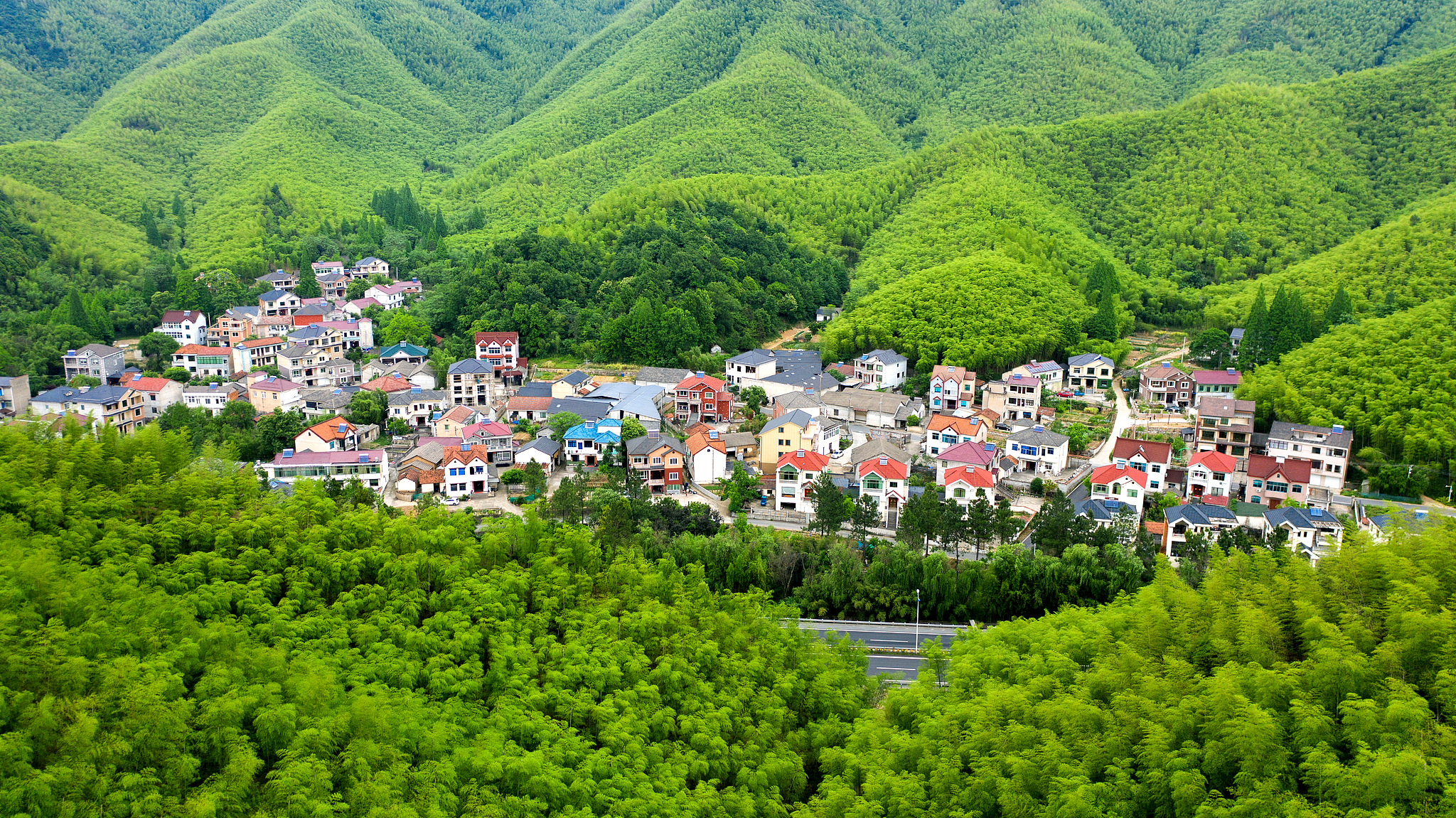
An aerial view of lush green bamboo scenery in Anji County, East China's Zhejiang Province File photo: VCG
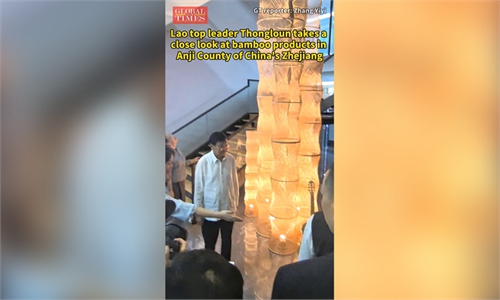
During his trip to Anji County, East China's Zhejiang Province, as part of his recent state visit to China, Lao President Thongloun Sisoulith stepped into an exhibition center that showcased a distinctive local industry: "Bamboo as a Substitute for Plastic." At one point, the Lao leader picked up a bamboo clapper, tapped it back and forth, and then turned it over to examine it carefully.
In recent years, Anji has built a thriving industry from a rich local resource - bamboos. The exhibition featured more than 1,000 bamboo-based products, ranging from tableware and woven bags to furniture and new bamboo materials. In 2025, Anji exported 460 million yuan ($64 million) worth of bamboo products to over 70 countries and regions, including the US, Japan, the Netherlands and France, according to data provided to the Global Times by the Anji County Forestry Bureau and local customs authorities.
From exporting low-value products such as bamboo poles and fences to supplying materials for international projects and developing smart furniture and green materials, the evolution of Anji's bamboo industry reflects the broader upgrading of China's traditional manufacturing sector along the value chain, experts said.
Rapid expansion
Liang Fenghui, head of Fenghui Bamboo & Wood, told the Global Times that the company began exporting in the 1990s, first entering China's Taiwan island and Japanese markets before later expanding into Europe and the US through trade fairs such as the Canton Fair. Today, its products, including bamboo tableware, packaging and lighting, are sold in more than 20 countries and regions.
"Japanese customers tend to favor minimalist and clean designs, while European and US buyers are generally more interested in products with distinctive aesthetics and unique designs," Liang said.
Liang, who took over the family business from his father, said the company started with low-value-added products such as bamboo poles and fences. As market demand evolved, it gradually shifted toward bamboo handicrafts and more design-oriented products, moving up the value chain.
Fenghui is not alone. Across Anji, a growing number of companies are moving up the value chain.
Tong Weiqiang, CEO of Zhejiang Xingshang Intelligent Home Co, told the Global Times that his interactions with overseas clients and visits to foreign markets revealed a growing demand for sustainable materials. As bamboo-based alternatives to plastic gain wider recognition, he sees increasing opportunities for products that combine environmental benefits with enhanced functionality.
Against this backdrop, Xingshang Intelligent Home was founded in 2014 to explore the integration of bamboo with smart technologies.
"We used to sell materials. Today, customers are looking for functions and specific applications," Tong said. "Airport projects may require fire-resistant materials, outdoor applications demand durability, while hotels and commercial spaces place greater emphasis on design and sustainability. As a result, our products have become increasingly specialized and tailored to different scenarios."
Tong said the company has maintained long-term partnerships with Dutch bamboo materials firms, with its products finding their way into major public buildings, luxury hotels and commercial projects across Europe. As cooperation deepened, overseas clients increasingly traveled to Anji to work alongside local companies on product development and market-specific solutions.
The push for greener bamboo products is also being matched by innovation in manufacturing. Liang said the company has continued to refine its production processes by improving material utilization, upgrading equipment and boosting efficiency, which has helped reduce waste, cut costs and create greater value from bamboo resources.
The industry's rise has been supported by more than market demand alone.
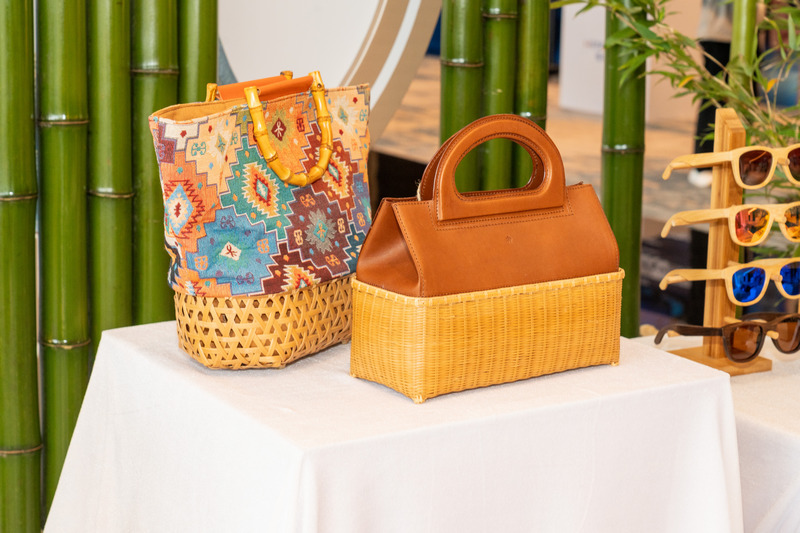
A bamboo-woven handbag on display at an exhibition center in Anji, East China's Zhejiang Province Photo: Courtesy of Anji County
Focus on innovation
Officials from the Anji County Forestry Bureau told the Global Times that local authorities have made bamboo-based alternatives to plastic a key development priority, backed by policy support and a National Bamboo Industry Research Institute, jointly established with the Chinese Academy of Forestry. The institute works closely with companies to help translate market needs into technological solutions.
The model has helped drive innovation. According to the Anji County Forestry Bureau, local firms have developed products ranging from bamboo pencils and biodegradable shopping bags to high-strength engineered bamboo materials, broadening the use of bamboo in everyday life and industry.
At the same time, Anji has been expanding the use of bamboo products across daily life. Today, bamboo-based alternatives can be found in local markets, hotels, homestays and tourist sites, reflecting the shift of "bamboo-for-plastic" from an industrial concept to a consumer reality.
Anji's bamboo industry has grown into a sector worth more than 20.5 billion yuan, supported by nearly 1,000 bamboo-processing companies, the Anji County Forestry Bureau said.
Anji's success in overseas markets is not driven by bamboo resources alone, Bian Yongzu, a financial expert and executive deputy editor-in-chief of Modernization of Management magazine, told the Global Times.
"In the past, many bamboo products were exported as raw materials. Today, companies are creating added value through innovation, design and sustainability," Bian said. "Whether it's bamboo-based alternatives to plastic or smart bamboo furniture, the key is that companies are redefining the value of bamboo."
Bian added that the evolution of Anji's bamboo industry mirrors a broader shift in China's manufacturing sector. "For years, Chinese companies competed largely on cost and scale. Today, competitiveness is increasingly driven by innovation, design, branding and industrial capabilities," he told the Global Times.
"Companies in Anji are no longer simply exporting bamboo. They are exporting the value created around bamboo through technology, product development and application-specific solutions," Bian said, adding that the transformation reflects how traditional Chinese industries are moving up the value chain and strengthening their presence in global markets.
Beyond exporting finished products, Anji's revitalized bamboo industry is forging new pathways for global cooperation, drawing growing international interest as underscored by the Lao President's recent visit.
RELATED ARTICLES