ARTS / CULTURE & LEISURE
Global mayors dazzled by tech-empowered cultural tourism on Mt Huangshan
By in Huangshan Published: Jun 08, 2026 09:49 PM

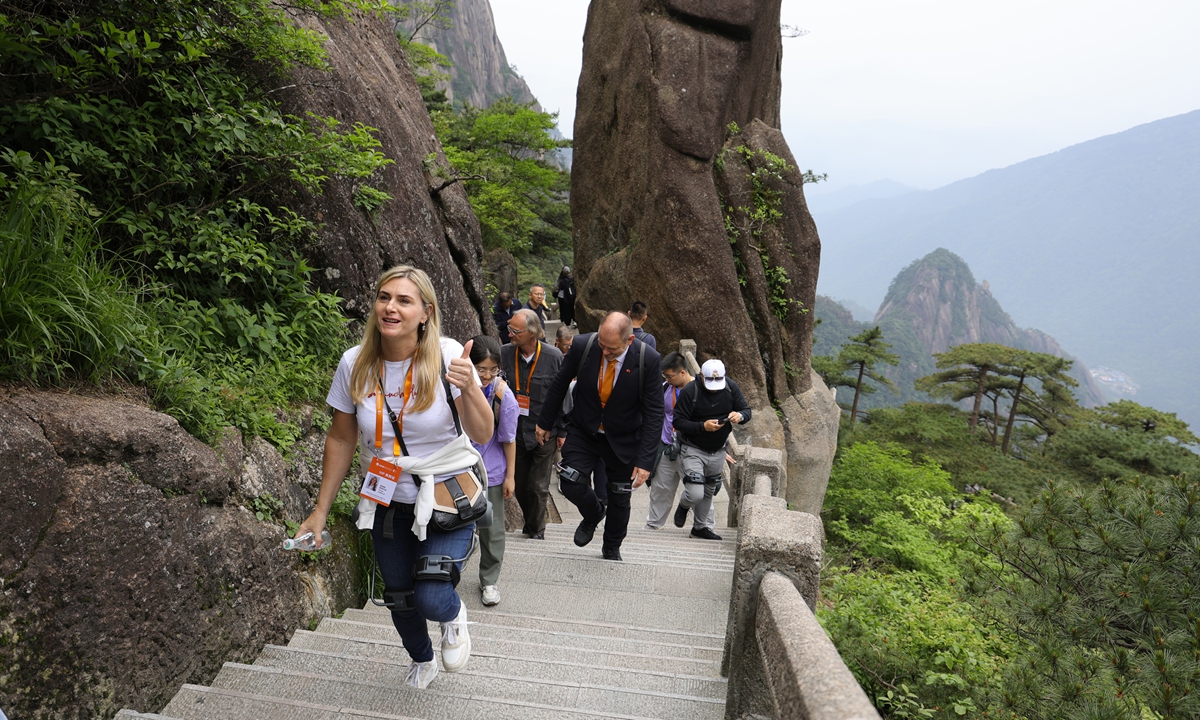
Mayors climb up Mount Huangshan using smart exoskeletons. Photo: Courtesy of Global Mayors Dialogue
How does the millennium-old Mount Huangshan scenic area use technology to balance ecology and tourism?The answer to that question lies in the impressive display of technology-empowered cultural tourism that several world mayors recently witnessed on Mount Huangshan, East China's Anhui Province, during the Global Mayors Dialogue held between May 28 and 31, which gathered dozens of municipal government representatives from 10 countries.
Mayors tried out intelligent exoskeletons that helped them climb steep paths, observed up close drones flying through valleys and learned how an AI system monitors the growth of the region's iconic Welcoming Pine around the clock.
Jelena Medakovic, mayoral representative and secretary for culture of Belgrade, Serbia, noted that cultural tourism cities worldwide could learn a lot from Huangshan's model of integrating tradition with modernity.
Mount Huangshan, a UNESCO triple-crown site (Culture & Nature Heritage, Geopark, Biosphere Reserve), attracts millions of visitors annually.
Yet it faces a global challenge - how to balance growing tourist demand with ecological protection.
"As a world heritage site, adding heavy assets like cable cars is difficult," said He Yi, mayor of Huangshan city, during a dialogue with global mayors on May 29.
"The contrast between this restriction and visitors' demand for easier access drove our 'scenario revolution' - using tech innovation to solve problems," He said.
Over the past year, Mount Huangshan tested over a dozen exoskeleton robots before finding the right fit for mountain terrain.
It also launched China's first scenic area cultural tourism large language model, which integrates weather, traffic, and monitoring data to predict congestion 12 hours in advance.
Drones now patrol the area as part of pine protection and geological monitoring efforts while complementing porters, preserving jobs and boosting efficiency.
Visitor numbers hit record highs in the past two years while complaints fell. That's the power of tech empowerment, according to He.
The visiting mayors were among the first to test Mount Huangshan's lightweight climbing exoskeleton.
This smart wearable device uses multi-modal sensors to recognize walking, stair-climbing, and descending, providing assistance while heading uphill and cushioning one's steps downhill, making the steep climb effortless.
Cloud delivery routes
After trying the exoskeleton, the mayors' attention was drawn by the sound of propellers approaching from afar. This was Mount Huangshan's regular drone logistics delivery route in operation.
It is hard to believe that just a year ago, "cloud messengers" like Xie Feijun, a fourth-generation mountain postal courier for Mount Huangshan, were still taking on the mountain on foot. "I used to carry a 25-30-kilogram mailbag on foot from Ciguang Pavilion to Baiyun Hotel, an hour and a half each way. It was tiring, and delivery was slow," Xie said.
In April 2024, the 4.2-kilometer route was cut to just six minutes by drones equipped with auto-obstacle avoidance and emergency return systems.
The saved time has turned Xie from a simple postman into a helper, who now carries tourists' luggage and livestreams tea sales.
"Mountain tea couldn't be shipped out before; now drones and e-commerce help tea farmers earn more," Xie said.
Drone applications have expanded to order management, emergency rescue and ecological patrols.

Mayors participate in a dialogue on Mount Huangshan. Photo: VCG
Mountain's super brainBehind the visible hardware lies a profound digital transformation.
Wu Yijun, a senior engineer with the Huangshan Scenic Area Administrative Committee, told the Global Times that even the "arm branches" of the Welcoming Pine, a unique looking pine tree that has become a symbol of the mountain, contain sophisticated mechanical structures developed with universities that allow the tree to sway freely in the wind while also restricting its movement during strong winds and heavy snow to prevent breakage.
Moreover, the Welcoming Pine now has a "digital twin" in the virtual world. Back in 2020, the park launched the "Welcoming Pine 3D digital modeling" project, completing 3D scanning, close-range photography, and modeling of the tree's main body.
These efforts have created a detailed digital archive for the tree, providing a data foundation for monitoring, display, and other protection and utilization efforts. The warmth of technology now can reach every tourist to Huangshan.
"Want to know if the Hundred-Step Cloud Ladder, or Baibu Yunti, is crowded right now? Want to know the easiest current route to the Welcoming Pine?" Visitors simply check their phones and receive instant replies.
Tourists now can get instant answers from the "Huangshan AI Travel Assistant," as the mountain has established China's first "full-journey AI travel companion" scenic area, according to the local government.
After entering the park, the AI retrieves their ticket QR code. When they stop at a rock, it explains its geology; when they descend the mountain tired from hiking, it recommends a restaurant with local cuisine.
"Relying on the AI large model, we can predict congestion one hour in advance with up to 90 percent accuracy," said Tian Hong, a deputy director of the Huangshan scenic area information center.
"When the system forecasts that the Hundred-Step Cloud Ladder will be overcrowded in an hour, the scenic area activates loop roads for diversion in advance and guides visitors via broadcasts."
Throughout the visits, experiences, and exchanges, Huangshan's diverse technological application scenarios and its development philosophy of "protection first, technology empowerment" have left a deep impression on the mayors and representatives from various countries.
Andrea Crescentini, mayor of Serravalle, San Marino, told the Global Times that in Huangshan, people are not just exploring a mountain but exploring a digital path for harmonious coexistence between humans and nature.
RELATED ARTICLES