ARTS / CULTURE & LEISURE
Largest sauropod footprint track site found in Ningxia offers clues to dinosaur behavior
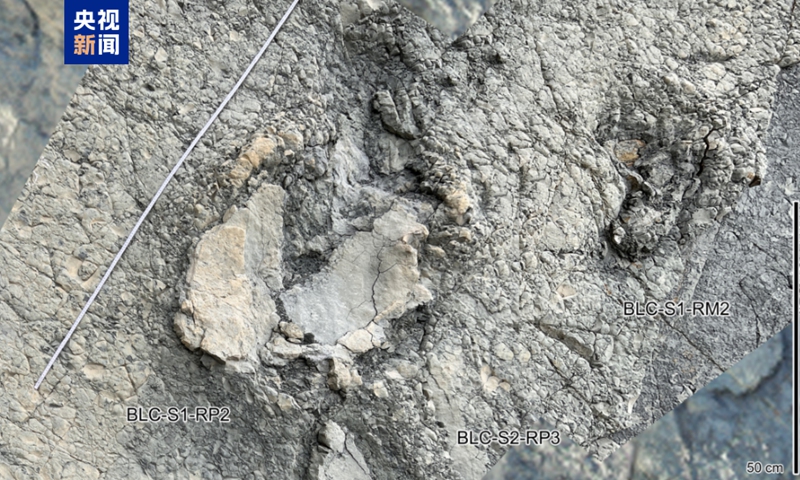
The sauropod dinosaur footprint fossil discovered in the Beilianchi site in the Liupan Mountains of Ningxia Hui Autonomous Region. Photo: CCTV News
The largest sauropod dinosaur footprint fossil site found so far in Ningxia Hui Autonomous Region, namely the Beilianchi site in the Liupan Mountains, was recently discovered by researchers from the Geological Bureau of Ningxia and an expert team from China University of Geosciences (CUG), a professor with CUG told the Global Times on Friday.
The discovery provides valuable physical evidence for studying the diversity, behavioral patterns, and paleoecological environment of sauropod dinosaurs in northwestern China during the Early Cretaceous period, according to CUG.
On a steep rock face covering 650 square meters in Longde County of the Liupan Mountains, 241 dinosaur footprints dating back 110 million years have been clearly preserved. Among them are 117 continuous footprints, while another 124 isolated prints are scattered across the site, forming at least nine trackways.
The types and characteristics of the trackways recorded at the site provide valuable field evidence for studying the locomotion patterns, herd behavior, and paleogeographic distribution of sauropod dinosaurs, Chinese paleontologist Xing Lida from CUG told the Global Times on Friday.
The footprints vividly document the movement trails of a group of medium- to large-sized sauropod dinosaurs, whose preserved hind footprints range from 58.3 to 143.5 centimeters in length. Among them, the largest trackway consists of 14 consecutive sets of fore- and hind-footprints, with the hind footprints averaging 118 centimeters in length and the entire trackway extending more than 13 meters.
The longest trackway stretches 20.1 meters in total, with the distance between the fore and hind footprints gradually decreasing, clearly reflecting the dinosaur slowing down while moving.
Based on calculations of the shoulder-to-hip distance, the research team estimated that the dinosaurs that left these footprints had hip heights ranging from 2.65 to 3.55 meters and body lengths of around 15 to 22 meters, identifying them as typical medium- to large-sized sauropods, regarded as "terrestrial giants" of the Mesozoic Era.
Another notable feature of the footprints is the scattered orientation of the trackways, with no clear dominant direction. The research team believes this was caused by individual dinosaurs passing through the area at different times.
The team identified at least two separate periods during which the footprints were formed, suggesting that the site served as a long-used habitat or watering area. The accumulation of numerous footprints within the same geological layer also indicates that the depositional environment in the area, such as a lakeshore, remained relatively stable during that geological period, allowing footprints to be repeatedly formed and preserved.
The discovery of the sauropod dinosaur site further confirmed that the Liupan Mountains region was once an important activity area for large sauropod dinosaurs.
The research team speculated that the dinosaurs that left the footprints belonged to a branch of sauropod evolution and were closely related to prehistoric species such as Huanghetitan and Daxiatitan, which were discovered in the Hekouqun of the neighboring Minhe Basin in Northwest China's Gansu Province.
RELATED ARTICLES