South Korean president says sincere apology from Japan for colonial rule of Korea needed before deepening military cooperation
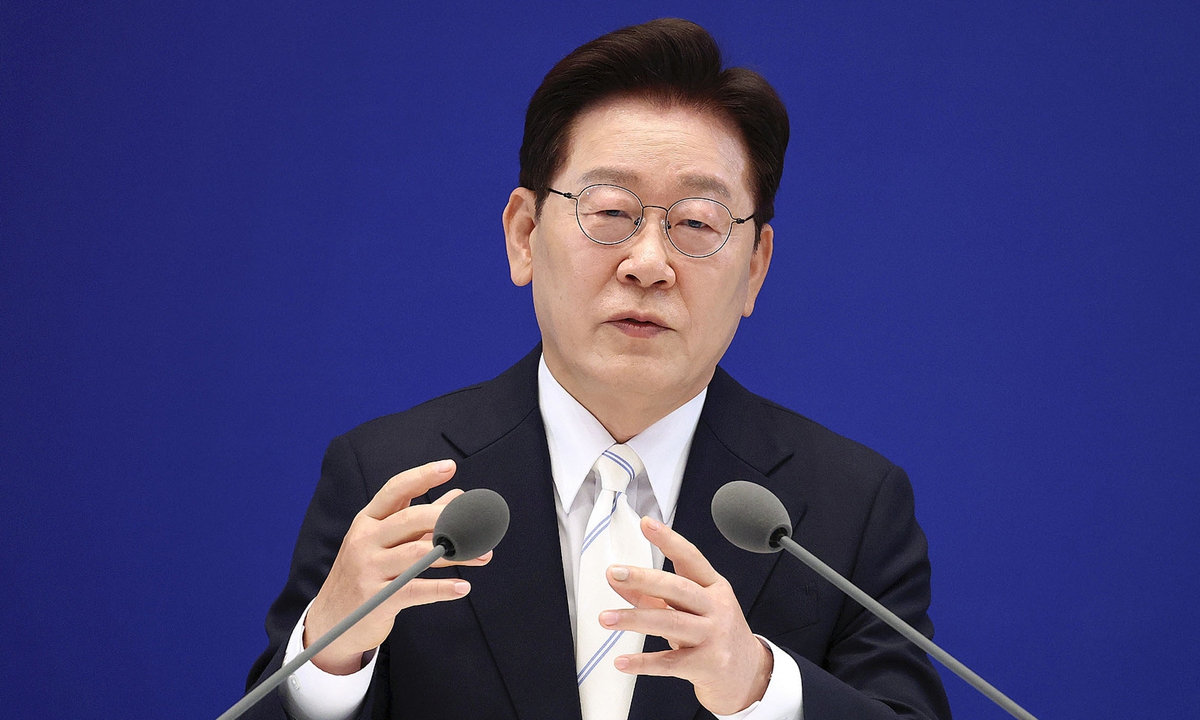
South Korean President Lee Jae Myung speaks during a press conference in Seoul on June 8, 2026, four days after the first anniversary of him taking office.
South Korean President Lee Jae-myung said on Monday that the country's efforts to deepen military cooperation with Japan would face limits unless Tokyo addresses historical grievances with what he described as a "sincere" apology for the Japanese 1910-45 colonial rule of Korea, South Korean media reported.
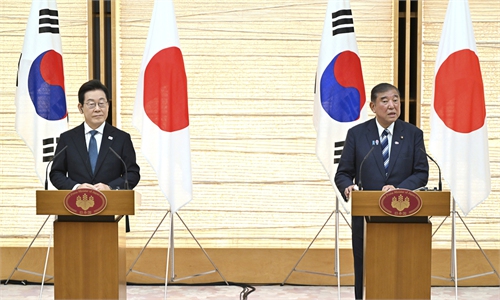
Lee said on Monday that he had told Japanese Prime Minister Sanae Takaichi that South Korea would find it difficult to accept a bilateral Acquisition and Cross-Servicing Agreement (ACSA) with Japan at present because of public sentiment, South Korean media The Hankyoreh reported.
Speaking at a press conference marking the first anniversary of his inauguration, Lee said, "I told Prime Minister Takaichi that, given public sentiment, it is currently difficult for us to accept this." This was the first official confirmation that South Korean and Japanese leaders had discussed the ACSA during a summit meeting, according to The Hankyoreh.
Lee suggested that a sincere Japanese apology over historical issues remains a prerequisite for deeper military cooperation and a genuinely closer bilateral relationship, according to Korea Herald.
"But that is the situation we face today. It is because these (historical) issues have not been fundamentally settled. I believe they must be resolved one day - they absolutely must," Lee said, according to Korea Herald.
"Only then can a genuine Korea-Japan relationship be achieved. There must be a sincere apology - one that sincerely says, 'I'm really sorry for hurting you.' I believe that day will come eventually."
The ACSA is an agreement, which would allow two countries to share and mutually procure military supplies and logistical support, including fuel, food and ammunition. Japan has sought to conclude such an arrangement with South Korea, according to Korea Herald.
Lee also said, "Right now, South Koreans would think, 'What are you talking about?' (when it comes to the agreement)" He added, "In my view, there is a practical need for it. (But) if I say something like this, I'll get scolded. Please understand our position as well," according to Yonhap.
At the same time, Lee took a cautious stance on trilateral South Korea-US-Japan cooperation and South Korea-Japan military cooperation, according to Yonhap.
"The issue of South Korea-US-Japan and South Korea-Japan military cooperation is somewhat unique," he said. "I think that, in the long run, security issues in Northeast Asia should move toward a complex multilateral security framework. (However) there are aspects that require caution at this stage."
Lee's remarks are interpreted as meaning that while cooperation should continue in consideration of public sentiment, full-scale military cooperation would only be possible after historical issues are completely resolved, according to Yonhap.
Lee's remarks have attracted attention from Japanese media. Japan's Nikkei reported that "South Korean president takes cautious stance on pact with Japan; says historical issues must be resolved."
On May 19, Guo Jiakun, spokesperson from China's Ministry of Foreign Affairs said that eighty years on since its defeat, Japan still hasn't fully removed the pernicious influence of militarism that still haunts the Japanese society as well as the government. Instead, Japan's Class-A war criminals who launched the war of aggression are worshipped in the Yasukuni war shrine to which many Japanese prime ministers and officials pay tribute and send ritual offering or monetary donation.
To this day, school textbooks in Japan fail to present its history of aggression as it is, nor do they seek to establish a "no-more-war" mindset. Instead, they portray Japan as a "victim" and instill a wrong view of WWII history. This is clearly a challenge to the outcomes of WWII and the postwar international order, said Guo.
Global Times
RELATED ARTICLES