ARTS / CULTURE & LEISURE
‘Gaokao’ remains an irreplaceable cornerstone of Chinese society in a changing era
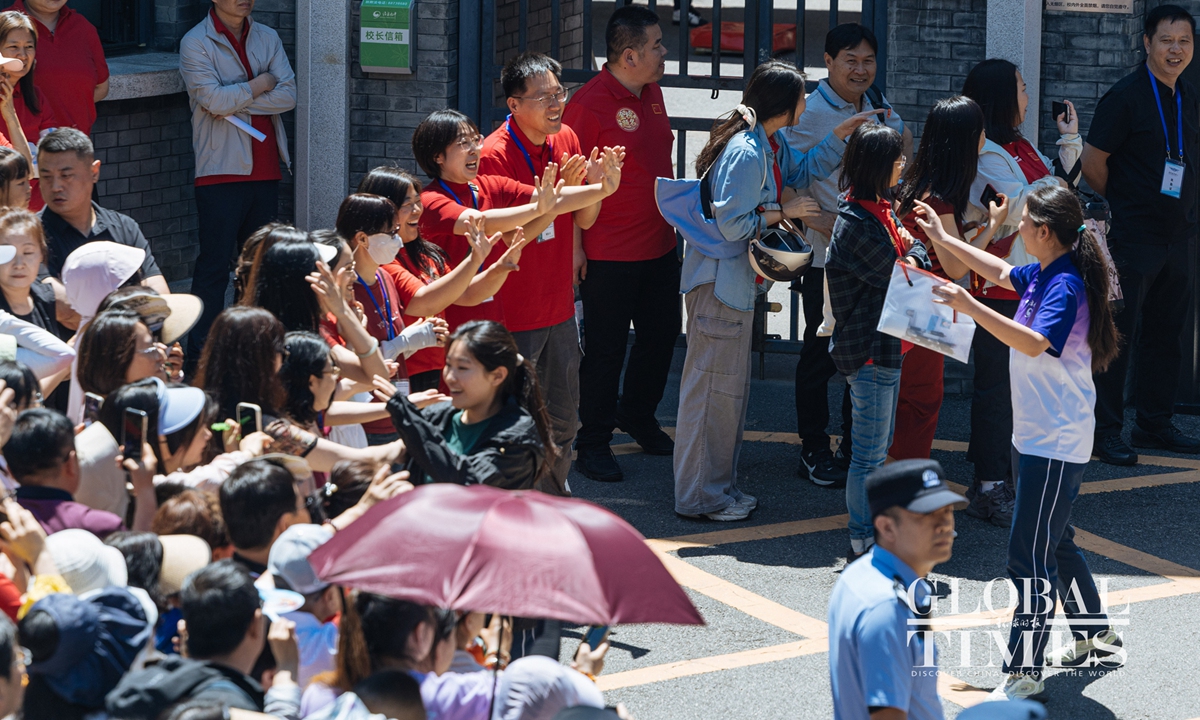
At noon on Sunday, the Chinese language exam, the first subject of the 2026 gaokao, concluded in Beijing. Photo: Li Hao/GT
Once again, it is the season of the national college entrance examinatios, commonly known as the gaokao. In an age of diverse development and ever-expanding choices, people discuss the growing variety of paths to higher education and raise all sorts of questions about the gaokao exam system.Yet there is no denying that, after more than four decades, the gaokao remains the most consequential and far-reaching exam in China today.
The times have changed and education reform has pressed steadily ahead, but the core value of the gaokao has never wavered. It is still the key institution for safeguarding social equity and selecting talent, and is widely acknowledged as the "least bad" talent-selection mechanism available at this stage.
Since the exam was reinstated in 1977, it has evolved in lockstep with China's reform and opening-up. To meet the needs of different phases of development, the gaokao has continuously sought to reinvent itself: Exam subjects have been adjusted repeatedly, admissions models have become more diverse, comprehensive quality evaluation has been gradually incorporated, and the pathways separating vocational education from general education have grown increasingly distinct.
These changes are meant to overcome the limitations of the old model so that talent selection better fits the times. Yet updates to its format have never altered the gaokao's core purpose. From the very beginning, it has shouldered two missions. First, to identify future talent for every sector of society and channel outstanding students into higher education. Second, to build an open and transparent channel for upward mobility, upholding society's aspiration for fairness. The maxim "knowledge changes destiny" still carries real weight.
In the current social context, life's path is no longer a single track. On the one hand, the rapid expansion of higher education has made attending university far easier than in the past and created many more opportunities, though gaining admission to a top university remains a challenge.
On the other hand, paths such as vocational skills training, studying abroad, and flexible employment keep widening, and many people no longer see university as the only way forward.
However, the development of higher education and the diversification of choices do not mean the gaokao's value is diminishing. Compared with other forms of social competition, the gaokao establishes a clear set of rules through unified exam papers, uniform standards, and centralized scoring. Whether they come from urban or rural areas, rich or poor families, all candidates stand on the same starting line and compete on the basis of knowledge and ability.
This procedural fairness is one of the most valued features of modern society. In particular, it preserves the possibility for young people from ordinary families to change their destiny through hard work. It makes "hard work pays off" more than an empty slogan, sustains upward social mobility, and anchors the values that the public holds dear.
Of course, debates and controversy surrounding the gaokao have never ceased. Problems such as hyper-competitive education, the urban-rural gap in educational resources, and the limits of an exam-oriented model are frequently raised in public discussion.
We should face these real shortcomings squarely: disparities in teaching staff, facilities, and educational philosophies between regions put some students at a disadvantage long before they sit the exam; the exam-oriented mind-set, entrenched over many years, can also constrain some students' individuality and creativity.
These problems are real, and demand further gaokao reform. But when evaluating a system, we cannot divorce ourselves from reality, nor can we judge the present by an ideal standard. Looking across all kinds of talent-selection mechanisms, no system is perfect, and the gaokao is no exception.
While acknowledging the controversies, it is even more important to recognize the consensus. After repeated debate and broad-based deliberation, society as a whole has arrived at a clear judgment: Under current conditions, the gaokao remains the least bad system for selecting university students and allocating high-quality higher-education resources.
It may have flaws, but it offers unparalleled stability, universality, and public trust. Abandon this system, tested by decades of practice, and we would be hard-pressed to find an alternative that is fairer, more efficient, and better suited to China's national conditions.
Any reform means fixing gaps and building on the existing foundation, not tearing everything down and starting from scratches.
Over the past forty-plus years, the gaokao has grown amid skepticism and improved through changes, always upholding the goal of fair talent selection. It also represents the broadest public consensus on how to select students for higher education.
The gaokao has long transcended being merely an academic test. It has evolved into a cultural symbol and a mechanism deeply embedded in the fabric of society. It links individual futures, the hopes of countless families, and the nation's development. It carries the struggles of generations, safeguards the baseline of social fairness, and embodies the nation's enduring commitment to education.
Times will continue to move forward, and the format of the gaokao system will undoubtedly keep evolving with the tide. But its role as the ballast of social equity and the main channel for selecting university students will not change for a long time to come.
Even as we promote improvements to the gaokao, we must clearly recognize its irreplaceable value. This nationwide exams, spanning more than forty years, will continue to guide generations of young people into the future, upholding society's belief that effort leads to progress and that dreams are achieved through hard work.
The author is a professor in the Department of Chinese Language and Literature at Peking University. life@globaltimes.com.cn
RELATED ARTICLES